The Numbers on One Product
Lesson video in production
The full lesson text below is complete — the video version lands with launch.
Sellers do not go broke from bad videos. They go broke from products that were never profitable at the price they listed. Here is the full arithmetic on one hypothetical product, and then the rule that lets you evaluate the next hundred products in ninety seconds each.
One unit, every line
Take a kitchen gadget. Retail price $26. Landed cost, product plus freight plus duties to a US warehouse, $8.60 per unit. Fulfillment, pick, pack, and shipping to the buyer, $5.75. The platform's referral fee is 6% of retail as of late 2026, $1.56. You set creator commission at 20% to attract real coverage, $5.20. And you hold back a returns reserve of 8% of retail, $2.08, because refunds are a certainty at scale, only the rate varies.
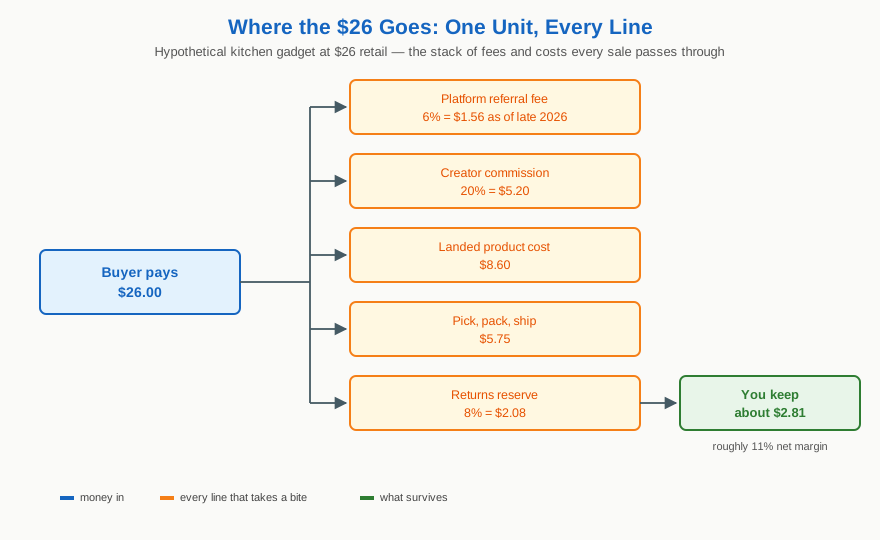
Twenty-six dollars in, about $2.81 out the other side. Roughly an eleven percent net margin on a product that looks like easy money at first glance. That is a normal TikTok Shop outcome, not a disaster. It is also exactly on the edge: one shipping increase, one commission raise, one returns spike, and the unit prints losses. This is why the affiliate lane comes first. You learn demand on other people's inventory, and you learn this math before your own cash is on the shelf.
The three-x test
Squeeze the whole stack into one screening rule. Fees and commissions together eat a quarter to a third of retail, and returns take their bite on top. So before anything else, the retail price needs to run about three times your landed cost plus fulfillment. Run the example: $14.35 of physical cost against $26 retail is under twice. The product fails the screen at this price. It would need to sell near $43, or land near $3, to belong in your shop. Most candidates fail exactly like this, in under two minutes, on a calculator, before any money moves. That is the test doing its job.
Where margin actually comes from
When a product fails the screen, four levers exist, and two of them are traps.
Raise the price, if the demonstrated value carries it. Your video does the justifying; some products hold a $39 price as easily as a $26 one once the demo lands. Test upward; operators routinely find higher prices converting as well or better alongside layered promotions.
Cut the landed cost, by ordering deeper, consolidating freight, or switching suppliers. This is the healthy lever. It is slow, boring, and where durable sellers live.
Cut the commission, and watch your affiliate coverage evaporate, because commission is what buys you the creator army. This lever works only for products that also sell through your own videos and search traffic.
Cut the returns reserve, which is not a lever at all. It is denial with a spreadsheet attached. When the reserve is too thin, the refunds still happen; they just happen to your bank balance unannounced.
Price band and the commission floor, reconciled
Connect this back to "Picking Products That Demo Well." The $15 to $50 band exists because of this lesson: under $15 the absolute dollars per unit cannot cover the stack, and far above $50 impulse buying fades. The 15 to 30 percent commission range is the other constraint, seen from the seller's side now: below 10 percent, creators ignore you; above 35 percent, most consumer products cannot survive the three-x test. The affiliate's dream commission and the seller's survivable commission overlap in a band, and every healthy product on the platform lives inside it.
The worksheet pack includes the product economics sheet from this lesson, all five lines plus the screen test, ready for your first ten candidates. Fill it in for the product you are considering before you spend a dollar on inventory. The math is the gate; everything else in the seller lane stands on it.
Downloads for this lesson
Keep going — you're working through Sell on TikTok Shop.
All courses are free ↗