Valuing and scoping the build
Lesson video in production
The full lesson text below is complete — the video version lands with launch.
Value first, always
Amateurs fall in love with a car and then discover what it is worth. You are going to work in the opposite direction, every time, because in this business the value of the finished car is the ceiling on everything you can spend.
Start with the free tools. Hagerty's valuation tools cover more than 40,000 collector vehicles with current values across condition grades from concours-quality examples down to restorable cars, plus trend history on many models. Look up the exact year, model, and trim. Then triangulate: recent completed auction results and asking prices on the major marketplaces tell you what the grades look like in real listings. For high-value cars, a professional appraisal is worth paying for before serious money moves.
Value the car at the condition you can actually deliver, not the condition you dream of. A shop that produces honest number-three driver-quality cars must buy and estimate against number-three outcomes.
The scope ladder
Scope is the single biggest lever you control, because the same car can consume wildly different budgets depending on the target.
| Scope level | What it means | Labor reality | |---|---|---| | Driver quality | Safe, reliable, presentable | 800 to 1,500 hours for a full restoration at this grade | | Structural restoration | Panels, floors, paint addressed properly | Sits between driver and frame-off, priced phase by phase | | Frame-off | Body off the frame, both rebuilt | 2,000 to 3,000 hours, with full builds landing $40,000 to $120,000 | | Restomod | Original look, modern running gear | Hours similar to frame-off, parts costs higher, different buyer |
The practical insight for a one-person shop: scope in phases, not as one number. A client who cannot fund a frame-off today can often fund a phase-one structural and mechanical rebuild that makes the car usable, with paint deferred to a stated later phase. Phase scoping converts a no into a yes the client can afford.
The scoping math
The formula is simple enough to run on a napkin, which is exactly where you should run it, repeatedly, until the answer is boring.
Finished value, at the grade you can deliver, minus purchase price, minus parts and materials at real quotes, minus subcontracted paint and machine work, minus your hours at a rate you would accept. What remains is headroom. Headroom pays you or it does not exist.
Two disciplines protect this math. The contingency of 10 to 20 percent lives inside every estimate because teardown will find something. And when a restoration's total cost will exceed the car's resale value, which is common and sometimes still worth doing for a client who loves the car, document that expectation in writing before work begins. A signed acknowledgment that this is a love project, not an investment, is the difference between a client and a plaintiff.
The fork
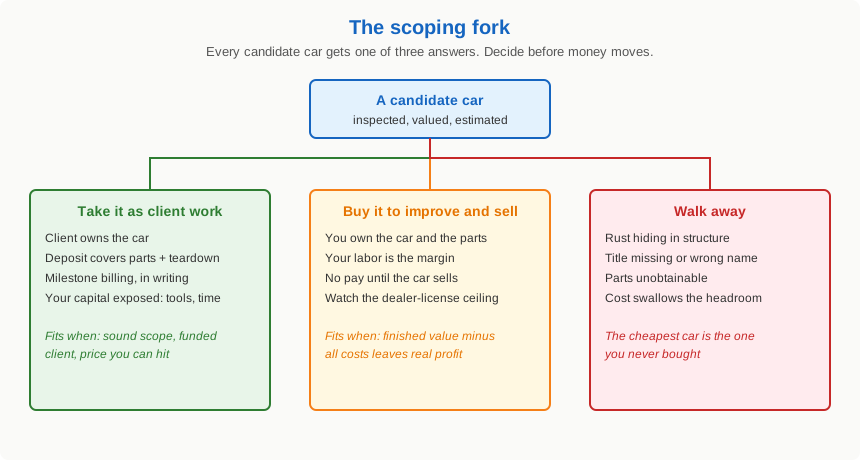
Every candidate car now gets one of three answers. Client work, when the scope fits a funded client and a price you can hit. Buy-improve-sell, when the headroom after all costs is real profit and you accept the wait. Walk away, when rust hides in structure, the title is wrong, parts are unobtainable, or cost swallows the headroom.
The fork is also a calendar decision. Client work pays in milestones through the project. A flip pays once, at the end, after the sale. Running one of each is how a one-person shop keeps cash moving, and stacking three flips with no client work is how a garage becomes a museum of unsold cars.
Scoping decides what a project should cost. Telling the client what it will cost, in a form that survives contact with reality, is a different craft, and it is where the course goes next.
Downloads for this lesson
Keep going — you're working through Start a Car Restoration Business.
All courses are free ↗