The route, not the jobs
Lesson video in production
The full lesson text below is complete — the video version lands with launch.
Most people imagine a cleaning business as a sequence of jobs. Someone calls, you clean, you get paid, you hope the phone rings again. That image describes a cleaner with a car. It does not describe a business.
A cleaning business is a route: a set of homes you visit on a rhythm, weekly or every two weeks or monthly, whose owners pay you the same predictable amount each visit. The route is the product. Jobs are just how you stock it at the beginning.
What the work actually is
Strip away the romance and residential cleaning is four things done in sequence, over and over, in other people's homes: dusting and wiping every reachable surface, sanitizing kitchens and bathrooms, vacuuming and mopping every floor, and restoring the place to the arrangement you found it in. A standard recurring clean for a two- or three-bedroom home runs roughly two to three hours of steady work. Deep cleans, move-out cleans, and add-ons like ovens and refrigerators take longer and price higher.
The business part happens around the cleaning. Answering calls, quoting, scheduling the week so drives are short, tracking who pays, buying supplies before you run out, and handling the moment a client says the bathroom missed a spot. Owners who only like the cleaning part stay cleaners. Owners who get good at the around-the-cleaning part build routes they can eventually sell or hand to a crew.
The one-off treadmill, drawn plainly
Here is the core economic picture of this course. Watch what happens to two cleaners who each book the same amount of work.
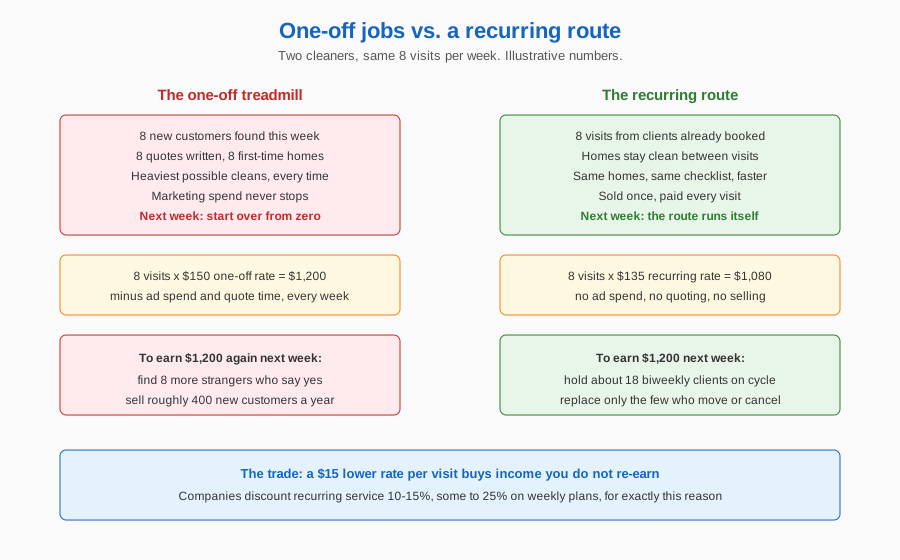
The cleaner chasing one-off jobs must find a new customer for every single visit. Every week is a sales week. The cleaner with a route sells once and gets paid dozens of times, and each recurring home is easier to clean than the last because it never gets terrible in between.
The numbers in the diagram are illustrative, but the shape is not. Operators consistently describe one-off work as the hardest money in the trade: heavier homes, price shoppers, and no end to the marketing spend. Recurring clients are where the margin lives, which is why companies discount recurring service, typically 10 to 15 percent and up to 25 on weekly plans, to lock it in.
Route density is your invisible second income
A route has two dimensions. How many clients, and how close together they sit. Twenty clients scattered across a metro is a job with a long commute. Twenty clients packed into three or four adjacent neighborhoods is a business, because you spend your hours cleaning instead of driving.
That math gets its own treatment later in the course. For now, hold the principle: from your first week, treat geography as a pricing decision. Where you accept clients decides your effective hourly earnings more than your rate card does.
The boundary lines
This course covers recurring residential cleaning: homes and apartments cleaned on a schedule for the people who live in them. A few neighbors in the catalog share the shelf. Short-term-rental turnovers run on checkout deadlines and laundry logistics, a different machine with its own course. Pressure washing and exterior work are separate trades with separate gear. Light handyman tasks can become an upsell later, but repairs are a different liability conversation. If you imagine eventually running the business without being in every home yourself, there is a course for the operator-not-on-site model too, and your route is the asset that gets you there.
What you will have decided by the end of this course
By the last lesson you will have made the calls that define a real cleaning business: your service area, your price list, your insurance, your first ten clients, and a thirty-day launch plan with checkpoints instead of vibes. Before any of that, though, you owe yourself one honest conversation about whether this trade fits you. The fit check is a mirror, not a sales pitch, and it deserves to come first.
Keep going — you're working through Start a Cleaning Business.
All courses are free ↗