Passing Part 107
Lesson video in production
The full lesson text below is complete — the video version lands with launch.
What the exam actually is
The Remote Pilot Certificate with a small UAS rating is the federal license to fly for money in the United States. You earn it by passing an initial aeronautical knowledge test at an FAA-approved testing center, run through the testing provider PSI. No flight test. No checkride. You do not even need to own a drone to take it.
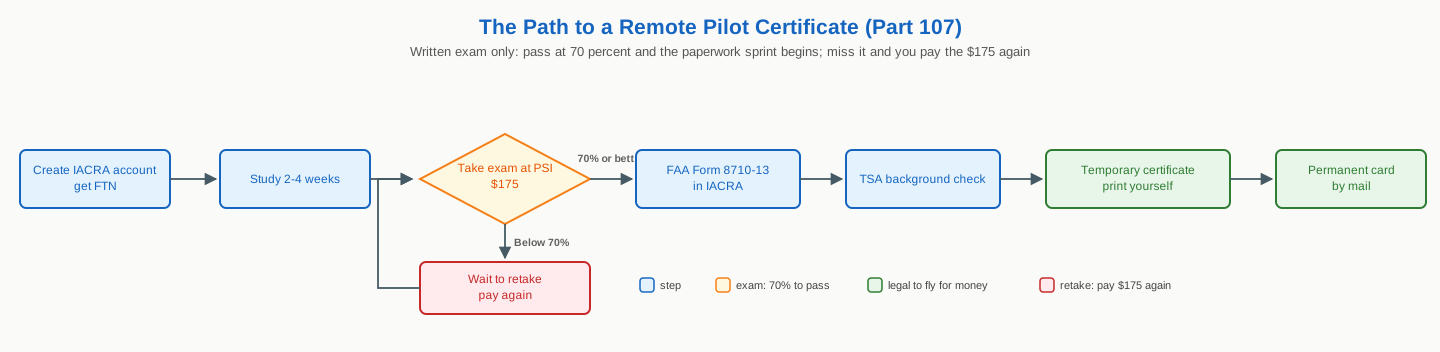
The exam is 60 multiple-choice questions, two hours, and 70 percent to pass. It costs $175 per attempt, and a failed attempt means paying again after a waiting period, so treat the fee as motivation to prepare properly. You bring a government photo ID and nothing else; the testing center provides the rest, including the FAA's figures supplement with the sectional chart excerpts you'll be asked about.
Before you can register, you create an account in the FAA's IACRA system and receive an FTN, the FAA Tracking Number that follows your aviation record forever. Book the test early for a date two to four weeks out. A deadline does more for study habits than any prep course.
The study plan that costs almost nothing
The FAA publishes its own study guide, the Remote Pilot sUAS Study Guide, free, along with the Airmen Certification Standards that define exactly what is tested, and the testing supplement containing every figure the exam can show you. Test-prep instructors consistently point to three knowledge areas as both the hardest and the most heavily represented: regulations, airspace, and weather. One popular prep course estimates those three areas alone make up about half the questions, and every ground school drills them hardest for exactly that reason. Airspace is where new pilots suffer, because sectional charts are a visual language of their own: floor and ceiling numbers, blue versus magenta boundaries, the difference between Class B, C, D, and E. Give yourself permission to be bad at charts for a week before you are good at them.
A sane plan for a working adult, built around building alongside employment until the certificate and the first clients are both in hand:
Two to four weeks to the certificate
Paid prep courses run roughly $150 to $250 and bundle practice banks and video walkthroughs. Reasonable purchase, optional purchase. Free study guides and question banks circulated by training academies cover the same ground if your budget is tight this month.
The paperwork sprint after you pass
Passing the test does not make you legal yet. You complete the remote pilot application in IACRA, attach your knowledge test ID, sign the Pilot's Bill of Rights, and submit. The TSA runs an automatic background screening. When it clears, you get an email letting you print your temporary certificate, which is full legal authority to fly commercially. New pilots on r/drones consistently report that temporary certificate arriving within about a week of submitting, two to six days in most accounts, with the permanent plastic card following by mail over the following weeks. You can work, and charge, on the temporary.
Carry proof when you fly. The rule is that you must have the certificate accessible during commercial operations, along with your aircraft registration, and you must present them to law enforcement or FAA officials on request. A photo of the certificate on your phone plus the printed card in your flight kit covers you.
Staying current
The certificate never expires. What lapses every 24 calendar months is your operating privileges, unless you complete the free online recurrent training (ALC-677). Here is the good news that older drone courses get wrong: since the April 2021 rule changes, that recurrent training is a free online course on the FAA's safety site, taken from home, no testing center and no fee. Completing it also keeps your night-flying privileges current, which matters because night operations are now legal without a waiver, a change covered later in the course.
You now hold the license. Keeping it means knowing the operating rules cold, because that is where new pilots lose certificates they just paid for.
Keep going — you're working through Start a Drone Services Business.
All courses are free ↗