What an hour actually nets
Lesson video in production
The full lesson text below is complete — the video version lands with launch.
Every gig decision you make for the next six months should be made against one number: your net hourly. Not what the app shows at the top of the screen. Not what your gross says at midnight when the weekly summary arrives. What actually lands, after the car and before you spend a dollar of it. This lesson builds that number once, carefully, so you can rebuild it in five minutes with your own figures any Sunday night.
Start with a real gross hour. Uber drivers averaged $23.33 an hour in gross earnings across 2024 in the Gridwise trip data. That is an engaged-hour figure, from a real dataset, so it is a fair starting point for the arithmetic. Say you drove a typical 16 miles in that hour, which is what a mixed city hour looks like for a rideshare driver.
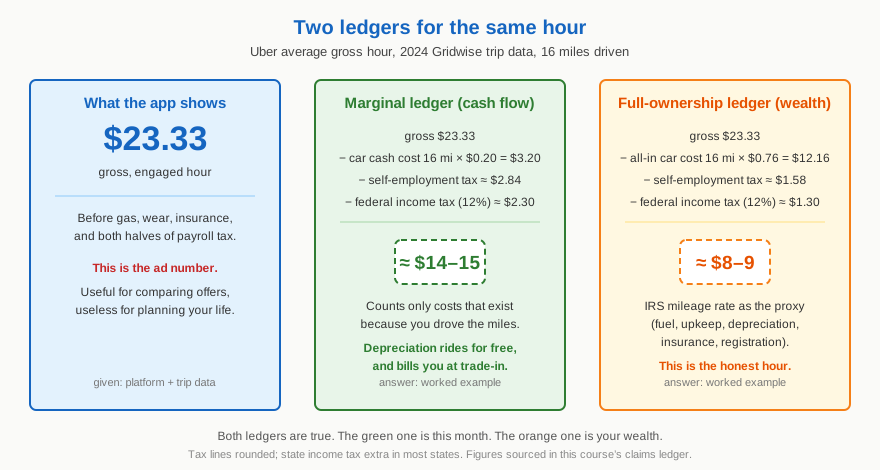
Here is where most gig math goes wrong, so I will go slow. Your car costs are real, but they come in two flavors, and the honest answer lives between them.
The first flavor is marginal cost: the cash that leaves your pocket only because you drove those miles. Fuel at roughly 11 cents a mile for a car averaging 30 miles per gallon on $3.30 gas, plus maintenance, tires, and oil, which AAA-style cost modeling puts around another 10 cents. Call it 20 cents a mile, or $3.20 for the hour. On this ledger, your $23.33 gross hour nets about $20 before tax. This is the ledger drivers use when they want to feel okay.
The second flavor is full ownership cost: everything the car costs you because it exists and is being consumed, including depreciation, insurance, registration, and financing. The IRS standard mileage rate is the sanctioned proxy for this. For the second half of 2026 it is 76 cents a mile, up from 72.5 cents in the first half, an unusual midyear adjustment worth knowing about. AAA's own 2025 study puts all-in ownership of a new car at $11,577 a year, about 77 cents a mile at 15,000 miles, which agrees with the IRS almost exactly. On this ledger, 16 miles costs $12.16, and your $23.33 gross hour nets about $11.17 before tax. This is the ledger that explains why the two-year-old Camry with 90,000 new miles is worth $4,000 less than you expected when you finally sell it.
Both ledgers are true. The marginal ledger is your cash flow this month. The ownership ledger is your wealth, quietly draining. Drivers who only ever read the first ledger end up replacing a transmission with no memory of earning the money that worn it out.
Now the taxes, which arrive all at once because nobody withheld them. Two deductions happen before the tax man takes his share. You deduct either the standard mileage rate times your business miles or your actual expenses, whichever is better for you, and you deduct half of your self-employment tax. What remains is net profit, and on net profit you owe self-employment tax of 15.3 percent, which is both halves of Social Security and Medicare, the part an employer used to pay for you. Then you owe ordinary federal income tax at your bracket rate, and state income tax on top in most states.
Run the full-ownership ledger to its end. Twenty-three thirty-three gross, minus $12.16 of car, leaves $11.17 of net profit. Self-employment tax takes about $1.58. Federal income tax at a 12 percent bracket takes about $1.34, with the qualified business income deduction trimming that slightly. You are left holding roughly $8 to $9 for the hour, and your state may take another bite. On the marginal ledger the same hour lands near $14 to $15 net. So the honest headline, the one this entire guide stands on: a verified $23 gross hour is worth about $9 to $15 an hour once it reaches your life, and where you land inside that range depends mostly on how new and expensive your car is.
| Line | Full-ownership ledger | Marginal ledger | |---|---|---| | Gross hour (Uber avg, Gridwise) | $23.33 | $23.33 | | Car cost, 16 miles | $12.16 at 76¢/mi | $3.20 at ~20¢/mi | | Net profit | $11.17 | $20.13 | | Self-employment tax | about $1.58 | about $2.84 | | Federal income tax (12% bracket) | about $1.30 | about $2.30 | | What lands | about $8–9 | about $14–15 |
Does that mean the apps are a scam? No. Eight to fifteen dollars an hour, this week, with no interview and no schedule, is a genuinely useful thing when rent is due. It is simply a different thing than $33 an hour, and you should price your time, your car, and your energy against the smaller number.
There is one more cost this hour hides, and it deserves its own treatment: the tax bill arrives quarterly, not weekly, and it bankrupts bridge workers every spring.
Downloads for this lesson
Keep going — you're working through The Gig Bridge: Honest Income While You Build.
All courses are free ↗