The 1099 reality: taxes on bridge income
Lesson video in production
The full lesson text below is complete — the video version lands with launch.
Nobody at DoorDash is withholding taxes from your payout. Nobody at Uber, either. That is not a loophole in your favor. It is a loan the government extends you at zero interest and collects every April with penalties attached. Bridge workers who ignore this for a year get the single most predictable financial injury in gig work: a spring tax bill for thousands of dollars, at the exact moment the bridge was supposed to be behind them.
Here is the machinery. As an independent contractor you get a Form 1099-NEC from each platform that paid you enough. The threshold for that form was $600 through 2025 and rises to $2,000 for tax year 2026 under the 2025 tax law. Platforms that pay you like a marketplace, settling card payments, may send a 1099-K instead, whose threshold for 2026 returned to $20,000 and 200 transactions. Two things stay true no matter which forms show up. First, if you earned it, it is taxable, form or no form; the threshold only controls paperwork. Second, if you drive for three apps, all three count toward the same tax bill.
Then the part that surprises corporate lifers the most: self-employment tax, on top of income tax. When you had a W-2 job, 7.65 percent came out of your check for Social Security and Medicare and your employer matched it in the background. Now you are both parties, so you pay both halves: 15.3 percent, of which 12.4 percent applies up to the 2026 Social Security wage base of $184,500 and 2.9 percent applies with no cap. It is computed on 92.35 percent of your net earnings, because you deduct half of it first:
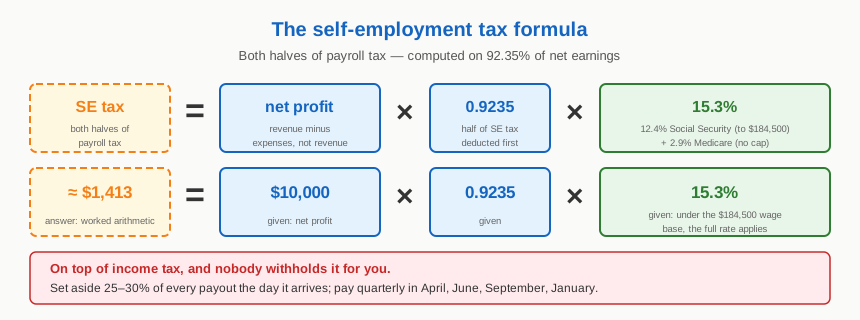
Net profit means profit, not revenue. This is where gig work pays you back a little. Every business mile you drive is deductible at the standard rate, 72.5 cents for the first half of 2026 and 76 cents for the second half, or you can deduct actual vehicle expenses if your documentation is good and your car is expensive enough for that to win. You cannot take both. Beyond miles: the business share of your phone bill, hot bags and phone mounts, platform fees you pay, inspections, and the rideshare insurance endorsement covered later in this guide. And one deduction worth knowing exists: the qualified business income deduction, 20 percent of net business income for most sole proprietors, which the 2025 tax law made permanent instead of letting it expire.
The rhythm that keeps you out of trouble is quarterly. Four times a year, April, June, September, and January, you send the IRS an estimate of the tax you owe as you go. The safe harbor that stops penalties: pay at least 90 percent of this year's tax or 100 percent of last year's, 110 percent if your income was over $150,000. If you bridged onto gig income from a salaried job with withholding, your old paycheck may already cover much of the liability, which is a genuine break. The practical rule most operators land on: move 25 to 30 percent of every payout into a separate savings account the day it arrives, and send quarterly payments from there. On the net-hourly math from "What an hour actually nets," that rule is already priced in; this is just the mechanics of paying it.
Two bridge-specific notes before the mechanics. If you are collecting unemployment and picking up gig income, report it; in most states gig earnings reduce or pause weekly benefits, and the overpayment clawback is worse than the haircut. And if your state has no income tax, the 25 to 30 percent set-aside shrinks toward 20 to 25 percent; your state's department of revenue page will say in two minutes.
One last reframe, because it matters for the far bank. The discipline this lesson demands, tracking miles, keeping receipts, pricing your profit instead of your revenue, is not a tax chore. It is the exact bookkeeping muscle that makes the business on the other side of this bridge survivable. You are not just complying. You are rehearsing ownership.
Numbers are half the story. The other half is what the work feels like hour to hour.
Downloads for this lesson
Keep going — you're working through The Gig Bridge: Honest Income While You Build.
All courses are free ↗