The Honest Money
Lesson video in production
The full lesson text below is complete — the video version lands with launch.
What the market pays
Start with the live numbers, because everything else in this course hangs off them. Self-employed handymen across the United States bill $50 to $80 an hour plus materials, and company-affiliated handyman services bill $75 to $125 an hour. Angi's pricing data runs $50 to $150 an hour depending on region. Most solo operators also set a minimum call-out charge, typically $75 to $150, which covers travel, the supply run, and the fact that a 20-minute job still consumes half your morning.
Whole jobs tell it better than hourly rates. Typical handyman visits run $186 to $612 in Minneapolis, averaging $399, and $199 to $727 in Philadelphia, averaging $459. That is the shape of the business: one-day and half-day tickets, a couple per day, repeated for years.
Your instinct will be to enter at the bottom of the range "to get started." Every operator who has done it reports the same result: the cheapest clients are the hardest clients, and raising prices later is harder than starting near market. Price at or near your local middle from day one. You are selling the disappearance of a problem, and disappearing problems are worth full price. Those rates are also unusually safe from software, which is why this course carries a two out of ten on AI exposure, per how this catalog rates AI exposure: nobody has automated hands inside a stranger's house, and the errands software can run, quoting and invoicing, are the ones you want run for you.
The trap: 40 hours is not 40 hours
Here is the number that kills first-year handymen. You will work 40 hours a week and get paid for maybe 20 to 25 of them.
The unpaid half is not laziness. It is driving between jobs, hunting parts at the supply house, quoting jobs you do not win, invoicing, texting photos, waiting for a client who is running late, and restocking the truck. The trade's comfortable illusion is your hourly rate; the business's reality is your effective rate:
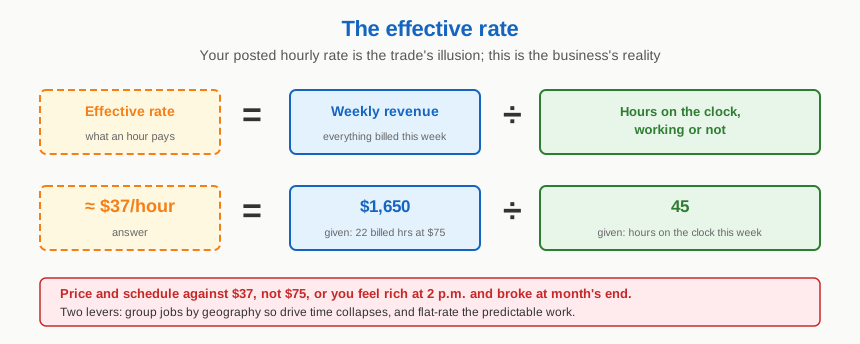
Work it through. Bill 22 hours at $75 an hour and your week grosses $1,650. Divide by the 45 hours you actually spent, and your effective rate is about $37 an hour. That is still a solid living, and it beats most laid-off corporate salaries' hourly equivalent once you count commuting. But you must price and schedule against $37, not $75, or you will feel rich at 2 p.m. and broke at month's end.
Two levers fix this over time. Group jobs by geography so drive time collapses. And push the small predictable work to flat rates, which pay for outcomes instead of your minutes, so an efficient hour earns more than $75 rather than exactly $75.
The bite list
Now the deductions nobody's YouTube video puts on the thumbnail.
Self-employment tax: 15.3 percent. As your own boss you pay both the employee and employer halves of Social Security and Medicare, 12.4 percent plus 2.9 percent on net earnings. Nobody withholds it for you. The working rule: set aside roughly 30 percent of every payment for the tax combination of self-employment tax plus income tax, and pay quarterly estimates. A quarter-hour with a tax professional in your first month is money well spent.
Insurance. General liability for a solo handyman runs about $50 to $80 a month with a specialist small-business insurer. It is not optional. You are being trusted alone inside the most expensive thing your client owns.
Fuel, tools, and consumables. Blade dulled, bits snapped, caulk dried out, gas burned. Budget a slice of every ticket, maybe 10 percent, back into gear.
Unpaid administration time. Already counted above, but it shows up in your calendar like a client who never pays. Protect an hour a morning for it and it stops leaking into evenings.
Health coverage, if this trade replaces a benefits-carrying job. No line above covers your appendix; health coverage after leaving employment is its own decision and its own guide.
Slow months exist too. January after the holidays and the dead stretch before spring can thin out, and that season gets its fixes later in the course. Nothing in this business compounds if the pricing is wrong, though, which is why this course builds your price card before your tool kit.
Downloads for this lesson
Keep going — you're working through Start a Handyman Business.
All courses are free ↗