Pricing Jobs and the Estimate
Lesson video in production
The full lesson text below is complete — the video version lands with launch.
Three numbers, one system
A handyman price card is not one number. It is three: a floor, an engine, and a menu.
The floor is your call-out minimum. You charge it the moment the van moves, and it exists because a 20-minute job consumes travel, loading, and a calendar slot. Typical call-out fees run $75 to $150, and most operators fold the first hour of work into it so the client sees "the visit costs $125, including the first hour."
The engine is your hourly rate. Self-employed handymen across the country bill $50 to $80 an hour, with company services at $75 to $125. Where you land depends on your metro and your license status, and one operator's data point is instructive: a working handyman service bills a $90-per-hour minimum on short calls, so even a twenty-minute stop pays like an hour and small jobs stop being tempting to underprice. Anchor your rate to your effective-rate math from the money lesson, not to your fear.
The menu is your flat rate. Predictable jobs get one price, and Housecall Pro's pricing guide puts typical flat-rate handyman work at $150 to $600. Live job-level benchmarks from pricing data and working operators:
| Job | Flat-rate range | Source | |---|---|---| | Ceiling fan install | $110–$440 | Angi pricing data | | Ceiling fan install | $200–$250 reported by working handymen | r/handyman operators | | TV mounting | $330–$440 in a high-cost metro | Angi pricing data | | Door adjustment | $85–$240 | Angi pricing data |
Flat rates reward the fastest version of you instead of the slowest. A fan swap that takes you 50 minutes flat-rated at $200 pays $240 an hour. That is the point: your growing speed becomes your margin instead of your client's discount. Set each flat rate from your honest worst-case time at your hourly rate, plus a wobble factor for the house you have not seen yet.
Which price for which job
One decision rule covers it:
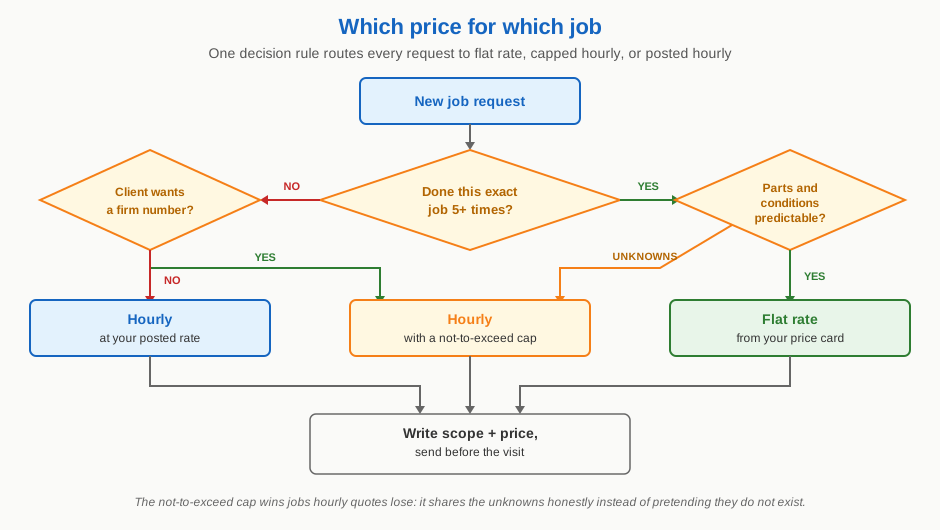
The not-to-exceed cap deserves a sentence of explanation, because it wins jobs hourly quotes lose: "I estimate two hours, so $180 with materials, and I will not go over $260 without calling you first." The client hears a ceiling. You keep protection from the surprise inside the wall. Operators who quote this way report clients accept it readily, since it shares the unknowns honestly instead of pretending they do not exist.
The estimate walk-through
Prices hold when the estimate behind them is honest, and honesty here is a process.
Walk the job with the client and narrate, as the walk-through ritual in the service-menu lesson describes. Then, before you quote, answer four questions on paper: what tasks, in order; what can go wrong for each; what materials, priced from a real store run; and what your worst-case time is. Quote from the worst case with a small buffer built in, not from the lucky version. The corpus of operator experience is unanimous on this: the money in small jobs is lost to the unforeseen, and a contingency line in your estimate is what protects both your margin and the client's expectations.
Materials get itemized and marked up, openly. Pricing guidance for the trade puts the standard markup at 10 to 30 percent over retail on parts you source, store, haul, and warranty, and hiding it inside "labor and materials" is what breeds invoice disputes. Say the number out loud when you quote.
For material-heavy jobs, a deposit, commonly around half the materials cost, is normal and worth asking for. It filters out the half-interested and funds the supply run. For everything under a day of work, payment due at completion, card reader ready, before you pack the last tool.
Say the price like a fact
The last pricing skill is delivery. The quote is one sentence, then silence:
"To patch and paint that wall so it disappears, $275 flat, and I can do it Thursday."
No windup, no apology, no "if that sounds okay." The pause after the number belongs to the client. Operators consistently report that the same price, said with a question mark, invites negotiation, and the same price said as a fact books the job. Your rate card is finished; now the work needs a body and a calendar.
Downloads for this lesson
Keep going — you're working through Start a Handyman Business.
All courses are free ↗