The Sixty-Day Decision
Lesson video in production
The full lesson text below is complete — the video version lands with launch.
Most people treat the COBRA decision as a fork they must take on their last day. It is not. It is a 60-day option, and understanding that changes both your risk and your bank account.
The window, precisely
Your COBRA election window runs 60 days, counted from the later of two dates: the day your coverage ends, or the day the election notice is mailed. Elect within the window and coverage applies retroactively to the day your job plan ended. After electing, you get 45 days to make the first payment. Put those three facts together and you get a strange, useful property: for roughly the first two months after quitting, you can wait to decide, and if something terrible happens, elect COBRA then and be covered for the terrible thing, backdated. If you were laid off rather than quitting, those two dates sit inside a bigger set of clocks, severance review windows and filing deadlines, and severance and anchor dates is the guide that runs that calendar.
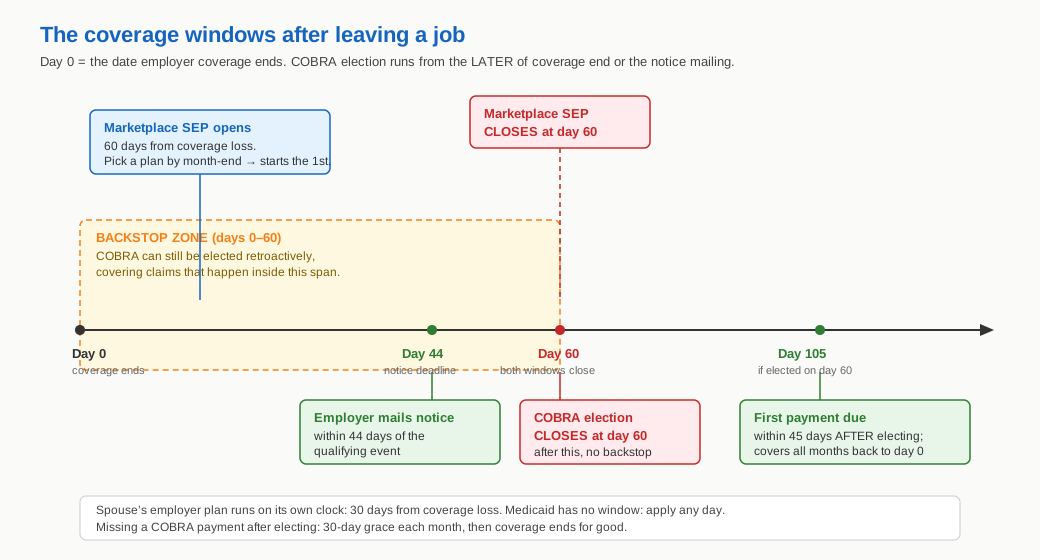
That is the free option. Holding it costs nothing. Exercising it early, by electing on reflex, throws it away.
The backstop play
Here is the sequence I would run, and the one that comes up again and again from people who have lived it on r/personalfinance threads about job loss coverage.
Week one, enroll in a marketplace plan through your special enrollment window, effective the first of the next month. Do not elect COBRA. Keep the election paperwork in a drawer. You now have coverage going forward and a 60-day retroactive bridge behind you. If nothing goes wrong, you never elect COBRA at all and the drawer stays closed.
If something goes badly wrong inside the window, say a hospitalization in week three, you have a decision to make, and it is a real one: elect COBRA retroactively and pay the full backdated premium for those months, which covers the hospitalization under your old plan's terms, or let the marketplace plan pick it up from its start date, which leaves the gap weeks uncovered. That decision needs the two plans' real numbers, which is exactly why you priced both doors before you needed them.
Two cautions from the same Reddit threads keep the play honest. First, you cannot hold both and double-dip: electing COBRA for the same months you hold a subsidized marketplace plan means paying for both and can tangle your subsidy reconciliation. Pick one per month. Second, the strategy depends on you actually completing the marketplace enrollment inside its own 60-day window, because that window closes on a schedule that does not care about your COBRA paperwork.
The lock-in, which is the real trap
The trap has two halves, and both are about what you cannot undo.
If you elect COBRA, you generally cannot move to a marketplace plan mid-year whenever you feel like it. Voluntarily dropping COBRA does not open a special enrollment window; the marketplace door reopens at open enrollment, or when your COBRA runs out, or on a different qualifying event. People who elected COBRA out of fear and repriced in month four are stuck until January. That is the single most common regret in this whole subject.
The second half is subtler. If you blow off the marketplace window because you are on COBRA, fine, that is a choice. But if you never enrolled anywhere and the 60 days close, you are uninsured until the next open enrollment, which can be months away, with no backstop left. The window that protects you also runs out on you.
The 2026 wrinkle that makes deferral cheaper than it used to be
There was a time when electing COBRA first and shopping later was merely expensive. In 2026 it can be catastrophic for one specific group: people whose income lands them just under the subsidy cliff. Every month on COBRA is a month at full freight with no subsidy available, and for a household near the line, that difference is hundreds of dollars a month. The subsidy table and the cliff itself get their full treatment later in this guide. The short version for this lesson: the cost of reflex-COBRA went up this year, and the value of running marketplace numbers first went up with it.
The marketplace is where the repriced math lives.
Keep going — you're working through Health Insurance After Quitting.
All courses are free ↗