How Subsidies Work Now
Lesson video in production
The full lesson text below is complete — the video version lands with launch.
If you read anything about marketplace insurance before 2025, some of it is now wrong. This lesson is the current rulebook, and the changes matter enough that people who priced coverage two years ago should start from zero here.
What expired, in one paragraph
From 2021 through 2025, enhanced premium tax credits capped what anyone paid for a benchmark plan at 8.5 percent of income, no matter how high the income. Those enhancements expired at the end of 2025, and Congress did not extend them. For 2026 the old structure is back: a sliding scale of required contributions that rises with income, and a hard cutoff above 400 percent of the poverty line where subsidies stop completely. Across marketplace consumers, the average net premium payment, after tax credits, jumped 58 percent this year, from $113 to $178 a month. More than a million people did not come back at all.
The sliding scale, 2026 edition
The way a subsidy works is simple once you see the two moving parts. The government looks at the second-lowest-cost silver plan in your area, called the benchmark, and decides what share of it you should pay yourself. That share is a percentage of your income that rises as your income rises. Whatever your share does not cover, the subsidy pays, and you can apply it to any metal level you like.
For 2026 coverage, here is the scale, straight from the IRS indexing table in Revenue Procedure 2025-25:
| Your income, as percent of poverty line | You pay, as percent of your income | |---|---| | Under 133% | 2.10% | | 133% to 150% | 3.14% to 4.19% | | 150% to 200% | 4.19% to 6.60% | | 200% to 250% | 6.60% to 8.44% | | 250% to 300% | 8.44% to 9.96% | | 300% to 400% | 9.96% | | Above 400% | No subsidy at any price |
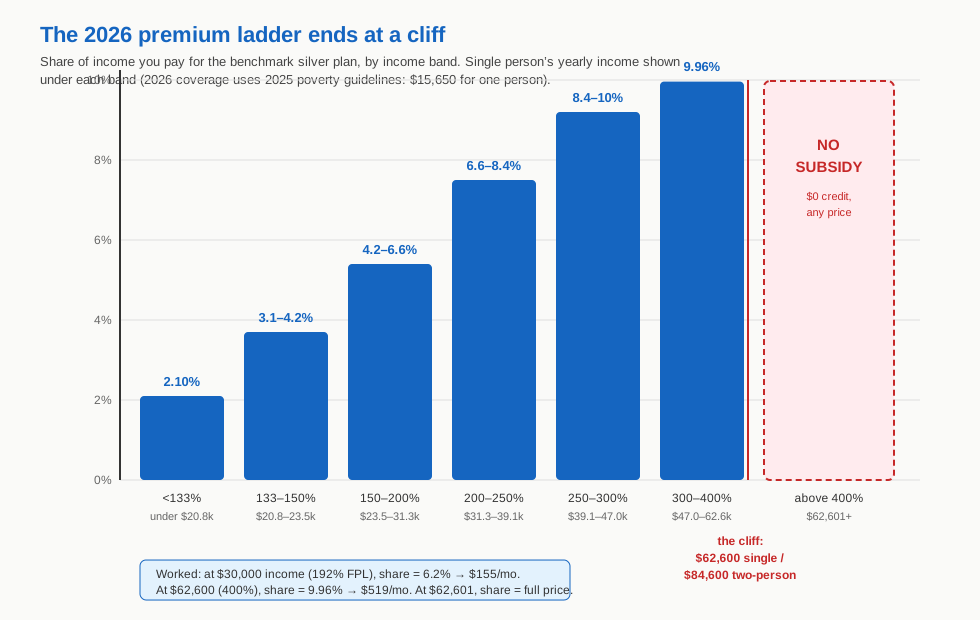
The poverty line the marketplace uses for a coverage year is the prior year's federal guideline: for 2026 coverage, that is $15,650 for a single person, so 400 percent is $62,600. For a household of two, the line is $84,600. Mark those numbers somewhere, because the cliff is not a slope. It is a wall.
Two facts that make the scale work for you
The subsidy attaches to the benchmark, but you can spend it anywhere. If your required share is $155 and the benchmark is $625, your subsidy is $470 a month. Apply that to a $456 bronze plan and the bronze costs you zero. Zero-premium bronze plans are common this year precisely because the subsidy is benchmark-based and bronze is cheaper than the benchmark. Choosing between bronze, silver, and gold on purpose gets its own lesson later in this guide.
The second fact: cost-sharing reductions still exist. Below 250 percent of the poverty line, silver plans come with quietly shrunk deductibles. The average silver deductible for enrollees at or below 150 percent of poverty was $80 this year, against a standard silver deductible of $5,304. Eighty dollars. That is not a typo, and it is the strongest argument in the entire marketplace for anyone whose first year of self-employment income will be thin.
Why income estimation became the dangerous part
One more 2026 change, and it is the one I most need you to internalize before you ever type an income estimate into a marketplace application. In prior years, if you underestimated your income and took too much subsidy in advance, the repayment was capped at a few hundred to about $1,500. A law passed in 2025 eliminated the caps starting with 2026 coverage. If you take advance subsidies based on an estimate that comes in low, you now repay every dollar of the excess at tax time. The estimate you type into the marketplace application has teeth it did not have two years ago.
The scale above is national and the percentages are law, but your premium is your income, and the only way to feel that is to run real numbers through the machinery, on both sides of the cliff.
Downloads for this lesson
Keep going — you're working through Health Insurance After Quitting.
All courses are free ↗