Royalty arithmetic before you write a word
Lesson video in production
The full lesson text below is complete — the video version lands with launch.
Run the math first
Most people write the book and then discover what a sale pays. Reverse that. Every pricing and lane decision in this business flows from four pieces of arithmetic, and all of them are public. We will run each one with real current numbers.
Start with the format that carries most new publishers: the ebook.
Ebooks. Amazon pays either a 70% or a 35% royalty, and which one you get depends entirely on your list price. Since July 7, 2026, the 70% band runs from $2.99 to $12.99 on Amazon.com; before that date the ceiling was $9.99 (KDP list price requirements). Inside the band, you get 70% of the list price minus a small per-megabyte delivery fee, which Amazon says averages about six cents per sale (KDP ebook royalties). Outside the band, you get a flat 35% with no delivery fee.
Two worked examples:
| List price | Rate | Your royalty per sale | |---|---|---| | $4.99 | 70% minus ~$0.06 delivery | about $3.43 | | $13.99 | 35%, no delivery fee | about $4.90 |
Read that second row again, because it is the trap that catches optimistic new publishers. At $12.99 you earn roughly $9.03 per sale. At $13.00 you earn about $4.55. One dollar of extra list price nearly halves your take, because $13.00 sits outside the 70% band. Price inside the band unless you have a specific reason not to.
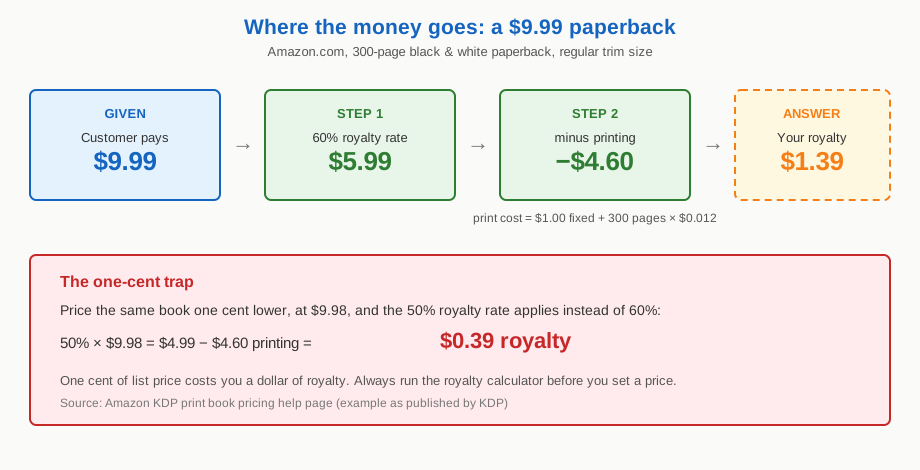
Paperbacks. Print books work differently: your royalty is a percentage of the list price minus the printing cost, and the percentage is 50% or 60% depending on the price you set. Amazon's own published example: a 300-page black-and-white paperback at $9.99 earns (60% × $9.99) − $4.60 printing = $1.39. The same book at $9.98 slips into the 50% rate and earns $0.39. One cent of price, one dollar of royalty (KDP print book pricing).
The printing cost is not a mystery; it is a published table. On Amazon.com today, a black-and-white paperback in a regular trim size costs $2.30 flat for 24 to 110 pages, and $1.00 plus 1.2 cents per page for anything longer — check KDP's current print-cost table at the edges (KDP printing costs). So a 150-page journal costs $2.80 to print. Price it at $7.99 and the 60% rate leaves you (0.60 × $7.99) − $2.80 = $1.99 per sale. Color is far more expensive: premium color runs $1.00 plus 6.5 cents per page after a flat $3.60 for short books, and standard color runs $1.00 plus 2.55 cents per page. This is why coloring books and photo-heavy books price higher, and why low-content publishers live in black-and-white interiors.
The two subscription flavors
Kindle Unlimited page reads. If you enroll your ebook in KDP Select, which requires 90 days of exclusivity, subscribers can read it for free in Kindle Unlimited. You are then paid per page read out of a monthly fund, at a rate that has run between roughly $0.004 and $0.005 per page through 2025, with a cap of 3,000 pages counted per customer per title (KDP on Kindle Unlimited royalties, Written Word Media payout tracking). A 300-page novel read cover to cover earns about $1.20 to $1.50. That sounds tiny until you notice that genre fiction readers binge: page reads can quietly rival or beat sales revenue for fiction in Kindle Unlimited.
Audiobooks. Audiobooks are produced through ACX, Amazon's audiobook exchange. The legacy royalty is 40% of the list price if you stay exclusive to Audible, Amazon, and Apple, or 25% if you distribute everywhere. In 2025 Audible introduced a new model, opt-in, paying 50% exclusive and 30% non-exclusive (Audible's new royalty model). The catch is production cost: paying a narrator by the finished hour can run four figures per book, so treat audio as a later-stage move for books that already sell.
What the arithmetic tells you
Multiply it out and the shape of the business appears. A nonfiction ebook at $4.99 makes you about $3.40 a sale; the same content as a 250-page paperback at $12.99 makes you (0.60 × $12.99) − ($1.00 + 250 × $0.012) = $3.79. A low-content journal makes about $2. A page-read novel makes about a dollar-forty per full read. Nobody retires on one sale. The operators who earn real money here do it with catalogs: tens of books, each found by a different search, each contributing a trickle.
That word, trickle, is where most people's hope goes to die. What a first year actually looks like in dollars comes later in the course; hold the arithmetic in mind until then, because nobody selling you a course will show you those numbers.
Downloads for this lesson
Keep going — you're working through Self-Publish on Amazon KDP.
All courses are free ↗