Hard truths: how books and accounts die
Lesson video in production
The full lesson text below is complete — the video version lands with launch.
The lane that got shut down
The most important industry story of the last few years, and the one most course sellers skip, is the crackdown.
Through the late 2010s and early 2020s, a whole sub-industry taught automated low-content publishing: scripts converting design catalogs into thousands of near-identical journals per week. One operator from that era described soft limits of a thousand uploads a week and still getting warning emails. Amazon's response arrived in stages: low-content books lost free ISBNs and expanded distribution in 2022; in September 2023, KDP capped publishing at three titles per day and began requiring disclosure of AI-generated content (The Guardian on the 2023 limits, Authors Guild on the AI policy and upload caps); and the rule has tightened since, to ten title creations per book format each week, the limit KDP itself now publishes (KDP on the title creation limit). For a publisher making one researched book at a time, none of these numbers will ever touch you. They exist to kill the upload farms.
The mass-upload lane is dead by policy design. What survived is the version this course teaches: researched books, designed packaging, human quality control. Understand the history so you recognize the smell of old advice, because an enormous amount of course material from the automation era is still sold as current.
The five ways accounts die
Termination emails cluster around five causes. Every one is avoidable, and every one ends catalogs.
Trademark and brand terms. Titles, subtitles, keywords, and covers using protected terms and brands, a character name, a franchise, a brand of planner, get flagged. One publisher's account was terminated over trademarked terms in listings; the appeal failed. Check the words you don't own before you publish them.
Plagiarism and scraped content. Copying another book's text, "fact books" assembled from copied lists, interiors lifted from other publishers. A kids' fact book publisher in one coaching community lost an account to this and was advised the appeal path might cost one to two thousand dollars in attorney fees, with no guarantee.
Cover and interior copying. Commissioning a cover that mimics a bestseller, or reusing one interior across many "different" books with swapped covers, both named by Amazon as negative customer experience and both common termination triggers in the low-content lane.
Review manipulation. Swapped, paid, or coerced reviews, covered fully in the launch lesson. Amazon's detection improved years ago and keeps improving.
Metadata games. Keyword-stuffed titles, misleading subtitles, bestseller claims in the title field. These usually start with a correctable notice rather than termination, which is why the next section matters.
The notice playbook
When Amazon emails you about a content issue, you are on a clock, typically five business days to fix title and metadata problems before the book is removed from sale. The operators who survive notices run the same playbook, and the coaching communities that lived through these years teach it explicitly:
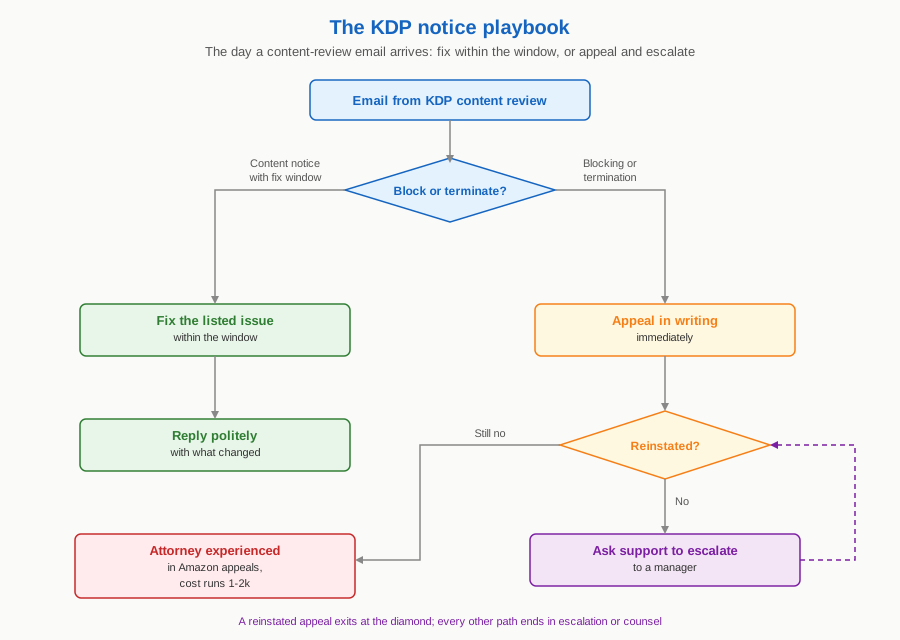
The behaviors that recur in every survivor's story: reply the same day, be scrupulously polite, state exactly what was wrong and exactly what you changed, and never ignore a notice, because unresponsiveness reads as guilt. When first-line support loops canned replies, the taught phrase is a plain request to escalate the case to a manager. When appeals exhaust, specialists in Amazon account appeals exist, with community-reported fees in the low thousands. No outcome is promised, and a terminated account usually takes the catalog's income with it, which is the real reason every rule in this course is worth following exactly.
The quiet death: books that don't die
Accounts die loudly. Books die quietly, and this is the more common failure. A book with no reviews, no sales, and no ranking after a competent launch is not a tragedy, it is information: the research bet didn't clear. The operators who last treat it as research cost, publish the successor, and stop spending on the corpse. The operators who don't last keep feeding ads and hope to a listing that the market already assessed.
Seasonality is the one quiet-death lookalike. Gift-driven niches swing hard: fourth quarters are enormous for gift books, and the same catalog can look dead in February through no fault of its own. Before declaring a book failed, ask whether its niche has a season, and if it does, judge it on a full year.
You now know how this business fails, which means you are ready to run it. What running looks like, week by week, comes later in the course; what it demands of you is already on this page.
Keep going — you're working through Self-Publish on Amazon KDP.
All courses are free ↗