Keeping the Route Alive
Lesson video in production
The full lesson text below is complete — the video version lands with launch.
Getting ten lawns is a sprint. Keeping forty is a system. This lesson is the system: how the route is arranged, how service is standardized, why customers leave, and how money arrives without a fight.
Density is the whole game
Look at two possible versions of the same eight-lawn day.
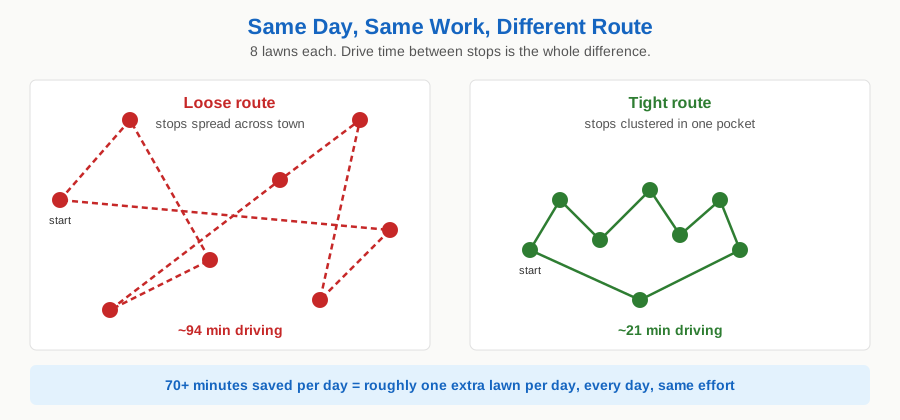
Same lawns. Same mowing. Same you. The loose route burns over an hour and a half of the day driving; the tight route burns about twenty minutes. That difference, repeated daily, is the difference between a mediocre season and a strong one, which is why solo-operator guidance keeps naming route density as the top profitability factor. Density pays you twice: in extra stops per day, and in the willingness of neighbors to join a route that visibly serves their street.
Building density means making density the rule when you accept work. Every new lawn should sit inside or directly beside your existing cluster. The tempting lawn fifteen minutes away at $75 fails the test that the adjacent lawn at $50 passes, because the cheap-looking far lawn quietly taxes every other stop on its day. Operators learn to say the sentence that protects the route: "I'm not taking work outside my area this season." Declining is a pricing decision.
The cluster grows by streets, not by scattered wins. When you cut one street well, you pick up its neighbors cheaply, and soon the whole street is a single stop that happens to have six driveways.
The service standard
Customers cannot judge cut quality the way you can. What they judge is reliability and communication, and both can be standardized.
- Same day, same crew, same result: every customer on the Tuesday route gets Tuesday. Weather moves the day, you announce it, and the announcement is the whole trick: a text at 8 a.m. beats a perfect lawn on Thursday.
- The look-back: thirty seconds at the curb before you load. Missed strips, blown clippings on the walk, the gate left open. The look-back is where five-star reviews are manufactured.
- The completion text: one line, every visit, once: "Done today, back Thursday." Nothing else. Customers report a quiet dependence on these texts within a month.
- Problems, immediately: hit a sprinkler head, scalp a corner, break something: text a photo and an fix offer the same hour, before they find it. Route owners say the recovery, done fast, builds more loyalty than never erring.
Churn, honestly
Every route leaks. Customers move, die, lose income, buy a robot mower, or hire the neighbor's kid. Industry reality for recurring home services is a steady annual churn, so a route that wants to hold forty lawns must keep selling even when full, because it is never actually full for long. Plan a standing acquisition behavior, a handful of door hangers or one ask-for-referrals text per month, forever.
The churn you can prevent comes from three fixable causes. Silence, meaning you never communicated a change, fixed by the completion text. Drift, meaning quality slid as you got busy, fixed by the look-back. And price shock, meaning a raise arrived unannounced, fixed by the notice-and-justify rule: any price change gets a heads-up text before the invoice, tied to something real like fuel or a second year of service. Operators consistently report that announced raises retain nearly everyone and surprise raises burn lawns you liked.
Money arrival
Bill monthly, same date every month, every customer, no exceptions. Industry practice is invoice around the first of the month for the prior month's cuts, by email or text, with payment due inside two weeks. Card on file, collected at signup through any field-service invoicing tool, is the upgrade that eliminates collections almost entirely, and it is the single strongest anti-nonpayment move a young route can make. Paper checks remain common with older customers; accept both.
Track one number weekly: receivables over 30 days old. The operating logic is simple: a customer two invoices behind is not a customer with a billing quirk, they are a decision you are avoiding.
A route that holds customers and clusters streets becomes something more than a paycheck: it becomes the platform for every higher-margin service you can sell to people who already trust you. Those services come later in the course.
Downloads for this lesson
Keep going — you're working through Start a Lawn Care and Landscaping Business.
All courses are free ↗