When the Season Ends
Lesson video in production
The full lesson text below is complete — the video version lands with launch.
Every lesson before this one assumed grass that grows. For most of the United States, that assumption dies in November, and the route with it. More first-year lawn care businesses end at the first frost than from any competitor, because the operator treated November as a surprise. This lesson is the two-part defense: bank money during the season like the cliff is coming, because it is, and choose your winter fork before October, not during it.
The banking math
Your season revenue has to cover two things: your in-season living costs, and the lean months after it. The calculation is three numbers, and you should run it in the first month of your first season, on the money worksheet that goes with this course.
- Your lean-month cost of living: rent or mortgage, food, insurance, everything, for the months your route does not run. In the northern half of the country, plan for three to four dead months. In the transition zones, six slow weeks. In the deep South and Southwest, mowing slows in winter rather than stopping, and this whole lesson shrinks to a paragraph.
- Your business costs that survive the frost: insurance bills monthly, loan or equipment payments, storage, phone. The route pauses. The overhead does not.
- Your off-season fund target: lean-month living costs, plus surviving overhead, plus a margin for the spring restart, which costs real money in fuel, blades, repairs, and marketing in the first green weeks.
The operating rule that makes the math real: move the off-season slice out of every invoice the day it arrives, into a separate savings account you do not touch. Ten to fifteen percent of every payment through the season is the common starting band for a northern operator. Operators who survive their first winter overwhelmingly describe some version of this habit, and operators who quit describe discovering in December that the account was also the vacation fund, the new trimmer fund, and the I-earned-it fund.
The fork
When growth stops, you have four honest paths. The right one depends on your climate, your body, and how hard you ran in summer, and none of them is the wrong answer. The wrong answer is deciding in November.
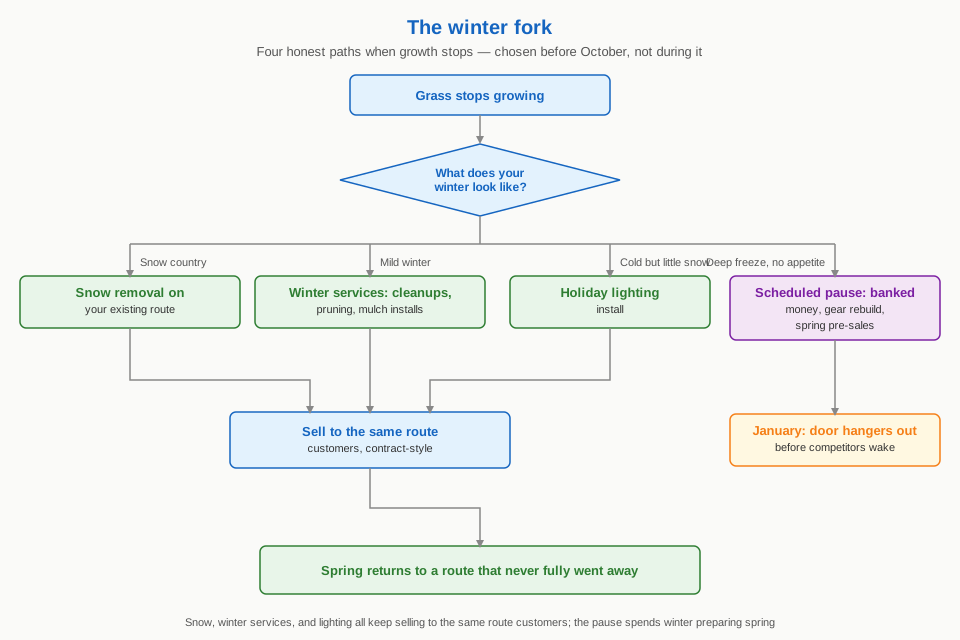
Snow removal, where snow is reliable, is the classic pairing and pairs beautifully with the route: same customers, same properties, inverse season. Entry cost is a plow or blade on the vehicle you already run, used equipment in the low thousands, and the work sells as seasonal contracts to the exact people on your mowing list. The trade-off is honest: snow work is on-call labor at odd hours, and a light winter pays nothing. Corpus-era pricing showed used plow setups around $1,200, and operators report customers preferring one company for both seasons.
Holiday lighting is the sleeper: install in November and December, using ladders, design sense, and customers who already trust you, at typical install prices of $220 to $650 per job on Angi's data, with removal in January. It is the most profitable weeks-per-hour work available to a route operator, and it fits the cold-but-low-snow climates where plowing is a gamble.
Winter services, in mild-winter markets, means the calendar stretches rather than breaks: final cleanups, pruning windows, mulch installs ahead of spring, and the tree-and-shrub work that was too hot to do in August. In much of the South and Southwest, this plus slowed mowing is simply the year-round version of the business, and the banking math shrinks to a small buffer rather than a season-sized fund.
The scheduled pause is a legitimate strategy, not a failure of one. Banked money, a winter of equipment rebuild and repair, January marketing before competitors wake, and a spring route pre-sold on door hangers in late winter. What kills operators is the unscheduled pause, the one that happens to them. The scheduled one is a plan. And if a pause lands with the account empty, urgent winter income is the bridge lane this catalog keeps for exactly that winter.
Decide by July
Put a date on the decision. By midsummer, you will know your climate's winter, your season revenue trajectory, and your body's honest state, and that is the moment to choose the fork and prepare: the plow quote in August, the lighting supplier relationship in September, the cleanup program presold before leaves turn. The operators who enter winter having chosen, enter it calm, and the ones who enter it having hoped, enter a second education.
The season, survived and planned, leaves one more debt this course owes you: the honest account of how operators fail, paid in full later in the course.
Downloads for this lesson
Keep going — you're working through Start a Lawn Care and Landscaping Business.
All courses are free ↗