The insurance stack
Lesson video in production
The full lesson text below is complete — the video version lands with launch.
Business insurance is not one product. It is a stack of separate policies, and each one answers a different loss. Brokers love selling the stack as a mystery. It is not a mystery. Here is the whole map, and once you see which policy answers which loss, you can reason about what you need instead of nodding at a quote.
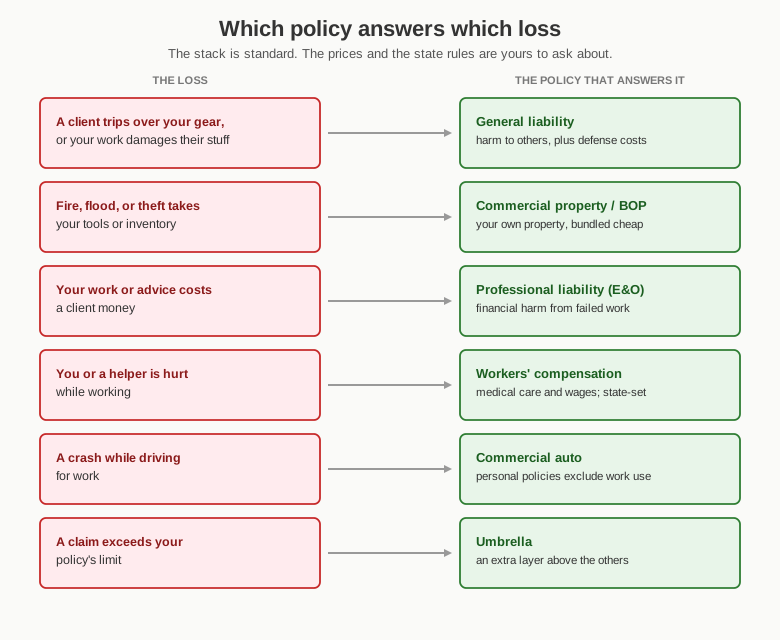
General liability is the base layer for any business that touches the physical world. A client trips over your gear, your ladder dents their car, your advertisement gets you accused of defamation: general liability pays the damages you are legally obligated to pay, up to the policy's limits, plus the cost of defending you even if the claim is baseless. That last clause matters more than people realize. Defense costs alone can run five figures before anyone decides anything, and carrier-reported averages for defending a single general liability claim run well past that. The direction is the point: defense costs arrive first, decisions arrive later. What does it cost? For a frame of reference, one large online broker's small business customers pay an average of about forty-five dollars a month, twenty-two percent of them pay under thirty, and annual premiums run from roughly two hundred fifty dollars to over three thousand. Operators in service trades report paying around sixty a month, and a widely used lawn care book from a few years back put a half-million to one-million-dollar general liability policy at three hundred to eight hundred a year; current medians for the million-dollar end of that band tend to run past its top. Those numbers are anchors, not quotes. Your industry, payroll, location, and claims history move the price a lot, and that variance is exactly why you will ask for competing quotes later in the module.
A business owner's policy, or BOP, is the bundle. The Insurance Information Institute calls it the most common policy for small businesses: it combines property coverage and liability coverage in one package, typically adds business interruption coverage that replaces income while you recover from a covered event. The cost advantage is the broker's claim, not the Institute's: bundling the two coverages costs less than buying each policy separately. Average around eighty-three dollars a month, annual premiums from four hundred to over six thousand. If you own real equipment, inventory, or work from a space that could burn or flood, the BOP question is worth asking first, because general liability alone will not replace your own property. That surprises people, so say it again clearly: the base liability policy pays other people for their losses. Your own tools are somebody else's job.
Professional liability, also called errors and omissions, answers a different kind of harm entirely. It covers claims that your work or advice failed to do what it was supposed to do, in work where the damage is financial rather than physical. The Institute's description is exact: it pays for alleged failure to perform, and it covers defense costs even when the claim has no merit. If you consult, edit, manage books, handle billing, or produce work a client's money depends on, this is your base layer, ahead of general liability. Remote admin is the purest case of the exposure, and professional liability for service work is the base layer that trade runs on. No general liability policy pays for the spreadsheet formula that cost a client a contract.
Workers' compensation covers people hurt working for you, wages while they recover and medical care, and it is the one policy where the law grabs you by the collar. The Insurance Information Institute states the pattern: in all states but Texas, an employer must carry it above a certain number of employees, and that threshold varies by state, in some places as few as three, in others five. Read that as the shape, not the number. Many states draw the line at your first employee, and some at a payroll threshold, so the honest instruction is: the day you hire, you ask your state's labor department where its line is. And notice the trap hiding in that sentence. Contractors are not employees, but states get to decide who counts as which, not you and not the person you paid. Misclassifying an employee as a contractor is one of the most common and most expensive setup mistakes a new business makes. When you get near hiring, the decision math is its own subject.
Commercial auto exists because personal auto policies generally exclude business use. If you drive to jobs with gear in the car, a personal policy can deny a claim made in the middle of a work day. The pattern to remember: the vehicle answers to auto insurance, never to general liability, no matter whose fault it was or where you were driving.
Inland marine is the oddly named one, and operators with trucks swear by it: it covers equipment that moves, the tools in your vehicle, the pressure washer, the gear that walks off a job site. Vehicle policies cover the vehicle. Property policies often assume your stuff sits somewhere. Tools that live in a truck need a policy that follows them. The heaviest movable equipment in this catalog belongs to party rental, and equipment and inland marine coverage for a fleet of bounce houses and tents is that course's own stack question.
Cyber liability covers the data side: client records, breach response, the laptop with a client's tax documents on it. For most one-person service businesses it is not a day-one buy, and for any business that stores client data it stops being optional at some point. Ask the question once a year.
An umbrella policy sits over the top of your other liability policies and pays when a claim exceeds their limits. The Institute's summary is the one to remember: coverage over and above other liability coverages. It is cheap relative to what it adds, and it is the last thing you buy, not the first.
The exclusions deserve their own paragraph, because this is where the surprise bills live. A stack you bought separately has separate gaps: general liability will not pay your employee's injury, will not replace your own tools, will not cover the car crash on the way to a job, and will not stand behind the quality of your work, which is a warranty problem, not an insurance problem. Every policy you ever see has a page of exclusions, and that page is the actual policy. When you buy, you will read it with a specific question list, and this module gives you that list.
One boundary line closes the map: what each trade's clients demand of you, certificates, endorsements, extra insured status, is practice for your business course, because the pattern is trade-specific. What you just learned, which policy answers which loss, is the same in every state. What each one costs you, and which ones your state compels, is the question list you take to your insurer.
Keep going — you're working through Legal, Licenses & Insurance.
All courses are free ↗