Separate your money
Lesson video in production
The full lesson text below is complete — the video version lands with launch.
The single cheapest money habit you will ever build costs you one bank application and thirty minutes. Every payment the business earns lands in an account that belongs to the business. Every personal dollar comes back across a bridge you built on purpose, on a schedule. That is separation, and I want it in place before your first customer pays you, because starting clean takes thirty minutes and un-mixing later takes a weekend you will resent.
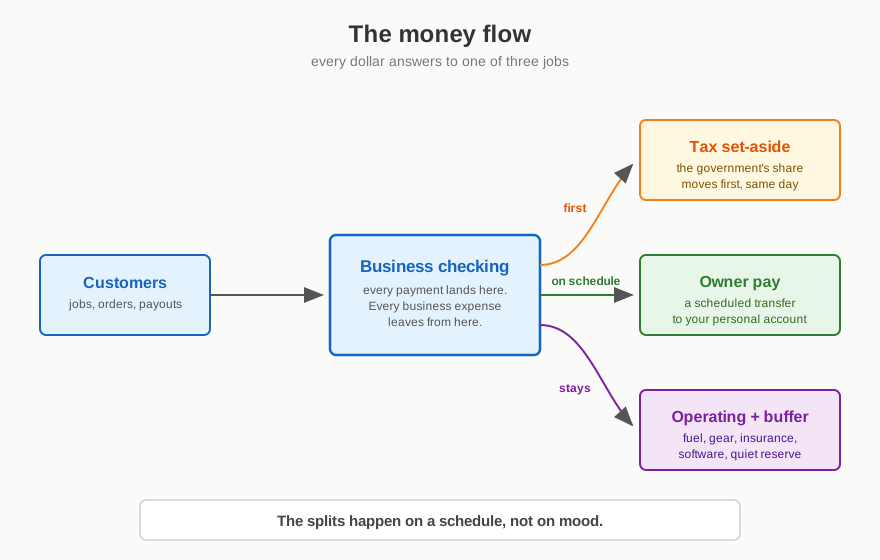
Here is the flow, worth memorizing until you can draw it on a napkin. Customer money enters the business account and only the business account. From there it splits three ways. A slice moves immediately to the tax account, which is not a savings account in spirit but a holding pen for money that was never yours. A slice moves to you, the owner, as a transfer on a schedule you chose. What remains is operating money: fuel, gear, insurance, software, the costs of staying in business. The splits happen because the schedule says so, not because you felt generous or stingy that week.
The minimum setup is three accounts. Your personal account, which you already have. A business checking account, which every payment enters and every business expense exits. A second account at the same bank, opened in about four clicks once the checking exists, labeled Tax. Some owners run fancier arrangements with profit accounts and reserve accounts, and that architecture is fine when a business has more moving parts. Yours does not yet. Three is the number that survives contact with a first year.
Setup, in order
If you formed an LLC or a corporation, the bank will want your formation paperwork and an employer identification number, and the bank will tell you exactly which documents when you call. If you are a plain sole proprietor operating under your own name, you can open the account with your Social Security number, though many banks prefer an employer identification number, which the IRS issues online. Whether to form an entity at all is a cost/benefit call, and the entity decision is the legal module's ground. Either way the account gets opened this week, not after the first customer. Sorting money that already exists is archaeology; sorting money at arrival is bookkeeping.
Why mixing fails is worth spelling out, because from inside your own head it feels harmless. The failure is memory. A hardware run, a grocery stop, a tank of gas on the same day, paid from the same card: six months later you will not remember which one was the business, and neither will anyone else. Multiply that by a year of receipts and you get the classic first-tax-season disaster, a weekend spent scrolling bank statements reconstructing categories from vibes, followed by overpaying tax because you could not prove the deductions. I have yet to meet the owner who did this reconstruction twice. Most either quit the business or, finally, open the second account.
The rules that keep it clean are short enough to fit here. The business account pays for business costs, full stop. Your personal card pays for personal life, full stop. You pay yourself by transfer, on a schedule, and that transfer is your income, chosen by you rather than extracted by ATM reflex. When you genuinely must cross the line, say you used personal cash for a supply run, you record it the same day as money the business owes you, and it gets repaid in the weekly hour. The edge case does not break the rule. The edge case gets logged.
One shape of payment deserves a word because it tempts everyone: paying yourself whatever is left over whenever you feel short. That habit quietly re-imports every problem separation solved. The fix is to make your owner transfer a fixed event, an amount you set when you know your costs, moved on a standing day, reviewed monthly. Some months it will feel small. It is still the only honest way to know what the business actually produces for you, which is a number you will want when pricing, hiring, or quitting-your-job decisions arrive later.
What about businesses where money arrives in odd shapes? A project business takes deposits before work starts; a rental operator holds other people's damage deposits that are not income at all; a platform business waits out payout delays before cash appears. Those shapes are real and each has a course in this library that teaches it. The frame does not change for them: deposits arrive at the business account, the tax slice moves on what is actually income, and owner pay stays scheduled. The courses own the shape. You own the frame.
Downloads for this lesson
Keep going — you're working through Money & Bookkeeping.
All courses are free ↗