Your set-aside percentage
Lesson video in production
The full lesson text below is complete — the video version lands with launch.
Everyone quotes a set-aside number at new owners. Save a quarter. Save thirty percent. Save forty, if the person talking once got burned. The honest answer is that the number is computable, from your filing status, your expected profit, and your state, using published rates, in about ten minutes with a calculator. This lesson does the computation with you, once, end to end. Then you substitute your own numbers and write your percentage on the same paper as your transfer rule.
The pieces stack in a fixed order. Self-employment tax first, which you met in the last lesson: 15.3 percent on 92.35 percent of profit, about 14.1 cents per dollar. Federal income tax second, which depends on your bracket after the standard deduction and a pass-through deduction. State income tax third, which I cannot compute for you because states run from zero to well past eight percent. Buffer last, because rounding up is the point.
Start with the 2026 federal brackets. These are the IRS figures for tax year 2026, verified against the revenue procedure that published them, and they matter to you only up to the rung where your profit lands. In your first year, almost certainly the first two rungs.
| Tax rate | Single, taxable income | Married filing jointly | |---|---|---| | 10% | up to $12,400 | up to $24,800 | | 12% | $12,400 to $50,400 | $24,800 to $100,800 | | 22% | $50,400 to $105,700 | $100,800 to $211,400 | | 24% | $105,700 to $201,775 | $211,400 to $403,550 | | 32% | $201,775 to $256,225 | $403,550 to $512,450 | | 35% | $256,225 to $640,600 | $512,450 to $768,700 | | 37% | above $640,600 | above $768,700 |
Taxable income is not your profit. Before brackets apply, you subtract the standard deduction, which for 2026 is 16,100 dollars for single filers, 32,200 for married filing jointly, and 24,150 for head of household. Most owners who do not keep mountains of receipts are better off with the standard deduction than itemizing, and it is one less thing to maintain. Then most owners also qualify for the qualified business income deduction, a pass-through provision that knocks up to 20 percent off qualified business income, which shaves the federal bill further. It only begins phasing down above about 201,750 dollars of taxable income for single filers, roughly double that for joint filers, so for your first years assume you get it and let tax software confirm the details at filing.
Now the worked example, every step shown. Assume a single filer expecting 50,000 dollars of profit, in a state with a 5 percent income tax.
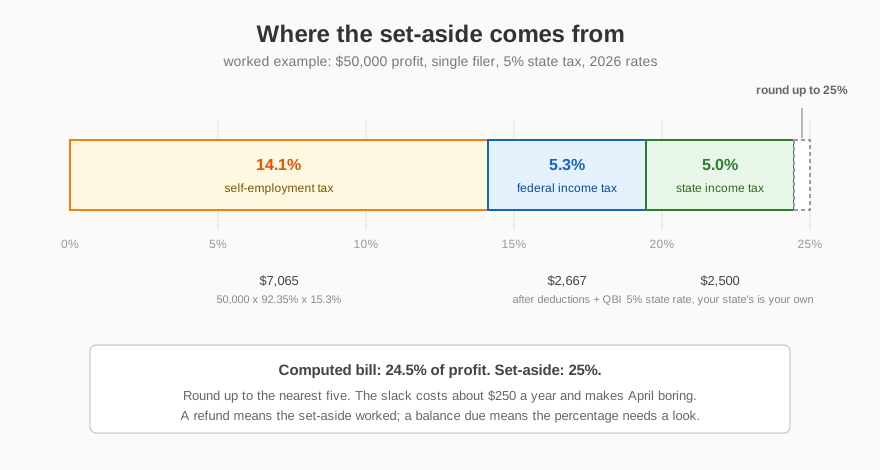
| Step | Arithmetic | Result | |---|---|---| | Self-employment tax | $50,000 x 92.35% x 15.3% | $7,065 | | Half of SE tax deducted | $7,065 / 2 | $3,532 | | Income after SE deduction | $50,000 − $3,532 | $46,468 | | Subtract standard deduction | $46,468 − $16,100 | $30,368 | | QBI deduction (the smaller of 20% of business income or 20% of that remainder) | 20% x $30,368 | $6,074 | | Taxable income | $30,368 − $6,074 | $24,294 | | Federal income tax | 10% x $12,400 + 12% x ($24,294 − $12,400) | $2,667 | | Federal total | $7,065 + $2,667 | $9,732 | | State at 5% | 5% x $50,000 | $2,500 | | Everything | $9,732 + $2,500 | $12,232 |
Divide the everything row by profit: 12,232 against 50,000 is 24.5 percent. So this owner sets aside 25 percent, rounded up to the nearest five.
The same machinery at different scales gives you the anchors worth remembering. A single filer expecting 20,000 dollars of profit in that same 5 percent state computes to roughly 20 percent all-in, because the standard deduction shelters so much of a small profit. Expecting 100,000 pushes part of the income into the 22 percent bracket and the total toward the high twenties. If your state has no income tax, subtract the state slice. This is why I refuse to hand you a number to memorize. The number moves with your life, and now you know how it moves.
Round up. Always round up. The set-aside exists to make April boring, and the cheap insurance is a couple of points of slack. Rounding 24.5 to 25 costs this owner about 250 dollars of short-term liquidity across the year, and buys a bill that is covered to the dollar plus a small refund. Under-round and you get the worst outcome in personal finance: technically right, emotionally bankrupting, paid in panic the following April.
Your assignment takes ten minutes and produces the single most load-bearing number in this module. Take the worksheet, enter your filing status and a realistic profit guess for your first year, and walk the same steps with your bracket and your state's actual rate. If the guess is hard, guess low; the percentage you derive will be slightly high, which is the direction we prefer. Write the final percentage next to your transfer rule from the separation lesson, because the two operate as one mechanism now: deposit lands, percentage moves, remainder runs the business.
Re-run the derivation twice a year and whenever your profit guess changes by a lot. Brackets and thresholds adjust every year with inflation, and the revenue procedure that publishes them comes out each autumn. The habit to build is not knowing this year's numbers forever; it is knowing that you can always re-derive them in ten minutes, which makes you impossible to frighten with a statistic.
Downloads for this lesson
Keep going — you're working through Money & Bookkeeping.
All courses are free ↗