The Money Math of a Jar
Lesson video in production
The full lesson text below is complete — the video version lands with launch.
If you take one lesson from this course financially, take this one, because packaged food punishes anyone who prices by instinct. A service business prices from its own costs upward. A product business prices from the shelf downward: the retailer decides what your product sells for, everyone between you and the shelf takes their contractual share, and whatever is left has to cover your costs and your life. Price from the shelf backward or discover the shortfall after you have ten thousand units in a warehouse.
First, a vocabulary fix that costs people real money: margin is not markup. A retailer taking a forty percent margin on your jar does not add forty percent to your price. Margin is their share of the final shelf price: sell to them at six dollars and retail at ten, and their four dollars is a forty percent margin. Markup would be six times one point four, which lands at eight forty and shortchanges them. Retailers, distributors, everyone in this chain speaks margin. When you hear "the store wants forty," compute it off the shelf price, always.
Now the cascade. Walk one dollar's worth of shelf price backward through the standard grocery chain:
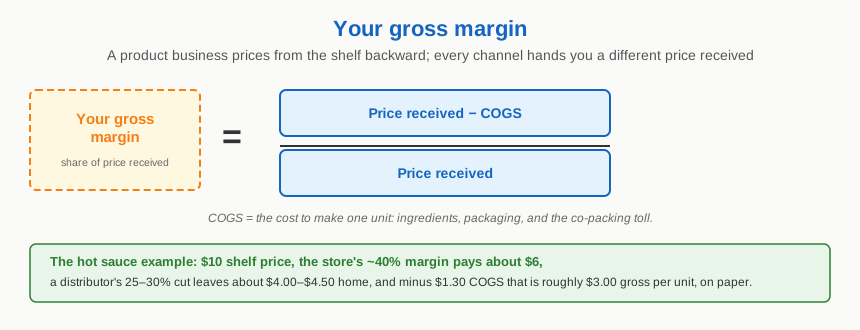
Take a hot sauce that retails at ten dollars, a real operator's numbers. The natural grocery store takes roughly a forty percent margin on grocery items, so it pays you, or your distributor, about six dollars. If a distributor sits between you, they take roughly twenty-five to thirty percent of that, and a broker, if you use one, takes about five percent of net sales. Your six dollars of shelf value arrives home as about four to four-fifty. If the bottle costs one dollar thirty to make, ingredients, packaging, co-packing toll, you gross around three dollars a unit on paper. Then reality takes its bites: promotional discounts you fund, opening discounts distributors demand, damaged goods, and the unsold inventory stores charge back to you. One operator described selling a product through a distributor for one dollar twenty that retailed at two fifty, and being pressured for a ten to twenty percent discount every time a new distribution center opened. The middle is not robbery; it is priced rent for access to shelves you cannot personally stock. Software takes no bite anywhere in that cascade, which is part of why this course carries a four out of ten on AI exposure, per the catalog's AI-exposure method: the jar, the shelf, and the demo table are physical, and the machine-friendly parts, listing copy and ad creative, sit on your cost side where automation helps you.
Margins vary by channel more than by negotiation:
| Channel | Typical retailer/distributor share of shelf price | What you get, roughly | |---|---|---| | Farmers market / your booth | table fee only | ~90%+ of retail | | Your own website | payment + shipping subsidies | retail minus ~10-25% | | Independent store, direct | 30-40% store margin | 60-70% of retail | | Natural chain (direct) | ~40% store margin | ~60% of retail | | Chain via distributor | ~40% store + ~25-30% distributor | ~40-45% of retail | | Club (Costco-type) | 12-14% store margin | ~86% of shelf, but brutal volume terms | | Convenience | ~50% store margin | ~50% of retail |
The shares in that table are operator-reported ranges, not posted tariffs; exact numbers are set account by account. The club line looks like a gift and is not: club brings pallet-scale orders, packaging changes, demo obligations, and operators who priced that expansion put the cash requirement at fifty thousand to one hundred thousand dollars before the first pallet sells.
Trade spend is the line item beginners omit and veterans track weekly. It includes the temporary price reductions that put your jar at seven ninety-nine instead of nine ninety-nine, the free product for demos, the new-account discounts, and where required, slotting or entry fees for shelf space, which industry analyses put anywhere from about two hundred fifty to a thousand dollars per item per store, with one shelf-space analysis putting the average near fifteen hundred per store. Grocery itself earns net margins around one point six to two point one percent, which is precisely why the chain pushes every cost it can onto vendors: your promotion budget is their margin repair kit. Plan a world where fifteen to twenty percent of your gross wholesale revenue converts to discounts and fees, and be pleasantly surprised when a year comes in lighter.
Use all of this as a design tool. Before you finalize the product, pick its realistic shelf price from the category around it, cut it in that channel table's proportions, and see what COGS the survivor can support. If your jar costs four dollars to make and the category tops out at nine ninety-nine retail, treat it as a product design problem and solve it now: reformulate, resize, or repackage until the quarter-of-retail rule holds.
Downloads for this lesson
Keep going — you're working through Start a Packaged Food Brand.
All courses are free ↗