The Real Money Math
Lesson video in production
The full lesson text below is complete — the video version lands with launch.
Four variables, one equation
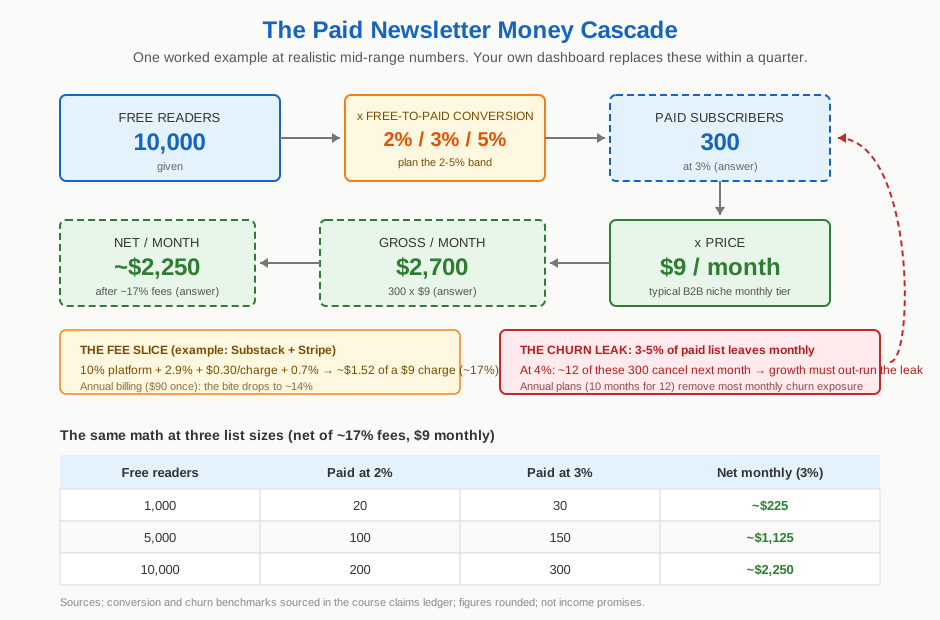
Every paid newsletter income projection, honest or dishonest, is built from the same four numbers: how many free readers you have, what fraction of them pay, what they pay, and how fast they leave. Before looking at any of them, look at how they connect, because the geometry of this business is unusual: it multiplies, so a weakness in any one variable caps the whole thing. A big list converts badly and still works. A small list can convert brilliantly and still pay little. The only input you fully control is price, and it is the smallest lever of the four. That is worth sitting with, because beginners spend most of their anxiety on price and almost none on churn, which is the variable that quietly halves incomes.
Conversion: believe the middle of the range
How many free readers become paid subscribers? This number is the most lied-about figure in the industry, so here is the spread, sourced.
The platforms market optimistically. Substack has historically suggested to writers that something around ten percent of free subscribers converting to paid is a reasonable expectation, and its own materials have cited a six percent average. Then there is the field data. Tech journalist Casey Newton wrote up his first year on the platform and reported landing closer to five percent, against guidance of about ten, and that figure roughly matches what other professional newsletter writers report. Independent analyses of real publication data land lower still: several put the typical free-to-paid conversion in the one-to-three percent range, with around three percent a common average and five percent excellent.
Plan on two to five percent. Not because platforms lie exactly, but because their figures skew toward famous writers with huge existing audiences, which you will not have at month three. An operator from the training world puts it more bluntly: on an inexpensive subscription, roughly five percent of free subscribers paying is what he sees, meaning ten thousand free readers produce around five hundred paid. Same conclusion, middle of the range. What those conversions buy is also the AI story in one line: this course carries a five out of ten on AI exposure, per how this catalog rates AI exposure, because producing a generic issue is nearly free now, and free generic issues are exactly why readers pay for a particular writer's judgment instead.
Churn: the leak in every bucket
Paid subscribers cancel. The commonly used benchmark for consumer subscriptions, published by one of the largest paid newsletters in the world, is that three to five percent monthly churn is good and under two percent is exceptional. Recurly's cross-industry benchmark, drawn from its subscription-network data as of July 2026, now puts overall churn at 3.6 percent across all industries, voluntary and involuntary combined, and its industry tables are labeled in annual terms, so check a benchmark's units before comparing your list to it. Run the implication: at four percent monthly churn, a paid list loses nearly forty percent of itself over a year. Every month's revenue is gross signups minus that leak.
Two design decisions, both covered later in this course, fight churn directly: pushing annual plans at checkout, and never letting a cancellation pass without asking why. For now, just refuse to do the rookie math, the one that projects today's paid count times twelve months with no leakage.
Worked scenarios
With honest ranges, here is what the business pays at three list sizes. Assume a nine-dollar monthly price, charged monthly, and subtract the full fee stack from the fees section below rather than a rounded guess: on that stack a nine-dollar subscription loses about a dollar fifty-two, so each paying reader is worth roughly seven dollars and fifty cents a month net. The right-hand column runs that net number.
| Free readers | 2% convert | 3% convert | 5% convert | Monthly at 3% | |---|---|---|---|---| | 1,000 | 20 paid | 30 paid | 50 paid | ~$225 | | 5,000 | 100 paid | 150 paid | 250 paid | ~$1,125 | | 10,000 | 200 paid | 300 paid | 500 paid | ~$2,250 |
Two observations. First, even the cheerful five-percent column is modest until the free list is large, which is why growth is half this course. Second, the numbers compound: a paid newsletter that holds three hundred paying readers at nine dollars is a real business, and three hundred is reachable in most professional niches inside a couple of years of steady work. That is the honest promise. Not a lottery, a ladder.
One older industry rule of thumb says a monetized free list is worth about a dollar per subscriber per month across ads, affiliate, and products combined. Treat it as a rough landmark only: it comes from marketing-course material, varies wildly by niche, and mostly serves to remind you that a free list has value even before anyone pays a cent. The full version of that idea, a multi-platform audience business with stacked income, is its own course; this one deliberately builds only the inbox asset.
The fees: the slice nobody puts in the ad
Subscription revenue does not arrive whole, and the size of the slice depends on how you bill. If you publish on Substack, the platform takes ten percent of paid subscription revenue, and Stripe takes its processing cut, 2.9 percent plus thirty cents per transaction plus 0.7 percent on recurring charges. Stack those components against the nine-dollar monthly plan in the scenarios above and the arithmetic is explicit: ninety cents to the platform, twenty-six cents plus thirty cents plus six cents to Stripe, about a dollar fifty-two gone from every nine dollars, which is roughly seventeen percent. The fixed thirty cents is what punishes small monthly charges. On the annual tier, ninety dollars billed once, the same stack takes about fourteen percent, which is the quiet financial argument for the annual-plan default covered later in this course. If you publish on beehiiv, the platform takes zero percent of subscription revenue, but the useful tiers are paid: the free plan tops out at 2,500 subscribers and the next tier starts around forty-nine dollars a month. Kit's free plan runs to 10,000 subscribers with monetization included, then starts near thirty-nine dollars a month (Kit pricing scales with list size — check kit.com/pricing for your tier).
None of these are ripoffs; they are different rent structures, and we compare them properly later in this course. The money lesson is just this: model monthly-tier revenue net of roughly seventeen percent, annual-tier revenue net of roughly fourteen, and be suspicious of any income story that quotes gross.
You now know what the business can pay and how slowly it pays it.
Downloads for this lesson
Keep going — you're working through Start a Paid Newsletter.
All courses are free ↗