The Honest Money Math
Lesson video in production
The full lesson text below is complete — the video version lands with launch.
Start with one yard
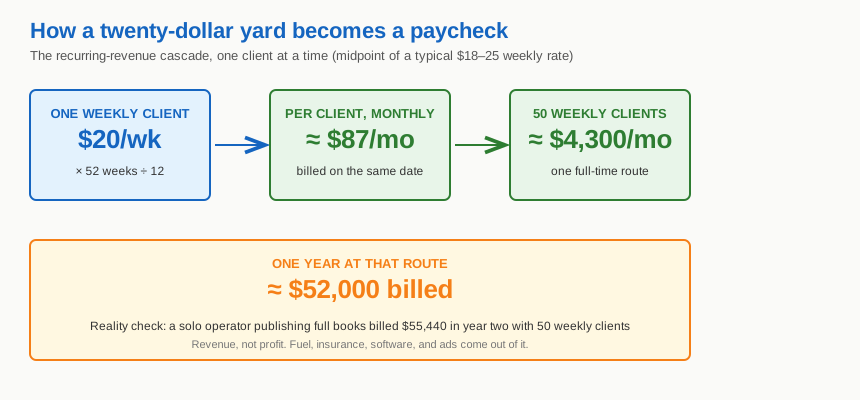
A typical weekly single-dog yard bills at eighteen to twenty-five dollars, per a r/sweatystartup operator publishing live rates, and an r/sidehustle survey thread reports operators collecting fifteen to twenty dollars for a weekly visit. Use twenty as the working midpoint. One client is $20 a week, which is about $87 a month and $1,040 a year.
The client barely notices $20. You cannot live on one client. The business only exists in the multiplication.
Fifty yards is the real unit of measurement
Fifty weekly clients at the midpoint is roughly $4,300 a month billed. That is one dense route, one vehicle, one person, roughly 25 to 30 hours of actual yard time plus drive time and admin. The reality check on this arithmetic is a solo operator who publishes complete financials: in his second year he ended with 50 weekly clients and one apartment complex, billing $55,440 total. The cascade above is not a promise. It is the arithmetic one real person rode.
Now the part the screenshots leave out. That same operator's expenses were $23,882 in year two, leaving $31,558 net. He was also part-time, working around a full-time job. Building alongside a W-2 is how this course's anchor operators both ran it. The money that leaves a route is consistent across operators:
| Expense | Typical at solo scale | Notes | |---|---|---| | Fuel and vehicle | $200-400/mo | Route density is the lever, covered later in this course | | Insurance | $18-29/mo | General liability at start limits, from the carriers' own published prices; covered later in this course | | Software | $0-150/mo solo, ~$346/mo at full stack | Spreadsheet first; the publishing operator's complete stack (route CRM, review tool, business phone, virtual mail) runs $346 a month | | Advertising | $0 to 43% of expenses | The publishing operator's ads hit 42.6% of total expenses in year two; referrals are the escape | | Bags, bleach, gear | $30-60/mo | The cheapest line in any service business |
How fast the money arrives
The first paid yard can be inside your first two weeks, and the acquisition playbook later in this course is built for that. But route assembly is slow multiplication. The Central Texas team fed its route with paid ads from day one, thirty to fifty dollars a day on Facebook plus ten to fifteen on Google, and counted two to five leads a day from the spend. A solo operator working evenings and weekends with no ad budget should plan on adding a handful of clients a week at best, which is why the realistic timeline to a 50-client route is somewhere between six months (aggressive, ads on, full-time hustle) and two years (nights-and-weekends pace).
That is the shape of the trade: weeks to first revenue, months to meaningful income, years to a route you could sell. The runway math before you commit wraps that shape; the route pays, but it pays on its own calendar.
The seasonal fork
Pet waste is a mild seasonal business, and the swing is predictable enough to plan around. The operator with the published books calls March his spring rush and booked his record month, $7,300, in it. Then summer dips, because warm weather makes owners likelier to scoop their own. Fall buries waste under leaves. Winter splits by climate and gets its full rulebook later in this course: in cold markets operators report it as their second-busiest quarter, since nobody wants to scoop in snow, while some clients pause and pay a heavy spring cleanup fee to restart.
Your money system has to absorb that shape. Three rules handle it.
Bill monthly, on the same date. Invoices out on the 1st or the 15th, every month, trains clients to pay and gives you a predictable deposit rhythm.
Hold one month of route expenses in the business account. Fuel, insurance, software, and your own draw for the slowest month, which is usually a summer one. If March doubles and July sags, March funds July.
Treat the spring rush as inventory you earn in February. Sign winter pausers early, pre-book their mandatory first cleanup, and set the expectation before the snow rather than after.
Money math only pays if the work itself is sustainable, and no spreadsheet can answer that question for you.
Downloads for this lesson
Keep going — you're working through Start a Pet Waste Removal Business.
All courses are free ↗