The Rules of the Route
Lesson video in production
The full lesson text below is complete — the video version lands with launch.
Density before dollars
Two operators with identical pricing can earn wildly different hourly rates, and the difference is almost entirely the order of their stops. The rule every route business converges on: all clients in one area get serviced on the same day. An operator in the Central Texas build thread describes a good route day as 20-30 stops; that number is only reachable when the stops are doors apart, and it is physically impossible when they are towns apart.
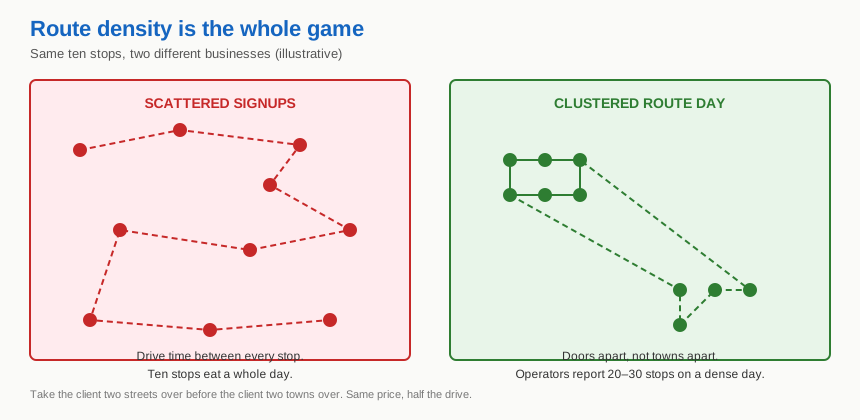
Practical version: assign every client a route day by neighborhood, Monday is the east side, Thursday is the lake streets, and take the signup two streets from an existing client before the signup across the county, even if the distant one found you first. Quote out-of-cluster prospects a modest travel premium and let the price sort it. Every minute of driving you shave off a stop is a minute you get back on every visit, every week, for the life of the client.
Service-day discipline
The route runs on its day. Clients build their week around not thinking about you, and the fastest way to lose a subscription is to slide it. When you genuinely cannot service a yard, weather, locked gate, blocked access, the standard is: photograph the reason, notify the client the same day, and re-book inside the week. Never silently skip. The industry's own post-mortem on churn is blunt: clients leave over missed visits more than anything else.
Gate protocol
You are a stranger in a fenced yard with someone's dog, and the protocol is what makes that acceptable to every party.
Close every gate behind you, immediately, every time, even for thirty seconds. Check the latch twice, once on entering, once on leaving, because a dog out through an unlatched gate is the catastrophic scenario of this business, and it is entirely preventable. Photograph the latched gate as part of your completion proof; operators built this into their standard workflow because it protects you as much as the dog. And you do not enter a yard containing an unrestrained dog you have not met. That is not a policy you bend for a nice-sounding client over text. It is the policy.
Billing rhythm and the tool question
Invoices go out on the same date every month, the 1st or the 15th, from a card on file. This is a one-paragraph policy with an outsized effect on your survival: predictable deposit dates, no chasing checks, and a clean paper trail if a dispute ever lands. Pair it with a simple cancellation policy, any time, effective at the end of the billing month, and a late fee you rarely have to use.
The only question about software is when. Under about 30 clients, a spreadsheet plus a calendar plus your payment processor's recurring billing does everything. Past that, route-management tools in the Jobber family earn their fee, and the publishing operator pays $149 a month for exactly that. The trigger to buy is when the spreadsheet costs you more than $149 worth of your time, not when a YouTuber shows you a dashboard.
Winter rules
Decide your winter policy in October, tell clients in November, and enforce it all season. The cold-market operators who published theirs run a simple standard: light snow is an advantage, waste sits on top and is easier to find than in grass. More than about two inches of fresh snow delays the route a day. You clean what is visible, accessible, and safe, document what was skipped, and you do not chip frozen waste out of ice, because the schedule and your wrists both break. Cleats, layers, backup gloves, and a headlamp are the winter kit.
Clients who pause for winter get told, before they cancel, that spring restarts with a cleanup fee and possibly a wait, because a yard untouched from December to March is a restoration job, not a weekly visit. One national operator reports spring waiting lists of six weeks. You only hold that card if you set the expectation in November, not in April.
The route is designed. Now it needs yards in it, and the first ones come from a door hanger and a Google profile, not a billboard.
Downloads for this lesson
Keep going — you're working through Start a Pet Waste Removal Business.
All courses are free ↗