Your cost floor
Lesson video in production
The full lesson text below is complete — the video version lands with launch.
Your cost floor is the lowest hourly rate at which one hour of work still moves you toward the money you started this business to make. It is not your price. Your price is a market decision. Your floor is arithmetic, and it belongs entirely to you.
Most people have never computed one. They price by asking around, or by taking the last wage they earned at the job they quit and nudging it up. Both methods ignore the two facts that sink new service businesses: you now pay the taxes your old employer paid half of, and a large share of your working hours earns nothing at all.
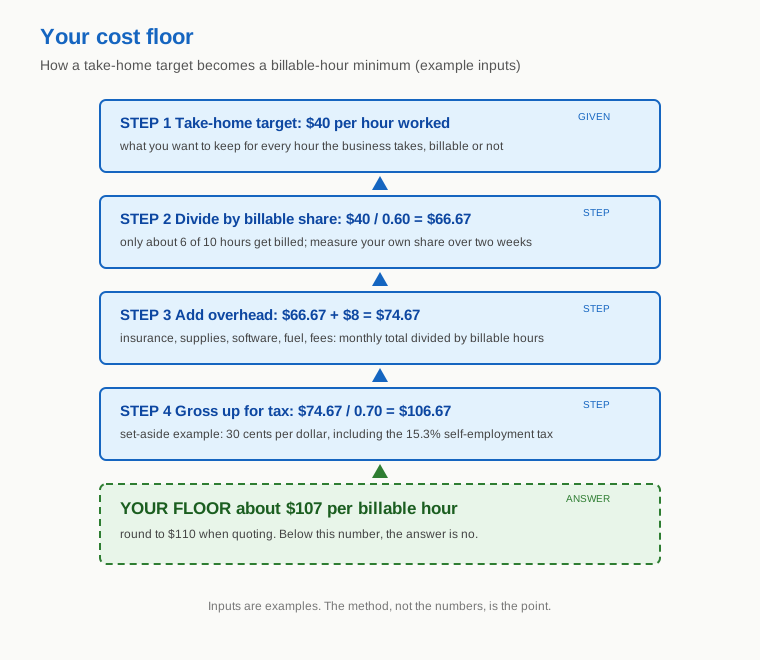
Step one: what an hour must pay you
Decide what you want to keep, per hour, for every hour the business takes from you. Not just the hours on site or on the call. The commute, the quoting, the run to the supply house, the invoicing at the kitchen table. If you left a salaried job, a reasonable starting target is roughly the hourly value of that salary, because that is the life the business has to out-earn for this to make sense. You can adjust it deliberately later. The point is to pick a number now and stop pretending your time is free.
In the worked example here I will use forty dollars an hour as the take-home target. It is an example. Your number is yours.
Step two: divide by your billable share
Now the part everybody skips. Of the hours you work this month, how many can you actually bill? Travel is rarely billable. Quoting is not billable. Bookkeeping, chasing invoices, learning, fixing your own equipment: not billable. Track your time for two weeks, honestly, and you will get your billable share. New operators are often shocked by it, and plenty start lower than they guessed. The worked example here uses six billable hours out of every ten worked; your own share is the one that goes in your worksheet.
If six of every ten hours are billable, each billable hour has to carry the cost of the other four. Forty dollars of take-home per worked hour becomes sixty-six dollars and change per billable hour. That single division is the difference between a business and a hobby with a logo.
Step three: add overhead per billable hour
Overhead is everything the business spends whether or not a client calls: insurance, software and scheduling tools, your phone plan's business share, supplies that get consumed, fuel, payment processing fees, marketing, the accountant. If you are pricing a separate business number, a dedicated line with texting such as Phone.com runs about $15–18 a month; that is an affiliate link — see our disclosure — and a free Google Voice number is the zero-cost alternative while the business is young. List yours for a typical month, total it, and divide by your billable hours for that month. In the example I use eight dollars a billable hour, which is a lean but realistic overhead for a solo operator at this volume.
Step four: gross up for tax
Here is where quitting a job quietly changes the math. As a self-employed person you pay self-employment tax, which is 15.3 percent on net earnings: 12.4 percent for Social Security and 2.9 percent for Medicare, the portions your old employer used to split with you. On top of that you still owe income tax, which varies with your bracket and your state. In the example I set aside thirty cents of every dollar, which covers the 15.3 percent plus a modest income tax slice. Run your own estimate, or ask the person who will do your taxes. Whatever your set-aside rate is, divide by what remains: seventy-four sixty-seven divided by point seven zero is about one hundred seven dollars. The two inputs you carried into this floor, the overhead list and the set-aside rate, each get a deeper home in the money module: the tax set-aside and overhead tracking are that module's own spine.
The floor
Forty dollars an hour of take-home, at a sixty percent billable share, with eight dollars of overhead and a thirty percent set-aside, needs about one hundred seven dollars per billable hour. Round it up when you quote. That is the floor.
If that number made you swallow hard, good. It should. People who planned to charge "about fifty" discover the truth here, and they discover it in a worksheet instead of in their bank account eighteen months from now. The floor is not aspirational. It is the number below which working harder makes the hole deeper.
| Step | Example | Your number | | --- | --- | --- | | Take-home target per worked hour | $40.00 | | | Divide by billable share (60%) | $66.67 | | | Add overhead per billable hour | $74.67 | | | Divide by after-tax share (70% set-aside) | $106.67 | | | Floor, rounded up for quoting | $110 | |
When the floor collides with reality
Sometimes you compute an honest floor and the market around you will not carry it. Do not quietly eat the difference. That path ends with you subsidizing strangers out of your savings. There are exactly three honest moves: lower the take-home target for a defined period while you build volume, cut overhead until the floor drops, or change what you sell or whom you sell it to so the work commands more. Your own market will have its say later in this course.
Downloads for this lesson
Keep going — you're working through Pricing & Rates.
All courses are free ↗