Where to land in the range
Lesson video in production
The full lesson text below is complete — the video version lands with launch.
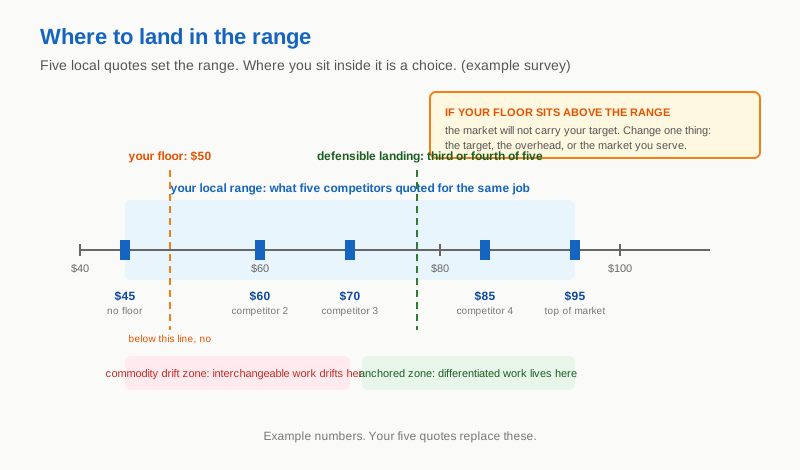
Take your five quotes and sort them low to high. Say they came back at forty-five, sixty, seventy, eighty-five, and ninety-five dollars for the same job. That spread is your market. Somewhere inside it is your price, and the mistake almost everyone makes is assuming the safe spot is the bottom. It is not. The bottom is where prices go to die.
Before anything else, put your floor on the same line. If your floor is fifty, the forty-five dollar competitor is now visible for what it is: someone working below the cost of staying in business, and a future opening in the market. If your floor had come back above ninety-five, that is a different conversation, and an honest one: this market will not carry your target as you currently define either. Lower the target on purpose, cut overhead on purpose, or sell something this market pays more for. Never close the gap silently by absorbing the loss.
Land above the middle
Operators who teach pricing teach landing in the upper part of the range, and they say it with striking consistency across unrelated trades. One home-services operator frames it as targeting roughly the eightieth to eighty-fifth percentile of the local field. A food-truck guide tells operators to sample about ten competitors and price at the third or fourth most expensive. Same instruction, different words: above the middle, not at the top, never at the bottom.
The reasons stack. Above the middle, each client is profitable enough that you can afford to serve them well. You are not the default comparison shopper's first call, so the people who reach you pre-selected for something other than cheapness. And you leave room to maneuver: raises, quiet weeks, a discount with a purpose, all fit under a price at the top of the range. A price at the bottom has nowhere to go but through the floor.
Anchoring: the first number frames every number after it
An anchor is the first number that enters a negotiation. Whoever sets it sets the range the conversation happens inside. If the client opens with "the last person did it for half that," their number becomes the reference point and you are now arguing upward against it. If you open with a confident, itemized number, yours becomes the reference and the conversation happens on your ground.
Three practical rules carry most of the weight. Say your number first whenever you can. Present two or three options instead of one bare figure, with your preferred option sitting in the middle or better, because people choose from menus, not from voids. And anchor on the outcome and the inclusions, not on your hours. Clients do not buy hours; hours invite the client to re-price your time. They buy the clean house, the closed loan, the edited series, the fixed problem. The survey taught you your market's words for that outcome. Use them.
Commodity drift
A commodity is anything the customer cannot tell apart from its competitors. Sugar. Gasoline. The fourth quote for identical work. When a client looks at your quote and sees nothing your five competitors did not also offer, price becomes the only tiebreaker, and tiebreakers only break one direction.
Drift is quiet. Nobody decides to become a commodity. You quote the same words, include the same things, answer the same way, and slowly the market files you as interchangeable. Every undifferentiated quote drifts a little lower. Drift has a second driver besides sameness: work a machine can do commoditizes faster than work it cannot, and the will AI eat this business guide owns the method for scoring that exposure. The cure is not a gimmick; it is making the differences visible: what you include that others charge extra for, how fast you respond, what happens when something goes wrong. The survey grid already told you where the market is uniform. Anywhere the whole field is uniform is a place you can differentiate, because the standard is sitting still.
And understand the signal cheapness sends. Operators say it plainly: when customers see the cheapest price in the market, they read it as the shakiest work, not as a bargain. A bottom-of-range price does not just lose you money per job. It repels the exact clients who would have paid your real price.
Choosing your spot
Put it together. Floor of fifty, range of forty-five to ninety-five, so the market carries your target. Now choose, on purpose: the anchored zone between the third and fourth quote, with a flat number stated confidently, inclusions itemized, options offered. Write down why you chose that spot in one sentence. That sentence becomes part of the two-sentence defense you will sharpen throughout this course.
Then the practice begins. A price on paper is not a price yet; a price becomes real the first time you say it out loud to another human being and then hold still.
Keep going — you're working through Pricing & Rates.
All courses are free ↗