The Retainer Ladder
Lesson video in production
The full lesson text below is complete — the video version lands with launch.
Most new VAs price by asking what other VAs charge and subtracting a little courage. The result is a rate chosen by fear, defended by apology, and abandoned by discount. This lesson replaces that with a structure: three rungs, each with a job to do, and a floor-rate calculation underneath all of them that tells you what you can afford to charge before a single prospect answers.
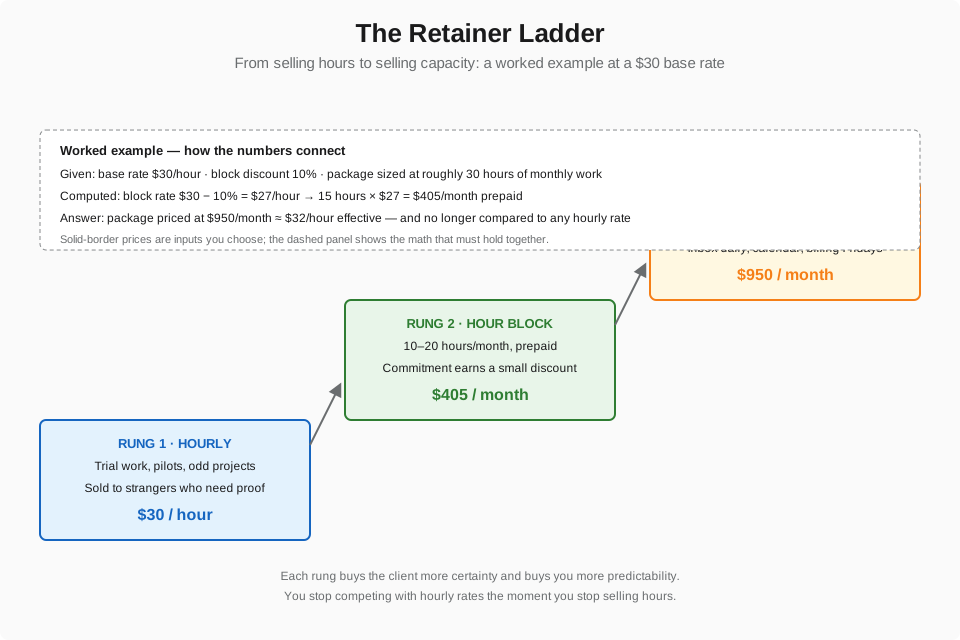
Rung one: hourly
You sell hours for trial work, pilots, and one-off projects, at a rate inside the market band from The Honest Money, call it twenty-five to sixty dollars an hour for a US generalist, with niche depth moving you up the band. The hourly rung exists for one reason: strangers need a low-commitment way to test you. It is a bridge, not a home.
Two rules keep the bridge from becoming a residence. First, hourly work is always scoped in writing: what is included, what is not, and a cap after which you check in. Second, hourly clients get migrated or ended within a couple of months. An hourly client you have served for a year is a retainer client you never asked.
Rung two: the hour block
A prepaid block of hours each month, typically ten to twenty, sold at a modest discount off your hourly rate, on the order of ten percent. The discount is not a favor; it is what the client pays for and what you get paid for. They are buying guaranteed access to your capacity. You are buying a predictable month.
Prepaid is the load-bearing word. The block is invoiced on the first and paid before the work. Unused hours expire rather than banking into next month, stated in the agreement from Legal, Money, and the Contract, because banked hours turn into a debt you owe yourself and a discount you gave away for nothing.
A floor applies: do not sell blocks under roughly ten hours a month. Small retainers carry nearly the overhead of large ones, the onboarding, the context-switching, the reports, and a five-hour client often behaves like a twenty-hour client in terms of interruptions. Ten hours is where a block starts paying for its own admin.
Rung three: the capacity package
The top rung stops selling time entirely. You sell a defined monthly outcome: inbox answered daily inside business hours, calendar managed with a written conflict check, billing out every Friday, a weekly one-page report, in one niche you already know, at a flat monthly fee.
Packages are where this business stops being compared to anything. A four-dollar offshore hour and a scheduling bot both compete on hours; "your operations run, and here is the report proving it" competes on nothing but you. Packages also carry the highest effective rate, because you are paid for judgment and accountability, and the efficiency you build with repeat systems belongs to you, not to the client's discount.
Price packages from three inputs: your floor rate, the hours the outcomes realistically take (measured with the time tracker, not guessed), and the niche premium. In the diagram's worked example, a thirty-dollar base becomes a nine-hundred-fifty-dollar package covering roughly thirty hours, about thirty-two dollars an hour effective, before counting the value of the certainty you sell. Package prices end in round, confident numbers. Ninety-five dollars an hour is a consultant; nine hundred fifty a month is infrastructure.
The floor rate
Every rung sits on one number: the least you can charge per billable hour without losing money on the year. Compute it backward, from life, not from the market.
Start with the monthly income the business must produce. Add the extras a job used to carry: your health premium, the retirement match nobody pays you, the tax sweep from Legal, Money, and the Contract. That is your true monthly target. Divide by realistic billable hours, which is not 160; A Real Week put the billable ratio at 60 to 75 percent, so plan on 80 to 110 billable hours a month at maturity, fewer in year one.
Worked example: a five-thousand-dollar true target divided by a hundred billable hours is a fifty-dollar floor. At that floor, a ten-hour block discounted ten percent still clears forty-five, and a package covering thirty hours must start above thirteen-fifty. If those numbers feel high, the finding is not "discount," it is that the business needs either a higher-value niche, better packaging, or more clients, and better to know it now.
One more discipline: publish nothing you cannot defend in one sentence. "My rate is forty an hour; blocks of ten hours a month run three-sixty prepaid; most clients start on the nine-hundred operations package." If a prospect hears that as expensive, they were never your client.
Where do these prospects come from? Closer than you think.
Downloads for this lesson
Keep going — you're working through Start a Virtual Assistant Business.
All courses are free ↗