What creators actually make
Lesson video in production
The full lesson text below is complete — the video version lands with launch.
Start with the distribution, because every guru screenshot you have ever seen was drawn from the far right tail of it. Goldman Sachs Research puts the creator economy at roughly $250 billion, heading toward $480 billion by 2027. The same research estimates only around 4 percent of creators earn more than $100,000 a year. Surveys of working creators land in the same place from the other side: in a 2025 report, more than two-thirds of creators made under $1,000 in a year, and even among people calling themselves full-time, nearly half earned under that line.
Read those two facts together. The market is enormous and the median participant earns almost nothing. Both are true, and your plan has to survive contact with the second one.
Why the median is so low
Not because the audience business is fake. Because most entrants quit inside the first ninety days, publish without a niche, and monetize nothing. They post into the void, see no money, and stop. The bar is rising under them at the same time: this stack carries an AI-exposure rating of six out of ten, per how this catalog rates AI exposure, because generic content is now nearly free to produce, and free generic content is exactly what buries the publishers of it. The stack model exists precisely to break that loop: services bring the first dollars while the audience is still small, and every later layer has a trigger condition you can check, not a follower count you can only dream about.
The old framing that makes the rounds is still the cleanest: Kevin Kelly's 2008 essay 1,000 True Fans argued that a creator who keeps the full $100 a year from each of a thousand devoted fans earns $100,000. The number is a thought experiment, and keeping "the full $100" is the hard part, since platforms and payment processors take cuts at every stage. But the shape is right. Depth beats reach. Five thousand people who trust you beat a hundred thousand who scroll past you.
A worked scenario
Here is the arithmetic on a modest, specific case: 5,000 email subscribers and 20,000 views a month on the engine.
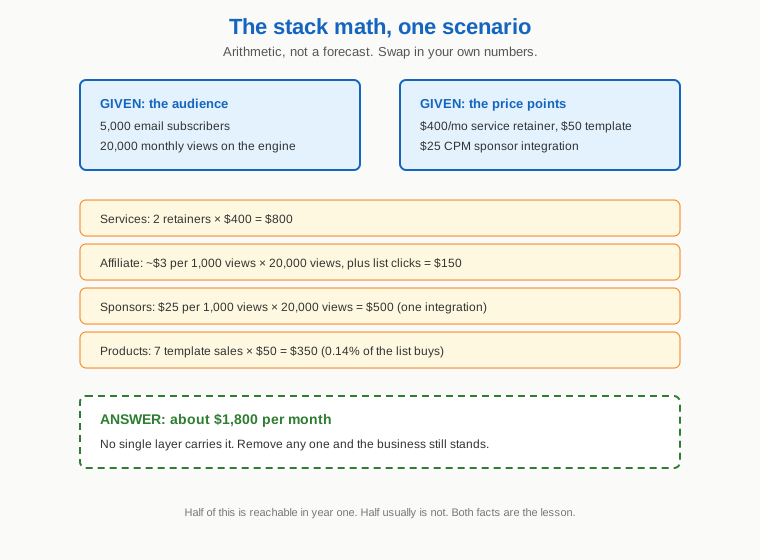
Walk the layers. Two service retainers at $400 a month is $800. Affiliate commissions run roughly $3 per thousand views plus list clicks, call it $150. One sponsor integration priced at $25 per thousand views on 20,000 monthly views is $500. A $50 template selling seven copies, which is 0.14 percent of the list buying in a month, adds $350. Total: about $1,800 a month.
Notice what the scenario is not. It is not one income stream that either hits or misses. Kill the sponsor layer and you still have $1,300. That resilience is the entire argument for stacking. Reddit creators posting real monthly breakdowns show the same shape from the other direction: one operator reported $973 in ads, $3,684 in sponsorships, $190 in affiliate income, and $21 in memberships in a sample month. Ads are a fifth of it. The stack is the business.
What the platform pays you
Know the revenue shares, because they cap the middle layer. YouTube pays creators 55 percent of ad revenue on long-form video and 45 percent on Shorts, and it admits you to that program at 1,000 subscribers plus either 4,000 watch hours or 10 million Shorts views in the window. Ad payout money is real, recurring, and the least controllable income you will have. Treat it as a dividend on the audience, never as the plan.
Money questions answered honestly make the rest of the course easier to trust. Your audience is already fixed from the fit check, so the next decision is the machine itself: the engine format that serves that audience with the least friction, and the production system around it.
Downloads for this lesson
Keep going — you're working through The Creator Income Stack.
All courses are free ↗