The arithmetic of ten
Lesson video in production
The full lesson text below is complete — the video version lands with launch.
Ten customers is not a milestone you wait for. It is an equation you can write on one line:
customers = attempts × answer rate × close rate
Attempts are contacts you actually made. Answer rate is the share that respond with interest. Close rate is the share of answers that become paying customers. Multiply the three and you get customers per week. The rest of this module exists to move that math from a guess to a measurement. The equation deliberately stops at customers per week: what a close is worth is the pricing module's number, and it multiplies everything on this line.
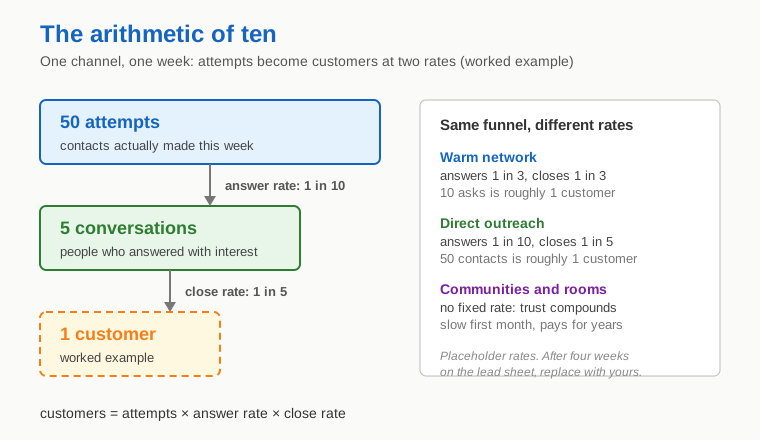
The sobering worked example
Use placeholder rates first, borrowed from the ranges in the outreach lesson, until your own sheet produces real ones. Say direct outreach answers run one in ten and closes run one in five. Then one customer takes fifty attempts, and that is the whole funnel: fifty contacts produce five conversations produce one customer. Fifty to one. Run the same math on a warm list, where one in three answers and one in three of those close, and ten personal asks land you roughly one customer. The rates differ by channel, the funnel never changes shape.
| Channel | Attempts each week | Answer rate | Close rate | Customers a week | |---|---|---|---|---| | Warm network | 15 personal asks | 1 in 3 | 1 in 3 | about 1 and a half | | Direct outreach | 50 contacts | 1 in 10 | 1 in 5 | about 1 | | Communities | presence in 3 rooms | compounds | compounds | not a direct line |
Those rates are placeholders, labeled as such, and the table earns its keep when you replace every one of them with numbers from your own lead sheet after a month of real work. Until then, the placeholders keep you from two errors: quitting because week one produced silence, and coasting because week one produced a fluke.
Back-solving your weekly number
Set the goal first. Ten customers in five weeks is a sane opening target for a full-time effort, and ten in ten weeks fits a build-while-employed pace. The same back-solve runs on your personal numbers: runway math turns severance and savings into months you can count, the way this equation turns ten customers into contacts per week. Divide to get customers per week, then invert the equation:
attempts per week = customers per week ÷ (answer rate × close rate)
Ten in five weeks means two customers a week. At placeholder rates, that is about ten warm asks and thirty five outreach contacts a week, roughly one working afternoon. The point of writing the number is that it converts anxiety into a quota. You are no longer hoping for customers. You are filling this week's quota and counting.
Two honest footnotes belong on the equation. First, rates drift as your messages improve, so the number you compute now is a ceiling on effort, not a promise. Second, some businesses run long cycles where a customer is months of courtship rather than a week of volume, and the arithmetic still holds, stretched: attempts and answers still precede customers, just on a slower clock. The long B2B cycles have their own pacing, and the courses for those businesses set honest checkpoints.
What ten prove
More than any survey, more than any plan. Ten paying customers prove that strangers or near-strangers will exchange money for this, at a price you set. They expose the real objections, the ones people actually say, which never match the ones you imagined at midnight. They shake out your operations: scheduling, delivery, the awkward first version of your service, all of it debugged on live humans who were warned you were new. And they mint your first proof, reviews, testimonials, before-and-afters, the evidence every later channel runs on.
Ten also sit at the base of a brutal funnel you should see once. Of U.S. private-sector business establishments born in March 2013, 34.7 percent were still operating in March 2023, per the Bureau of Labor Statistics. Roughly one in three. The businesses that die mostly die quiet and early, from exactly the failure this module fights: not enough specific people contacted, counted, and followed up. The ten do not guarantee you are in the surviving third. They are how you find out which third you are in while the stakes are still small.
The ten are a data collection exercise
The attitude I want you to carry past this lesson: your first ten customers are not a victory lap. They are instruments. Each one tells you which channel produced them, what message they answered, what almost stopped them, and what they said when you asked why they chose you. Capture all of it in writing, the day it happens. Your real rates, the ones that retire this lesson's placeholders, live in that record, and they are what make the arithmetic yours.
Downloads for this lesson
Keep going — you're working through First 10 Customers.
All courses are free ↗