The loaded cost
Lesson video in production
The full lesson text below is complete — the video version lands with launch.
Ask an owner what their new hire costs and they will say the wage. The wage is the smallest honest number in the pile. Every number below is current, sourced, and stacked in the order you will actually pay it.
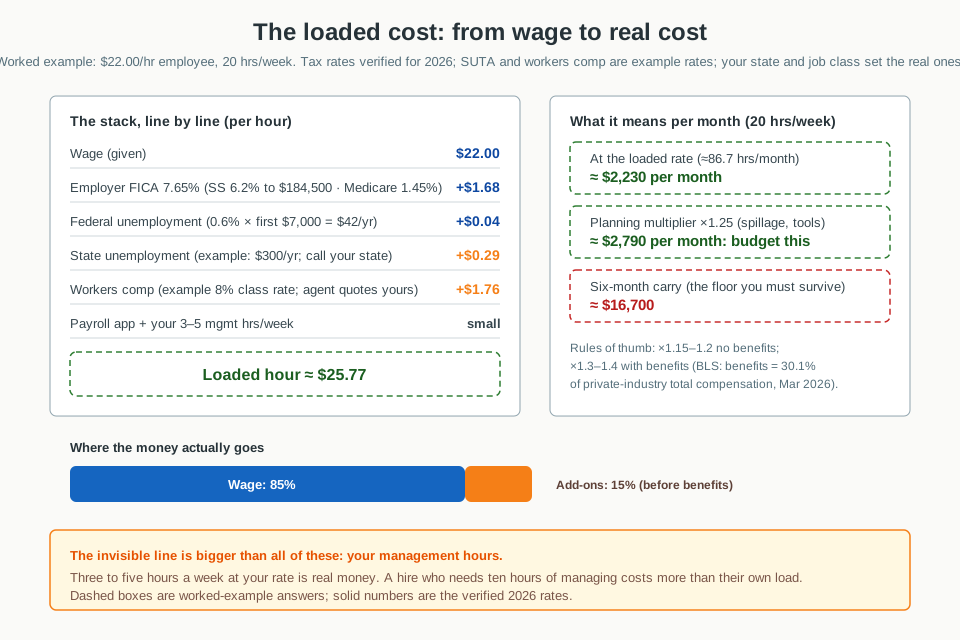
The stack, line by line
Work a concrete example: a twenty-two dollar an hour employee, twenty hours a week, which is the shape most first hires actually take.
Employer FICA: 7.65 percent. Social Security at 6.2 percent on wages up to 184,500 dollars in 2026, and Medicare at 1.45 percent with no cap. The employee pays a matching 7.65 out of their check; you pay yours on top of the wage, to the government, every quarter. On twenty-two dollars that is one dollar sixty-eight an hour. There is no threshold and no first-year exemption. The first dollar of wages carries it.
Federal unemployment, FUTA: 0.6 percent effective. Six percent on the first seven thousand dollars of wages, with a credit of up to 5.4 percent against state unemployment taxes you pay, so in a state with a clean credit the effective rate is 0.6 percent. That is forty-two dollars per employee per year. Small, and easy, and it exists only because you also pay the state side.
State unemployment, SUTA: varies. Your state sets the rate, new employers start at a standard rate that often lands in the low single digits on a wage base of roughly the first ten to twenty thousand, and your experience with claims moves it over time. Call your state's unemployment agency before you hire and ask two questions: what is a new employer's rate, and on what wage base. One phone call, and the answer is yours rather than a guess.
Workers compensation: set by state and job class. Nearly every state requires it once you have employees, and the rate depends on what the person physically does. Office help is cheap; roofers and tree work are not. Your insurance agent quotes it in minutes. Budget it before the offer, not after the injury.
Payroll software. You can run payroll by hand the way people can rewire a house by hand. Payroll apps file the deposits and the quarterly returns for a modest base plus a few dollars a person. Gusto, the payroll app many small operators start on, lists a contractor-only plan at thirty-five dollars a month plus six dollars per contractor; full W-2 plans cost more. Whatever you choose, it is the cheapest line in this stack.
Your management hours. The invisible line and the biggest one. Scheduling, training, checking work, the weekly one-to-one, the payroll hour. In the first ninety days, plan on three to five hours a week of your time, and at your rate that is real money. A first hire who needs ten hours a week of managing can quietly cost more than their own wage premium. That payroll hour lands inside a system this catalog's money module owns: the weekly money hour absorbs it, and employer taxes become a line in the set-aside math.
Where the stack lands
Add the verified lines for our example. Wage twenty-two dollars. FICA one sixty-eight. FUTA about four cents an hour. SUTA at an example three hundred dollars a year, about twenty-nine cents an hour. Workers comp at an example class rate of eight percent, one seventy-six. The wage becomes twenty-five dollars and seventy-some cents before your management time, and call it twenty-six with it.
Rounded rules you can carry in your head: the loaded-cost band for a first hire runs about 1.15 to 1.3 times the wage, and a stack without benefits lands at the bottom of it, 1.15 to 1.2. Offer benefits and paid time off and you climb toward the top of the band and past it. Those are not guesses pulled from air; the Bureau of Labor Statistics puts benefits at thirty point one percent of total compensation for private industry workers, and the low end of the multiplier is what a lean first hire without benefits actually carries.
Monthly, the twenty-hour week example lands around two thousand two hundred to twenty-three hundred dollars. With a planning multiplier of 1.25 for spillage, tools, and the things you will forget, budget about twenty-eight hundred a month.
The contractor comparison, honestly
A contractor looks cheaper on this stack, and in pure load terms they are: no FICA on your side, no unemployment, no workers comp on your side, no overtime law. That is because the contractor carries those costs themselves and prices them into their rate. A contractor at thirty-five dollars and an employee at twenty-five loaded are not thirty-five versus twenty-five. They are close to thirty-five versus twenty-six, plus different obligations, different control, and different risk.
Cost is not what decides employee versus contractor. The working relationship decides, and the law, not you, grades the relationship. That question is important enough to get its own full treatment next in the course, because getting it wrong is the most expensive mistake a first-time hirer can make.
One more number worth sitting with before that: the example hire costs about twenty-eight hundred a month, every month, before they generate a single new dollar. The trigger math from earlier told you whether freed hours, redeployed and sold, clear that line. If they do, this stack is simply the price of the machine. If they do not, no amount of wishing converts payroll into profit.
Downloads for this lesson
Keep going — you're working through First Hire.
All courses are free ↗