The trigger math
Lesson video in production
The full lesson text below is complete — the video version lands with launch.
You now know the only honest reason to hire: buyable hours crowding out only-me hours, at a cost you can count. That reason has to survive arithmetic. Here is the arithmetic.
Step one: the hours audit
For two weeks, log your working hours in three columns. Not roughly. Actually log them, at the end of each day, while the day is still honest. Building dual-track while employed, the audit runs inside a fixed budget: fifteen to twenty honest hours is that guide's whole frame, and the trigger math still applies inside it.
Column one: only-me hours. Sales conversations, pricing decisions, quality standards, key client relationships, the judgment calls that make the business yours. Nobody else can do these yet, and some of them nobody else should ever do.
Column two: buyable hours. Delivery work a trained person could do to your standard, scheduling, confirmations, supply runs, invoicing, the email inbox, setup and teardown, editing passes, packaging, follow-ups that follow a script.
Column three: wasted hours. Fixing your own mistakes, doing things the long way because you never built the shorter way, work that exists only because a system does not.
Most owners doing this for the first time discover two uncomfortable things. The buyable column is bigger than they guessed, and the only-me column is smaller. You are probably not as irreplaceable as your calendar says. That is good news. Irreplaceable is a trap.
Step two: price your freed hour
A freed hour has no value by itself. This is the single most expensive misunderstanding in small-business hiring, so I will say it plainly: hiring buys you hours, and hours are worthless until you assign them to something that earns.
The value of a freed hour is what you redeploy it into, at the margin. Two candidates only.
Redeploy into billable delivery at your rate. If you bill sixty-five dollars an hour and demand exists to absorb eight more delivery hours a week, a freed hour is worth sixty-five dollars.
Redeploy into sales and growth work. Harder to price, but the question is concrete: what did your last two hours of active selling produce? If a sales hour reliably generates a client worth four hundred dollars of margin, that is your number. If you have never tracked it, this is worth knowing before you hire, not after.
The redeployment must be real. Write down where the freed hours go before you post the job. "More capacity" is not a destination. Eight hours a week of freed time that drifts into tidying your inbox and running errands has bought you an employee to do nothing with.
Step three: the buy-back rate
Now the other side. What does it cost to buy an hour back?
Take the market wage for the buyable work in your area. Add the load: employer taxes, insurance, your management time. Later in the course that stack gets broken down line by line, so here you only need the working rule. For a first hire without benefits, the loaded hour runs roughly 1.15 to 1.3 times the wage. A twenty-five dollar wage buys back at about twenty-nine dollars loaded.
Then the test is one line:
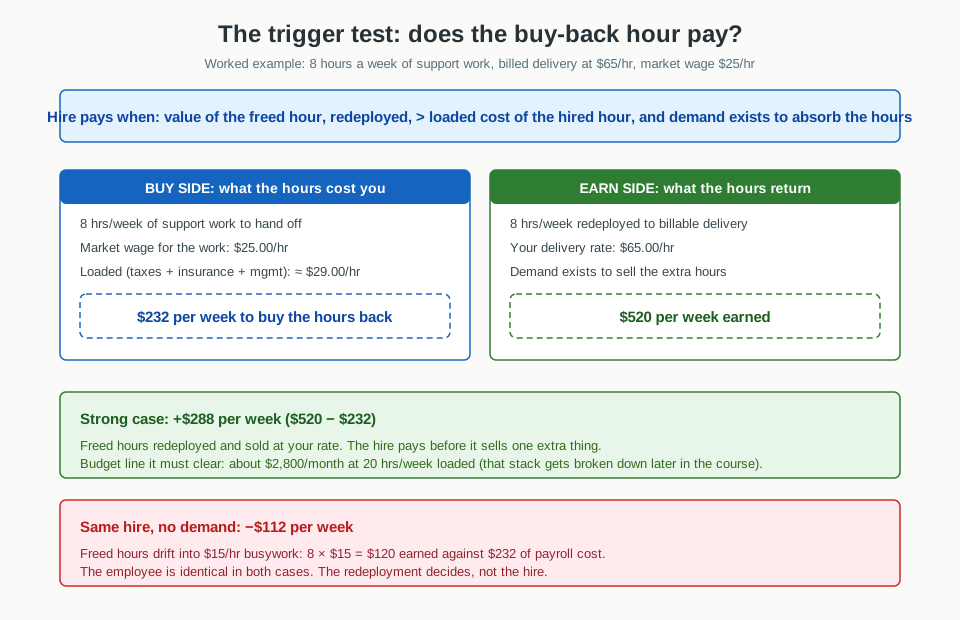
Hire pays when the redeployed value of the freed hour is clearly above the loaded cost of buying it, and demand exists to absorb the freed hours.
The demand half is its own discipline, and the demand check before the hire is the first-customers module's job: a pipeline you built and counted on paper before payroll ever tests it.
Run it with real shape. Say you bill sixty-five dollars an hour and eight hours of your week go to support work the market pays twenty-five an hour for.
Buy side: eight hours at twenty-nine dollars loaded is two hundred thirty-two dollars a week. Earn side: eight hours redeployed into delivery at sixty-five is five hundred twenty dollars. Net: plus two hundred eighty-eight dollars a week, before the hire has sold a single extra thing.
Now the same hire in a business with soft demand. You free eight hours, the extra delivery hours do not exist, and the freed time soaks into low-value busywork worth fifteen dollars an hour. Earn side: one hundred twenty dollars. The same hire, the same wage, and it now costs you a hundred twelve dollars a week plus your management attention. The hire did not change. The redeployment did. And if a layoff is what set you up in business, the demand check extends to your own savings: your runway in months is the number to hire against, never a feeling about how the month went.
That is the whole secret of why identical hires pay brilliantly for one owner and bankrupt another. The employee is the same. What differs is whether the freed hours were assigned, sold, and protected.
The twenty-dollar test
Operators who have made this move repeatedly land on a plain-language version of the same math. Nick Huber, who built a lawn business and then much larger companies, describes his first hire at fourteen years old: a flyer in two hundred school lockers offering twelve fifty an hour for mowing. The kid he hired turned three and a half hours of work into two and a quarter, and Huber's summary rule is blunt. If you are doing work you could pay somebody twenty dollars an hour to do, it is time to hire. He also holds that you should be billing two to three times what you pay the person doing the work. That ratio is the buy-back test from the other direction, and you will find each business course in this catalog applies it to its own rate tables.
The three honest triggers, restated as numbers
Turning away revenue you could serve: count it for a month. Refused work above your buy-back cost, twice your payroll line, is a green light.
Quality slipping on only-me work: estimate the cost of one lost client against a month of payroll. The comparison is usually fast.
Growth work starved: price your last sales hour as above. If the answer is more than about four loaded hours of help cost, the math is done talking.
And the fake triggers fail all three tests by definition: fatigue, the write-off myth, wanting to feel like a real company. Kill the tax one now if it is living in your head. A deduction reduces taxable profit; it does not create money. Spending a dollar to avoid thirty cents of tax is not a strategy, it is a leak. Nobody ever payroll'd their way to wealth on write-offs.
If the arithmetic says not yet, the answer is to fix the cheaper lever instead: raise prices, cut scope, automate the recurring task, or batch it. Those moves often clear the calendar enough that the honest triggers quiet down, and they cost nothing but a decision. Re-run the audit next quarter. Triggers move.
If the arithmetic says go, the next thing you need is the true cost of the person, stacked honestly from the wage up. That is where we go.
Downloads for this lesson
Keep going — you're working through First Hire.
All courses are free ↗