The first ninety days
Lesson video in production
The full lesson text below is complete — the video version lands with launch.
The first ninety days decide whether the hire compounds or evaporates, and the uncomfortable truth is that the variable is you. The person you hired arrives as raw capability. What they become is a function of the system you run.
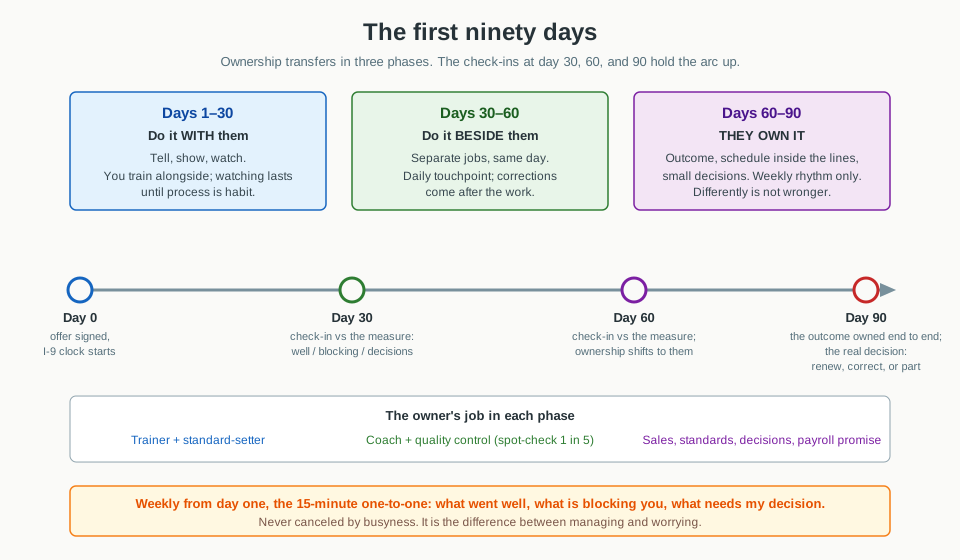
The arc
Days one to thirty: do it with them. You work alongside. Training operators use a sequence worth stealing wholesale: tell, show, watch. Tell them the process in written or video form before the work starts. Show them live, yourself, at full speed and then at teaching speed. Then watch them do it, repeatedly, until the process is habit rather than performance. The step everyone skips is the watching. "You good? You got it? Go get 'em" is not training; it is hope with a wave. Watch long enough that following the process is what their hands do without asking their brain.
Days thirty to sixty: do it beside them. Separate jobs, same day. They deliver; you deliver, sell, or build, with a short daily touchpoint. Your corrections now come after the work, not during it, and your job is to catch problems while they are still small enough to be conversations rather than incidents.
Days sixty to ninety: they own it. The outcome, the schedule inside the boundaries you set, the small decisions. You move to a weekly rhythm, and you resist, with real discipline, the urge to take the work back when they do it differently than you would. Differently is not wronger. The measure from the outcome statement is the referee, nothing else.
The three check-ins named in the offer letter hold the whole arc up: day thirty, day sixty, day ninety, each one a short conversation against the outcome statement. What is going well. What is in your way. What needs my decision. Written down in three lines. On day ninety you are making a real decision, renew or correct or part, and the ninety days of notes are what lets you make it honestly.
The weekly one-to-one
From week one, a standing fifteen minutes, same time weekly, phone or in person, not cancelable by busyness. Three questions, same three every week.
What went well? You need to know what is working so you reinforce it on purpose instead of only meeting at problems.
What is blocking you? This question is where the gold is. A first hire sits on obstacles for weeks out of politeness. Fifteen honest minutes weekly clears what would otherwise become quiet failure.
What needs my decision? This one trains the escalation boundary from the role definition, and it is how you stay the decision-maker without becoming the bottleneck again.
Managers in big companies are taught this cadence over semester-length courses. You can run it with a timer, and it is the difference between managing and worrying.
Quality control replaces your presence
You cannot be everywhere once someone else does the work, so quality control has to become a system instead of a feeling. The pattern that works at one employee is the same one that later runs whole crews. Crew training is the scaled version of this arc, and training a lawn crew is the lawn course's own subject, the trade behind the first-hire story in the trigger-math lesson.
Checklists make the standard checkable. The end-of-job checklist, the delivery checklist, the close-out checklist: the floor under the quality, in writing, ticked physically. Photos where the work is visual, before and after. A spot check of roughly one job in five during the first two months, announced, so it reads as coaching and not surveillance. And your review stream, since customers are already grading the work publicly; reviews mentioning the new person are your earliest quality alarm. Turnover work tightens the measure further, because the host grades every clean against the listing photos: turnover teams are the turnover-cleaning course's version of this whole arc.
None of this is distrust. It is how the standard survives your absence, and it is the foundation for every later hire, who will be trained by the checklists and the first person rather than by you.
What you stop doing
Now the part of this module nobody else will say to you plainly. When the hire takes the buy-back hours, those hours leave your calendar, and your calendar does not forgive a vacuum. The failure mode is silent: the freed Tuesday afternoons fill, within three weeks, with your old habits plus new interruptions, the sales calls you promised never get made, and now you are paying payroll to feel just as buried.
The buy-back sentence from the role definition is your defense. Those specific hours now have a specific assigned purpose, in writing, in your calendar, by name. Eight hours of freed time becomes "Tuesday and Thursday, two to six: sales calls and the commercial bid," defended like a client meeting, because it is one.
You also stop doing the work itself, and this one is emotionally harder than it sounds. The work you handed off was the work you were good at. There is a real boredom that comes from doing only the hundred-dollar work, the sales and standards and decisions, and some owners quietly sabotage good hires by drifting back into the comfortable ten-dollar work. When you feel that pull, the correct response is a new client, a new offer, a higher price, a second hire's trigger math, not taking the broom back.
What you never stop doing: the standard, the key relationships, and the payroll promise. Everything else can leave your hands.
There is one mistake left that beats all of these, and it is the one this module exists to kill. It is the difference between handing someone a task and handing them an outcome, and it deserves its own full treatment.
Downloads for this lesson
Keep going — you're working through First Hire.
All courses are free ↗