The honest money
Lesson video in production
The full lesson text below is complete — the video version lands with launch.
This lesson puts real numbers on both sides of the trade you read about in What junk removal actually is. Every figure here has a source, and the sourced ranges are wide, because disposal costs and price tolerance vary enormously by region. Treat the numbers as scaffolding and replace them with your own transfer station's fee schedule, which you will collect in your first week.
What jobs pay
The market has settled on volume pricing with a minimum charge. Across published 2025 data: typical minimums run about $100 at the low end, single bulky items run $60 to $150, and most homeowners spend $150 to $350 per job, which works out to roughly $1.50 per cubic foot. The franchise ladder runs small loads $107 to $396, half loads $396 to $600, full loads $600 to $1,099. Independent operators on r/sweatystartup consistently recommend a minimum of your own around $200, with $250 to $400 per load reasonable in an average-income area, and a completely full 7 by 14 by 4 foot trailer billing near $800.
What disposal costs
The national average landfill tipping fee hit $62.28 per ton in 2024, a record jump of ten percent in one year. Averages hide the spread: Los Angeles County charges $85.91 per ton for municipal waste and $100.91 for bulky items, while parts of the Southeast run in the forties. Most facilities also carry a gate minimum of roughly $12 to $35 per load — county fee schedules show $15 in Norfolk, Nebraska, $15 in Ada County, Idaho, $25 in Delta County, Colorado, and $25 in Greensboro, North Carolina — and surcharge items stack on top per piece: mattresses commonly add $10 to $35 each, tires a few dollars to $20, and refrigerant appliances extra. You will price those pass-through items line by line later in the course, when quoting gets its full treatment.
One job, all the way down
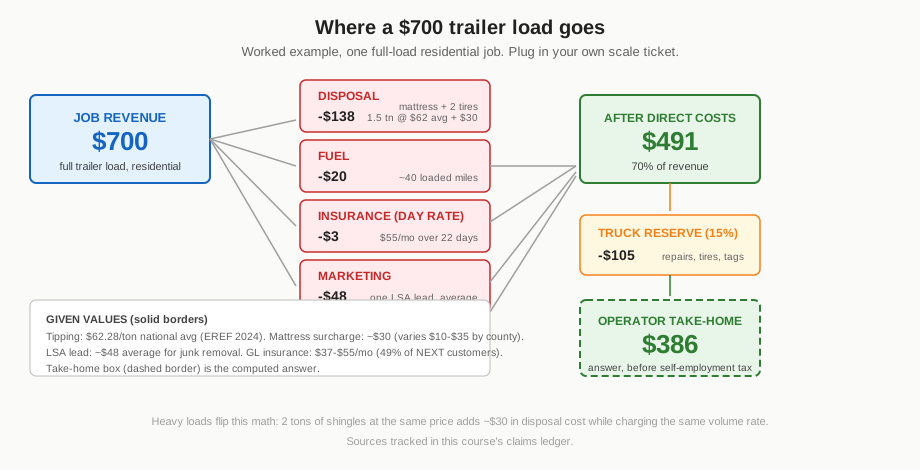
Here is a full trailer load in a mid-market town, charged at $700. The load weighs a ton and a half at the scale, about $93 at the national average rate. It contains one mattress, a $30 surcharge in many counties, and two tires at a few dollars each. Disposal total, roughly $138. Fuel for forty loaded miles runs about $20. A day-slice of general liability insurance, $55 a month spread over 22 working days, is $2.50. One Google Local Services lead at the junk-removal average of about $48 brought the job in. After direct costs you keep roughly $490, about 70 percent of revenue. Skim 15 percent into a truck repair reserve, because the transmission does not care that it is a good month, and the job pays you around $390 before self-employment tax.
Now run the same job as two tons of roofing shingles at the same $700. Disposal jumps by about $30 or more, but the real problem is what shingles do to your truck and your day. Weight is the cost side of every decision, which is why trade startup guides state the rule as a multiplier: take your disposal cost per load, multiply it by two or three, then add your labor. That covers the weight you underestimated, the surcharge you forgot, and the second dump run you did not plan.
What operators actually make
Two real data points, both from r/sweatystartup. One operator crossed a first $10,000 month after months of slower building; a previous month referenced in the same thread was $5,500. Another new operator's first two jobs grossed about $5,300, estate-scale work, and netted roughly $1,700 after dump fees, fuel, equipment, and startup costs. That is the honest shape of this trade: gross numbers that look like corporate money, net numbers that look like tradesman money, and a long ramp where the two converge as your quoting gets sharp. If you would be leaving a salary to haul, the ramp is a household problem first: do the runway math before you leap. One thing the ramp does not include is a machine taking the work: this trade carries a two out of ten on AI exposure, per the catalog's AI-exposure method, because nobody has software that carries a refrigerator down basement stairs, and the software that does exist, quoting aids and route planners, cuts your costs instead of taking your customers.
What it costs to start
The under-$1,000 band assumes you already have daily access to a truck or SUV and a strong back. If you have to buy the truck, this is a different capital conversation, and it gets covered honestly later in the course. With a vehicle in the driveway:
| Item | Typical cost | Source | |---|---|---| | Sole proprietor registration or LLC | $0 to $500, state dependent | state filing fees | | City or county business license | $50 to $100 | local clerk ⚠ range varies widely | | General liability insurance | $37 to $55 per month | NEXT, 49% of debris-removal customers | | Appliance dolly, straps, blankets, gloves, tarps | $200 to $300 used | operator consensus | | Truck door magnets or decals | $50 to $150 | print shops |
That lands most single-operator starts under a thousand dollars. Commercial auto coverage, which you need if the truck itself is business-owned, is the line that surprises people; junk-removal policies run $30 to $322 per month depending on coverage type, averaging about $150 combined, and that coverage decision gets its walkthrough later in the course.
Money in, money out, and the difference between them logged on every job: that is the whole money system of this trade.
Downloads for this lesson
Keep going — you're working through Start a Junk Removal Business.
All courses are free ↗