Designing a Route You Can Actually Drive
Lesson video in production
The full lesson text below is complete — the video version lands with launch.
Three logistics models, pick one
Delivery services in this industry run one of three models, and the choice is strategic, not cosmetic. On-demand means a customer books and a driver comes within hours; it works in dense metros and demands staffing you don't have. Window-based means customers pick from offered time slots; it's a compromise that still scatters your driving. Route-based means you define the days: Monday is the north loop, Tuesday is the apartment corridor, Thursday is the college edge, and everyone on the north loop gets picked up Monday. Experienced operators are blunt that forcing the wrong model onto the wrong market is a top reason delivery services fail.
You are one person with a car. Route-based is your model. It means saying "I pick up in your neighborhood on Tuesdays and Fridays" instead of "what time works for you?", and it is the most powerful operational decision in this course: every customer you place onto an existing loop makes every other customer on that loop cheaper to serve.
Zones and days
Build the route from geography outward. List the neighborhoods, apartment complexes, and zip fragments within your ten-minute circle from the fit check. Give each cluster a day. Two or three pickup days a week is plenty for a solo route, paired with next-day returns: pickup Monday evening, wash overnight and fold Tuesday, return Tuesday evening or Wednesday morning. Your 24-to-48-hour promise gets easier to keep when the week has a shape, and customers on fixed work schedules like knowing their day.
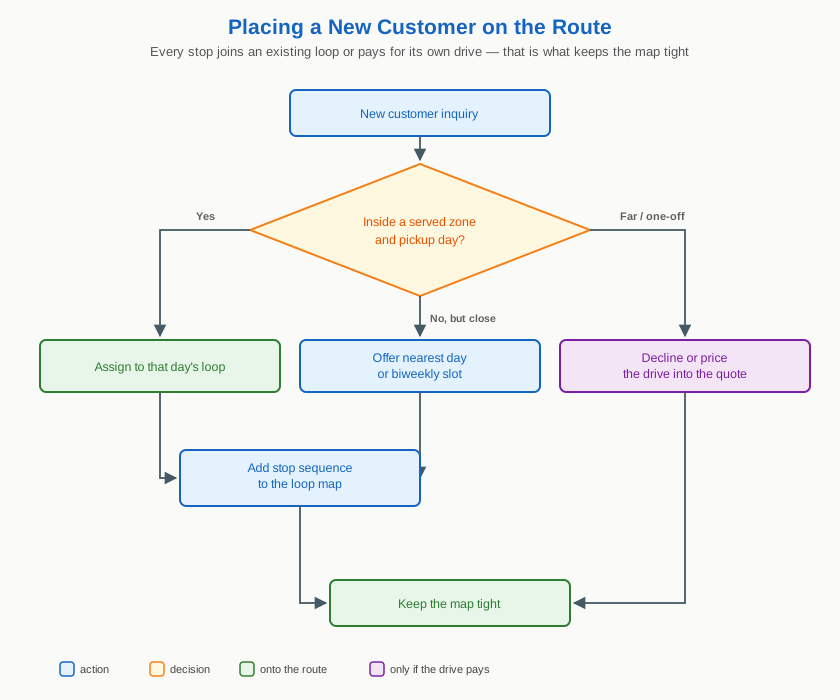
Defend the map. The first customer five miles outside every loop will beg, and the second will follow, and by month three you're driving a scatter plot. The discipline: a new stop joins only if it sits on or near an existing loop, or comes with an order size that pays for its own drive. Operators running serious pickup routes scope service by zip code for exactly this reason; the industry teaching is that you cherry-pick where the fleet goes, and your fleet is a hatchback.
The density math
Route economics reduce to stops per hour and miles per stop. A dense loop might be six stops in ninety minutes at two or three miles between them. A loose loop is three stops in two hours at eight miles between them. Same orders, wildly different mileage cost: the dense loop spends maybe five dollars per stop on driving at the IRS business rate of seventy-six cents a mile for the second half of 2026, seventy-two and a half through June, the loose one closer to fifteen. When your price sheet promises a certain profit per order, density is what delivers it.
Two habits compound the math. Batch by building: an apartment complex sign-up board is worth more than a county-wide ad, because one lobby can hold five customers on one walk. And sequence before you drive: order the night's stops as a loop that ends at your door, not a zigzag that doubles back. Free route apps handle this; the paid route software, more on it later in the course, earns its price only when texting, scheduling, and routing in one place saves you an hour a week.
The porch protocol
Pickup logistics are where new operators improvise, and improvisation at 7 p.m. in the dark is expensive. Standardize instead. Every customer gives three things at signup: where the bag will be (porch, garage, side door, front-desk closet in apartments), a door or gate code if needed, and a phone preference for the night-of text. Your pickup text goes out on schedule: "Loop starts around 6, you're stop three." Bags are photographed at pickup, one frame per bag, timestamped; paired with the check-in photo habit from Legal and Insurance, the entire chain of custody is documented without you thinking about it.
Missed bags happen: the customer forgot, the gate code changed, the dog is loose. The protocol is one text, one call, one note, move on; you'll return tonight and pick up Friday, and the route stays on time. Weather is the same discipline: waterproof bags or a trunk liner, and a heads-up text when a storm is about to make someone's unsheltered porch a problem. The route runs on predictability, and predictability is a set of written rules, not a temperament.
The map exists. A route, though, is only geography; the business itself lives in the twenty-four hours between pickup and return.
Downloads for this lesson
Keep going — you're working through Start a Laundry Pickup and Delivery Service.
All courses are free ↗