The fork: job search, business, or both
Lesson video in production
The full lesson text below is complete — the video version lands with launch.
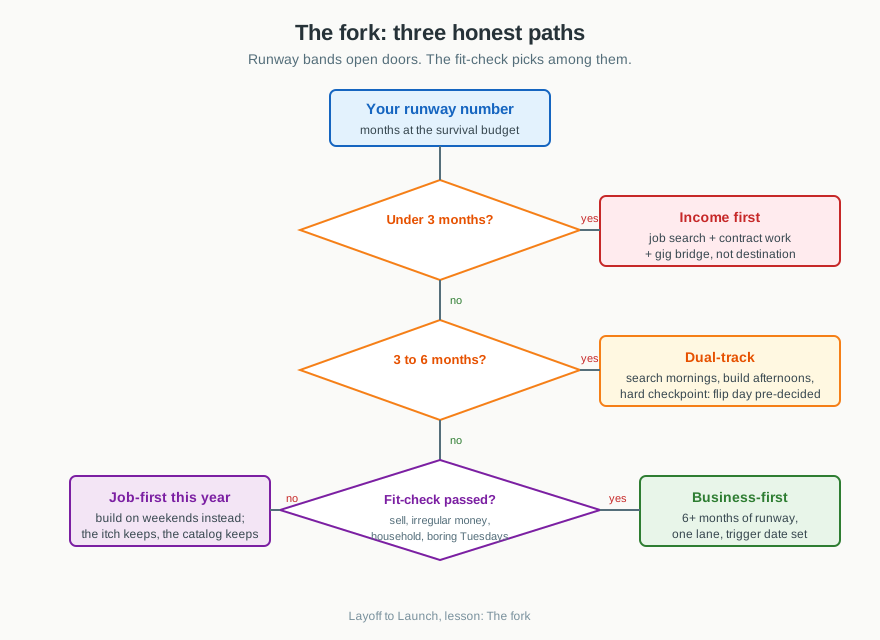
This is the decision lesson. Not because the decision is permanent, it is not, but because a path chosen on purpose beats a path drifted into, and drift is the default in exactly your situation: apply to everything, half-heartedly, while nursing a business fantasy, doing neither well, for five months. The fork has three tines. Your runway number picks which ones are honestly open to you, and your temperament picks among those.
What each path actually is
| | Job-first | Dual-track | Business-first | |---|---|---|---| | The shape | Search 15-20 focused hours a week; interview; land | Search mornings, build afternoons, one weekly checkpoint | Pick one lane fast; all working hours on first customers | | The money reality | Median landing near ten weeks; salary restores full budget | UI plus any offer that lands; slowest burn of attention | Weeks to first dollar in local services; months in online lanes | | The failure mode | Desperation applications; ghost jobs; hope as strategy | Doing both badly; the checkpoint nobody enforces | Building with no checkpoint; burning the pot on the wrong thing | | Best when | Runway under six months, role market healthy | Runway over six months, or a working partner's income | Runway over six months, fit-check passed, role market shrinking |
Read the failure modes twice. They are the reason this lesson exists. Every one of them is a drift pattern that felt like effort from the inside.
The fit-check
Before the thresholds, four questions. Answer them in writing, honestly, because the business path has an attrition rate that starts with people who never wanted to run anything, they wanted to be employed with better vibes.
Can you sell? Every business is a sales job wearing a costume. A cleaning business is selling cleanliness door to door. A consulting practice is selling yourself in every conversation. A YouTube channel is selling attention. If the thought of asking a stranger for money makes you want to die, the business path needs either a partner who sells or a hard second look.
Can you live with irregular money? Some money weekly, then nothing for three weeks, then a good month. The budget lesson's survival number is your shock absorber here, and the honest answer is partly about your household, not just you. Operators talk about this constantly: the first year is a rhythm problem before it is a revenue problem, and the people who quit usually quit in a dry spell, not after a real verdict on the business.
Does the household agree? The corpus of operator interviews this site was built from is blunt about it: businesses strain families that were not consulted. The conversation is short and it must happen before the commitment, not after the first bad month.
Would you still do the work on a boring Tuesday? Not the dream, the work. Invoicing, following up, fixing the thing that broke, answering the same customer question again. Romance is not required. Tolerance for repetition is.
If two or more answers came back no, that is data, not defeat. It means the job path or the dual path is your lane this year, and this catalog has a guide for building alongside employment on fifteen to twenty honest hours if the itch persists. That routing comes later.
The thresholds
Runway bands decide which paths are honestly on the table. I use these bands as judgment, not physics, and you get to argue with them, but only with numbers.
Under three months: income first. The pot cannot fund a venture whose first revenue is weeks away at best. The moves are the job search at full intensity, contract work through your old industry contacts, and bridge income, with gig apps explicitly as a bridge and not a destination. A business started on a three-month number is usually a business started on a credit card.
Three to six months: dual-track with a hard checkpoint. Search seriously, build modestly, and pre-decide the day you flip the weights, typically around the day the pot crosses half. The checkpoint goes in the calendar with the same weight as the runway recompute.
Six months or more: business-first is defensible if the fit-check passed. Six months covers the honest arc of a first low-capital venture, the first customers, the first pricing mistakes, the first repeat business, with a margin. Below six, the arc and the runway race, and the race is usually decided by the runway.
The conversation and the trigger
Two artifacts come out of this lesson. The first is the household conversation, which the fit-check demanded. A version that works:
I want to run something by you, and I want your honest reaction. I've counted it: we have about [five] months at the survival budget. My role's market is [what you found]. I'm proposing [the path], which means [what it costs and what it asks of us]. Here's the checkpoint: on [date], if [the pot is half gone and there's no revenue and no strong interview pipeline], I flip to job-first. I'd rather we decide this together now than renegotiate it in a panic later.
The second artifact is the trigger itself, written down with a date and a condition. "When the pot crosses half with no revenue and no interviews at final stages, the business becomes the evening project and the job search becomes the day job." A trigger decided in advance is a plan. The same decision made in the moment, pot at forty percent, is a crisis with paperwork.
The fork chosen, one branch needs a map: which business, with what you have. That routing runs by capital band and time budget, without selling you anybody's favorite.
Keep going — you're working through Layoff to Launch.
All courses are free ↗