The honest money
Lesson video in production
The full lesson text below is complete — the video version lands with launch.
Billing services charge three ways: a percentage of collections, a fee per claim, or a monthly flat fee. Percentage is the most common because it lines up everyone's incentives, and it is the model I will use in the examples below.
| Model | Typical range | Where it fits | |---|---|---| | Percent of net collections | 4% to 9% (OmniMD, CPA Medical Billing) | The default. Higher percentages for small or complex practices. | | Per claim | $3 to $12, commonly $4 to $10 (OmniMD, BellMedex) | Predictable for the practice; watch for excluded services. | | Monthly flat fee | $500 to more than $2,500, varying with provider count, specialty, and services (OmniMD) | Rare at the start; you need volume data to price it safely. |
What a client is worth
Work the arithmetic, because this one number decides whether the business makes sense for you.
A solo primary care or specialty practice might collect on the order of $30,000 to $50,000 a month. At 6 percent of collections, a practice collecting $40,000 a month pays you two thousand four hundred dollars a month. Three clients like that is seven thousand two hundred dollars a month gross, from a home office, before taxes and software. Two clients covers a modest take-home while you grow. One client is a part-time income.
Those are unit economics, not a promise. Everything above the red line depends on winning clients, which is the slow part of this business and gets its own treatment later in this course.
What launch actually costs
The stack can genuinely stay under a thousand dollars if you start lean.
| Item | Cost | Source | |---|---|---| | Clearinghouse + practice management (Office Ally Service Center + Practice Mate) | $0 | Office Ally pricing | | Print-and-mail claims, when a payer requires paper | $0.75 per claim | Office Ally data sheet | | Full EHR + billing platform (Tebra, when a client needs one) | Reported around $99 to $399 per provider per month, billed to the engagement | Pabau cost guide (Tebra itself prices by quote) | | Errors and omissions insurance | Small-business E&O averages $88 per month, and 46 percent of Insureon's customers pay under $75 | Insureon | | LLC filing | Roughly $35 to $500 depending on state | LLC University fee table | | Optional: CPB exam + AAPC membership | $425 for one exam attempt, $400 with student pricing, plus a $229 annual membership ($164 for students) | AAPC exam pricing, AAPC memberships |
You can defer the credential and the paid platform. You cannot sensibly defer insurance and a signed contract, both of which you will meet later in this course.
The part that disappoints people: the lag
You are not paid when you submit a claim. You are paid when the payer pays the practice, and then when the practice pays you, typically on the following month's invoice. Medicare cannot even issue payment on a clean electronic claim before day 14 after receipt, and before day 29 for paper (MAC guidance from FCSO). Commercial and Medicare Advantage claims commonly take thirty to forty-five days, and that is not a vague impression: state prompt-pay laws typically give a carrier thirty days to pay or deny a clean electronic claim and forty-five days for paper (Texas's insurance department publishes a typical example), and carriers tend to use most of the window. Your first month of service on a new client turns into your first invoice roughly a month later, and that invoice gets paid on the practice's payment cycle.
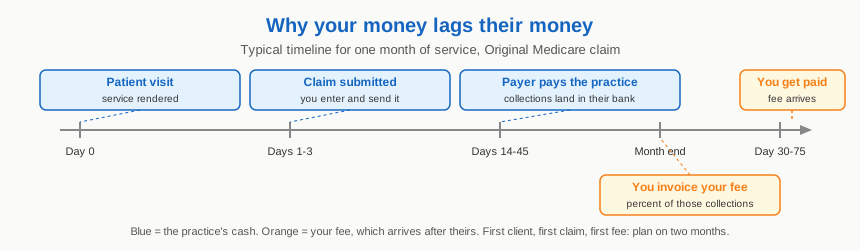
Plan on two months from first claim to first fee. Now stack the sales cycle in front of it. Operators on the r/CodingandBilling thread on finding clients describe taking eight months to land a first client through a personal network, and that story is typical, not unlucky. This course's metadata says months to first revenue because that is the truth of it, and the course's capstone treats a ninety-day no-revenue stretch as the normal opening, not a failure. Run the runway math before you commit; a two-month fee lag stacked on an eight-month client hunt is exactly the household problem that guide exists to size.
The industry's own weather report
One more honest number. In a Tebra survey of billing companies, 69 percent projected better than 6 percent growth for 2024, but 54 percent actually landed at 5 percent or less. For 2025, only 40 percent projected growth above 6 percent. The outsourced-billing market is real and large, and operators themselves report it flattening. You are not entering a gold rush. You are entering a mature market where competence and trust beat hype, which is fine news for someone willing to do the work slowly.
Before you spend anything, the course takes a hard look at fit, and it does not grade on a curve.
Downloads for this lesson
Keep going — you're working through Start a Medicare Billing Business.
All courses are free ↗