Denials, appeals, and the clock
Lesson video in production
The full lesson text below is complete — the video version lands with launch.
Anyone can submit a claim. Software can submit a claim. What a practice pays a percentage for is the recovery work: denials caught, corrected, appealed, and paid. This lesson is the machinery of that moat.
The denial economy
Initial claim denial rates in American healthcare ran about 11.4 percent in 2024 and 11.6 percent in 2025, still climbing (Enjoin's benchmark analysis, built on Kodiak Solutions data). Best practice is under 5 percent. What each denial costs to rework depends on who is counting: one industry roundup spans $25 to $181 (Aptarro), and the provider-survey series it cites put the average administrative cost at about $57 per denied claim in 2023, up from about $44 the year before. Every methodology agrees the number is real and nontrivial. For a practice, every denial you prevent or reverse is money that stays, which is why the monthly report card you send clients, covered later in this course, leads with this number.
Most denials fall into a short list of causes, and each has a standard play:
| Denial reason | What it usually means | Your move | |---|---|---| | Eligibility / coverage termed | Patient's policy changed before the visit | Re-verify, correct the payer, resubmit | | Medical necessity | Diagnosis does not support the procedure | Check the linkage, fix the pointer, or get documentation | | No prior authorization | Advantage plan required approval | Chase the auth or appeal with clinical records | | Bundled / global period | Service included in another billed service | Review the edit, adjust, or appeal with a modifier if truly distinct | | Duplicate | Claim already processed | Verify before resubmitting; true duplicates get written off | | Timely filing | Deadline passed | Appeal only with proof of on-time submission |
Read the CARC, the claim adjustment reason code, on the remittance, and the RARC remark code beneath it. The codes are public and standardized. Your speed from CARC to correct action is, more than anything else, what you are selling.
Corrected claim or appeal?
The fork in the road:
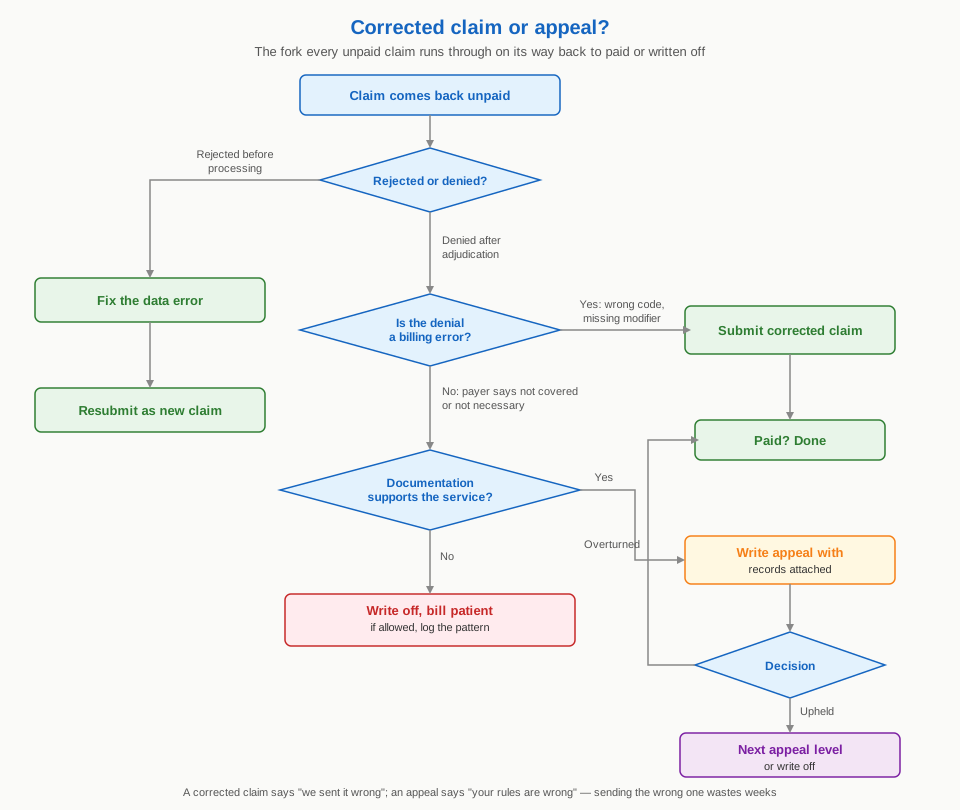
A corrected claim says "you processed it wrong because we sent it wrong." An appeal says "you processed it right by your rules, but your rules are wrong, and here is why." Sending the wrong one wastes weeks.
Medicare's five levels
Original Medicare appeals go five levels, and the first two resolve almost everything a small practice will ever fight:
- Redetermination by the Medicare Administrative Contractor, requested within 120 days of the initial determination (CMS).
- Reconsideration by a Qualified Independent Contractor, within 180 days of the redetermination.
- Administrative Law Judge hearing, for amounts above a minimum set annually.
- Medicare Appeals Council review.
- Federal district court, for larger amounts still.
The full ladder is documented on CMS's fee-for-service appeals pages. You will live at levels one and two. They are paper-and-portal work, and a well-documented redetermination with the record attached wins often enough to be worth the forty minutes it takes.
The clock that never forgives
Medicare claims must be filed within 12 months of the date of service, a limit Congress set in the Affordable Care Act and CMS enforces under 42 CFR 424.44, published in the electronic Code of Federal Regulations. There are narrow exceptions, and none of them include "the biller was busy." A claim that dies past timely filing is denied with no appeal on the merits, and the practice generally cannot bill the patient for it either. The money is simply gone, and the practice will know exactly whose queue it died in.
Commercial payers set their own filing limits by contract, often 90 days to 180 days from service, and state them in provider agreements nobody reads until a denial arrives. When you onboard a client, one of your first acts is reading those contracts and building a filing-deadline table for every payer. That table is dull, and it is worth thousands.
The compliance half of the moat comes later in this course.
Downloads for this lesson
Keep going — you're working through Start a Medicare Billing Business.
All courses are free ↗