Pricing and travel fees
Lesson video in production
The full lesson text below is complete — the video version lands with launch.
Mobile pricing has one rule the market enforces for you: the house call costs more than the salon visit, never less. You bring the salon to the kitchen, and the client pays for the hour they got back. Operator forums are blunt about this; when someone posted a ten-dollar mobile haircut, the replies were unanimous that mobile work must price above in-salon work to survive the drive. Your price is your salary, your gas money, and your rent, because you have no station fee but you do have a fuel tank.
Build the base price
Start from your local salon menus, which are public. Find the going rate for your core service within your radius. Add a convenience premium of roughly 20 to 40 percent for the house call, then check the result against the mobile market ranges from the money lesson: 70 to 100 dollars for a women's cut with a wash, single-process color reaching 75 to 150, senior cuts at 30 to 50 dollars. If your number lands below the salon you left, redo it.
Do not launch with a discount. A launch price teaches early clients what your work is worth, and raising prices later on the people who took a chance on you is the harder conversation. One nail tech's widely shared path illustrates the healthy version: start at 35 dollars as a beginner, raise in 5-dollar increments as speed and demand grow, to 60 dollars over a few years. Prices move up a step at a time, driven by a book that is full.
Draw the radius
The travel fee is where new operators get squeamish, so reframe it: the fee does not charge for gas, it prices your time and your calendar's scarcity. The standard model is zones.
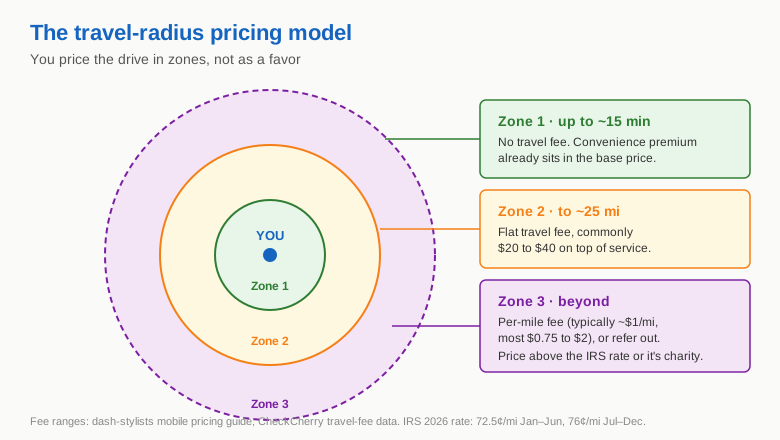
Zone one, close to home, roughly a 10 to 15 minute drive: no travel fee, the convenience premium in your base price covers it. Zone two, out to the far edge of the typical mobile radius, about 10 to 25 miles: a flat fee, commonly 20 to 40 dollars. Zone three, beyond that: per-mile pricing, typically about a dollar a mile, with most operators between 75 cents and two dollars, or simply decline and refer it out.
Two anchors keep the zones honest. The IRS mileage rate, 72.5 cents a mile through June 2026 and 76 cents after, estimates your true cost per mile; zone three pricing should sit above it or the trip is charity. And when you are tempted to absorb a far trip for a nice client, remember you are also absorbing the near client you could not fit in that slot.
Event pricing
Weddings and parties get their own sheet. Wedding hair and makeup each average about 150 dollars per person, trials run 100 to 300 dollars, and event travel fees typically run 50 to 200 dollars flat, or 25 to 75 dollars per hour of drive time. Quote group work as a single total: five people at 90 dollars plus a 75 dollar travel fee reads as one clean number, 525 dollars, and one deposit.
The policy that protects the prices
No-shows and late cancellations are a when, not an if. The standard defenses, in order of effectiveness: card on file at booking; automated reminders the day before, which operators consistently credit with cutting missed appointments; a published policy of a fee, commonly the full service price for a no-show and half for a late cancel, enforced calmly and uniformly. Booking platforms automate the card capture and the reminder text for you, and setting that system up comes later in this course.
Write the policy once, put it in your booking confirmation, on your price sheet, and in your voicemail message, and enforce it the same way for everyone. The first time you waive it for a sympathetic story is the moment your policy becomes a rumor.
Prices set, radius drawn, policy published. Now the uncomfortable part: a perfect price sheet meets an empty calendar, and filling that calendar is its own work, done one route at a time.
Downloads for this lesson
Keep going — you're working through Start a Mobile Beauty Care Business.
All courses are free ↗