What the Money Actually Looks Like
Lesson video in production
The full lesson text below is complete — the video version lands with launch.
Start with the number that sells courses: some marketers say loan signing agents make six figures working part time. Sometimes a person does. The National Notary Association's own survey work paints a wider picture: more than half of full-time mobile notaries reported earning over two thousand dollars a month, and among full-timers with at least three years in business, sixteen percent cleared seventy-five hundred, while the part-time majority, the largest group in the field, earned modest supplemental income. Those numbers also come from the boom years. This lesson gives you the honest arithmetic so you can price your own decisions.
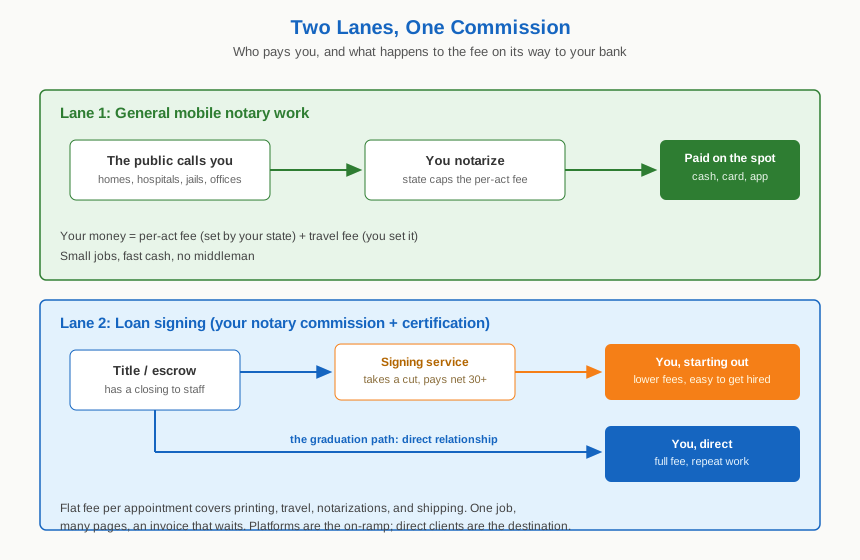
What each lane pays
General notary work is state-capped per act and margined on travel. California's cap is fifteen dollars per notarized signature, Texas is ten dollars for the first signature and a dollar for each additional, Florida is ten per act, New York is two dollars per person. Your travel fee has no state ceiling in most places and is set by you. One published schedule charges fifteen dollars of travel within five miles, twenty-five at five to ten miles, forty at ten to twenty, fifty at twenty to thirty, and sixty dollars out at thirty to forty, and bills twenty-five dollars for each hour a loan signing runs past two. Copy that shape, whatever your price points: travel worth about as much as the notarial acts near home, several times the acts far away, and waiting time priced once it stops being brief. A hospital or late-night call justifies a premium on top, and after-hours work should carry one.
Loan signing pays a flat fee per appointment. Working independently, agents typically see seventy-five to two hundred dollars per signing. Package type moves the number: operators report seller packages around sixty to seventy-five dollars, home equity packages around forty to fifty, and full refinance and purchase packages at the top of the range. New agents start at the bottom of the band. Experienced agents with direct title company relationships report a hundred and fifty to two hundred per appointment, and a few report more for difficult jobs, long distances, or last-minute calls.
Who takes a cut, and when you get paid
In the general lane, nobody sits between you and the money. You collect at the table. Cash, card reader, payment app; keep a receipt book and log the fee in your journal the day you earn it.
In the loan lane, there are two ways work reaches you. Go direct, meaning a title or escrow company hires you themselves, and the whole fee is yours. Work through a signing service, a company that sits between title companies and agents, and the service keeps a share; operators describe the split as the service keeping anywhere from roughly a third to nearly half of what the title company paid. In exchange, the service finds the work, handles scheduling, and takes a chance on new agents with zero reviews, which is exactly why you will start there.
Payment timing is the part new agents never believe until the first invoice ages. Signing services typically pay on net terms. Operators report waiting anywhere from a week to ninety days, with thirty to sixty days common. Direct title companies usually pay better and often faster, but they hire agents with track records. So the natural arc of the business is: start on platforms eating net terms, build speed and reviews, graduate to direct clients who pay the full fee.
What a hundred-dollar signing actually nets
Run the real arithmetic on a typical entry-level appointment.
| Item | Typical cost | |---|---| | Paper and toner, both borrower and lender copies | $8–12 | | Miles, 20 round trip at the federal business mileage rate | $14.50–15.20 in 2026 | | Phone, software, E&O insurance, amortized | a few dollars per job | | Your time: print, confirm, drive, sign, check, ship, scan | 2–3 hours |
At a hundred-dollar fee you are netting around seventy dollars cash for two to three hours of working time, paid a month later. The mileage line alone moved twice in 2026, to seventy-two and a half cents a mile for the first half of the year and seventy-six after July, so recompute it at the current federal rate rather than trusting any course's number, including this one. Even so, that is a good wage for work you can do evenings next to a day job, and volume compounds it: one operator's math holds that a handful of escrow clients feeding you roughly a dozen signings a week at a hundred and fifty dollars each is a six-figure year, though that operator's assumptions, and the market at the moment you try it, may not match yours. Treat that as the shape of the ceiling, not a promise about your floor.
The floor is the real risk, and it moves with interest rates. When rates are low, refinances flood the system and signing agents get swamped. When rates rise, refinance volume collapses and platforms fill with agents competing for fewer jobs, and forum operators describe accepted fees sliding toward sixty or eighty dollars during slow stretches. The National Notary Association's 2023 survey found signing agents hit a significant slowdown and kept going by diversifying into general work and other services. Your plan has to survive both climates, and that survival plan gets built later in this course. One headwind this arithmetic does not carry is software taking the table: this course rates a two out of ten on AI exposure, per how this catalog rates AI exposure, because the fee is paid to a commissioned human who verifies identity and witnesses signatures, and the automatable edges, scheduling and print logistics, are overhead rather than product.
Whether this arithmetic works for your life is a fit question before it is a money question. Sit with it honestly before you spend anything, because the numbers only matter if the life fits.
Downloads for this lesson
Keep going — you're working through Become a Mobile Notary and Loan Signing Agent.
All courses are free ↗