The Network Identity
Lesson video in production
The full lesson text below is complete — the video version lands with launch.
This is the lesson the whole course hangs on. Anyone can buy a phone and anyone can list one. The money is made and lost in the fifteen minutes before cash changes hands, in four checks most beginners have never heard of. Learn this stack until it is boring, because boring is what profitable looks like.
The IMEI is the phone's legal name
Every phone has an IMEI, a fifteen-digit identifier that carriers use to decide whether a device may join their network. Dial star-pound-zero-six-pound on any phone, or find it in Settings under About, and the number appears. When a carrier blacklists an IMEI, usually because the phone was reported lost or stolen, or because an installment balance went unpaid, that phone stops working on the major US networks, and the blacklist propagates through the shared GSMA registry that carriers use. The physical device does not change at all. Its value does, from market price to parts price in one database update.
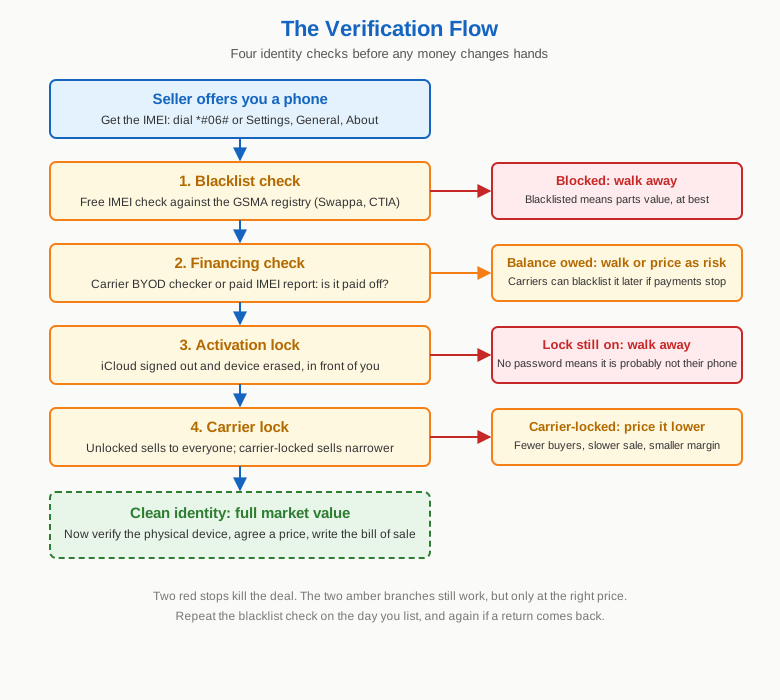
Check one: the blacklist
Free and instant. Run the IMEI through a free checker, the one on Swappa or the CTIA stolen phone checker, both of which query the GSMA registry. Clean means clean today. Blocked means walk away, no negotiation, because a blacklisted phone is worth what a repair shop will pay for parts and nothing more. There is no unlock, no fix, no guy who knows a guy. There is only a walk.
Check two: the financing balance
This is the check that eats beginners, because a financed phone can pass every other check and still ruin you a month later. Most people do not own their phone outright; they are paying it off on an installment plan attached to their carrier bill. If they stop paying after they sell to you, the carrier can blacklist the IMEI, and the phone you verified clean is now a paperweight you paid two hundred dollars for. Free blacklist checkers do not reliably show installment balances, and operators report that financed phones sometimes sail through them. So check harder: run the IMEI through the carrier's own bring-your-own-device checker, which flags devices still under financial obligation, or spend a dollar or two on a paid IMEI report service that shows financed status. The operators in our corpus put the discount for a phone with money still owed at thirty to forty percent off clean value, and that is the honest price of that risk: either the seller proves it is paid off, or you price the phone as a gamble. When you are starting out, the answer is simpler. Do not buy financed phones at all.
Check three: the activation lock
Activation lock is the anti-theft tie between a phone and its owner's account, iCloud on iPhones, the equivalent Google lock on Android. If the seller's account is still signed in, the phone will demand their password the moment it is erased or reactivated, and without that password the phone is locked to them forever. Ask the seller to sign out of their account and erase the phone in front of you: on an iPhone that is Settings, then their name at the top, Sign Out, then Settings, General, Transfer or Reset, Erase All Content and Settings. Watch the phone restart to its welcome screen. That is the only state you accept. The classic tell, "I forgot the password," does not mean you found a bargain. It means the phone is probably not theirs to sell. Walk.
Check four: the carrier lock
A phone can be free of every problem above and still be carrier-locked, meaning it only accepts SIM cards from one carrier until it is unlocked. Unlocked phones sell to everyone, so they appraise at the top of the range. Carrier-locked phones sell to a narrower pool of buyers, appraise lower, and sit longer. The free checkers usually report lock status, and you can also test by inserting a SIM from a different carrier. This is a price adjustment, not a walk-away: buy a locked phone only at the discounted price its narrower market justifies, and when you are new, simply prefer unlocked.
The whole stack, in order
Run the checks in this order every time: blacklist, financing, activation lock, carrier lock. Two walks are absolute, the blacklist and the activation lock. Financing is a walk until you are experienced enough to price risk deliberately. Carrier lock is arithmetic. Re-run the blacklist check the day you list the phone, because status can change between purchase and sale, and check it again if a buyer returns the device.
With the identity verified, the phone is worth appraising as a physical object, because a clean identity does not stop you from overpaying for the device itself.
Downloads for this lesson
Keep going — you're working through Flip Phones for Profit.
All courses are free ↗