The honest money: retainers, churn, and the real math
Lesson video in production
The full lesson text below is complete — the video version lands with launch.
Money first, because you are deciding whether to bet months of your life on this. This lesson has three parts: what the market pays, what the business costs to run, and the churn arithmetic that nobody selling you this dream will ever do out loud. The third part is the one that matters.
What clients actually pay
Small-business social media retainers span a wide band, and where you land in it depends on deliverables, market, and proof. The operator threads worth quoting are dated, so read them for the shape of the market, not this quarter's price list. In a 2018 freelancer pricing thread, one manager quoted plans from one hundred fifty to five hundred fifty dollars a month, and a shop that used to charge seven hundred fifty to nine ninety-seven for a post a day across channels had dropped to three hundred to three hundred fifty a month, its owner writing that social media management had "gone down tremendously in pricing value." In a 2021 thread, one brand-new manager charged three hundred a month across four platforms, while another new manager there reported the experienced operators around them charging a thousand to twelve hundred. The same thread surfaced an established Chicago agency whose entry tier ran two thousand a month for three posts a week, and the top replies called that extremely overpriced, which tells you two thousand is a ceiling people argue about, not a floor. Full-service local marketing agencies selling into local businesses bill twenty-five hundred to ten thousand dollars a month or more.
Training programs aimed at agencies push higher anchors. A long-running local agency program teaches a thousand-dollar monthly minimum, with a base program around fifteen hundred and a high end near three thousand, per its published blueprint. Another operator reports social media management averaging six to seven hundred a month per client, with two thousand as a practical ceiling for management-only work before the value question gets hard. Treat those as aspiration, not expectation. In your first year, plan around the middle of what the dated threads actually show: four hundred to a thousand dollars per client per month, rising as proof accumulates.
The market is not small. The US Small Business Administration counts about thirty-three million small businesses, and the majority have no one managing their social presence with any discipline. Your problem will never be market size. It will be distribution and retention.
What it costs to run
Startup costs are the good news. The tool stack that matters is a laptop, a phone, and roughly twenty to fifty dollars a month: a scheduling tool, a design tool, and a simple invoicing system. Meta's own Business Suite schedules Facebook and Instagram posts for free, which covers your first clients entirely. Detailed stack choices come later in the course.
The real costs are time and acquisition. Landing a client takes dozens of outreach touches and one to three conversations. Delivering for one takes, realistically, fifteen to twenty hours a month when you are new. That band is not a guess: later in the course a full working month gets counted hour by hour, and fifteen to twenty hours per client is what it sums to. Those numbers define your effective hourly rate more than any price sheet does. At six hundred a month and fifteen hours, you are earning forty dollars an hour. At four hundred and twenty hours, which happens to everyone at least once, you are earning twenty. Guard your scope accordingly.
The churn arithmetic
Now the part that kills agencies. Clients leave. They sell the practice, they hire a niece, they have a bad quarter, or they simply lose conviction. One self-published industry analysis from 2026, the single source behind every percentage in the paragraph that follows, measured what that looks like: agencies specializing in social media lose about forty-six percent of clients per year, the worst of any specialty except paid advertising. Solo and tiny agencies run hotter still, losing around thirty-two percent annually. Retainer-based agencies of all types average better, about eighteen percent annual churn and a fifty-six month average client lifespan, and the peak firing risk is the first ninety days. Nearly half of departing clients cite dissatisfaction with delivery, which is a euphemism for unmet expectations, and expectations are something you control.
Operator lore matches the data. Agency owners at scale describe losing roughly ten percent of clients per month, and agency training programs teach that six to nine months is a realistic average client stay, with anything past six months counted as a win.
Here is the arithmetic that follows, and it is the single most important calculation in this course.
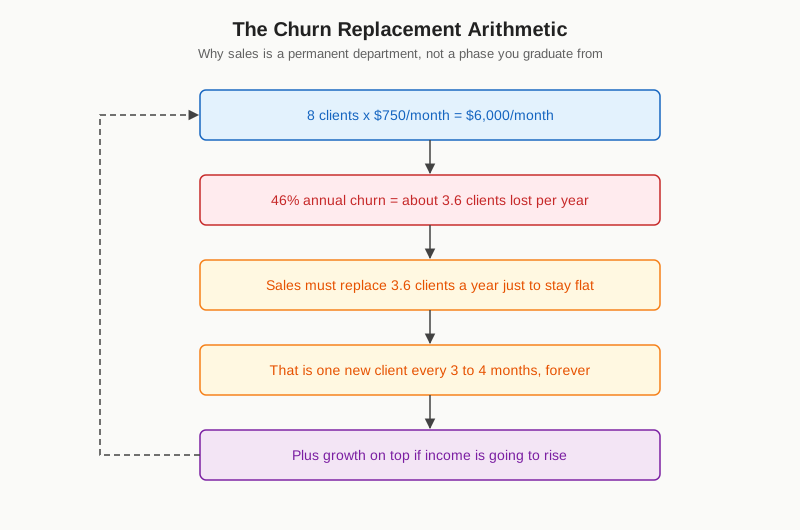
Run your own numbers with the course money worksheet. Say you want six thousand a month in revenue at seven hundred fifty per client. That is eight clients. At forty-six percent annual churn you lose roughly one client every three months, so before you grow a single dollar you must sell four clients a year just to stand still. Your sales engine is not a phase you graduate from. It is a permanent department. Operators who stop outreach the month they feel "full" discover this nine months later as a revenue cliff.
Two design decisions follow from the churn math, and both come back later in the course. First, your offer needs to be priced so each client is worth winning and keeping. Second, retention work, meaning reporting, expectation setting, and communication quality, is paid work. The same analysis puts social specialists at forty-six percent annual churn and retainer-model agencies at eighteen. That pairing is an inference across two rows of one report, not a controlled comparison, but it is the pattern every lesson in the back half of this course bets on. A retained client is worth more than two new ones, because new ones cost you sales hours and a first-month learning curve.
With the honest picture assembled, what this is, whether it fits you, and what it pays, the next step is building the machine.
Downloads for this lesson
Keep going — you're working through Start a Social Media Marketing Agency.
All courses are free ↗