Budget Energy, Not Hours
Lesson video in production
The full lesson text below is complete — the video version lands with launch.
Here is the mistake almost every dual-track builder makes in month one. They take their fifteen hours and spread them evenly across the week, one block a night, because that looks fair and organized. By week three they are staring at a spreadsheet at 9 p.m. on a Tuesday, too tired to remember why they started, and they conclude they lack discipline. They do not lack discipline. They budgeted the wrong currency.
An hour is not an hour. The hour after a ten-hour workday plus a commute is not worth the same as the first hour of a free Saturday morning, and pretending otherwise is how side businesses die with their founders exhausted and confused. Paul Graham put a name on this in his 2009 essay "Maker's Schedule, Manager's Schedule": your job runs on the manager's schedule, chopped into meetings and half-hours, while building a business is maker's work, which wants blocks of half a day and collapses into fragments. The dual-track life is the collision of both schedules in one person. You have to manage the collision on purpose.
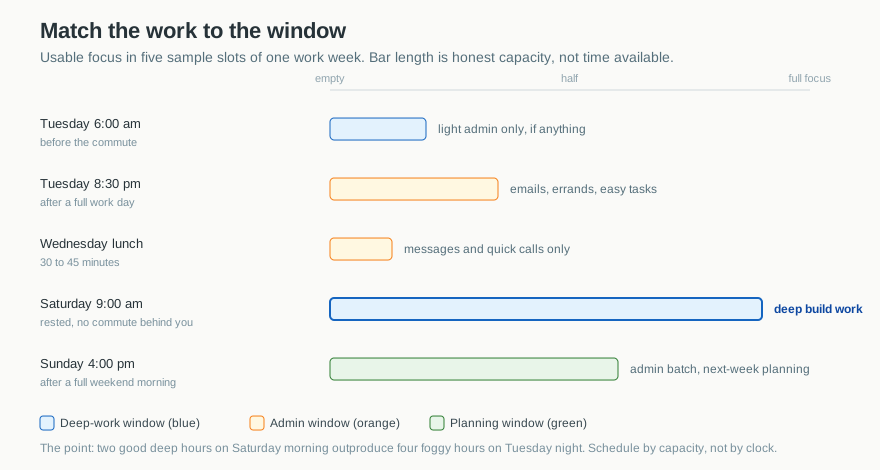
Look at the chart above, then look at your own week honestly. Two rested hours on Saturday morning outproduce four foggy hours on Tuesday night. That is how attention works after a full workday. So the design rule is this: put deep work in deep windows and shallow work in shallow ones. Deep work is anything that builds the business forward, like building the product, writing the offer, designing the route plan. Shallow work is admin, messages, ordering supplies, bookkeeping, anything with a checklist shape. Deep windows get the weekend mornings. Shallow windows get the tired evenings.
Now the guardrail most people ignore: sleep is not a line item you can cut. In 2024, 30.5 percent of American adults slept less than seven hours a night, per the National Health Interview Survey, and I promise you the dual-track crowd overindexes on that statistic. Every hour stolen from sleep is borrowed at interest. The interest is paid in worse judgment at the job, worse decisions in the business, and a body that eventually calls the loan. The founder sleepwalking through Q4 is not grinding. They are slowly going broke on attention.
There is a second energy ledger people never audit: decision fatigue. Your job spends your decisions, hundreds of small ones, before you get home. So do not spend your best remaining decision-making on trivia. Decide the trivial once: same breakfast, same build night, same admin hour, same order of operations when you sit down. A fixed opening routine for each block, even a stupidly simple one like "open the plan, read the top line, do the top line," saves the energy for the work itself. Routine is not rigidity. Routine is fuel injection.
Run this exercise before building the calendar. List your waking hours outside the job for a typical week, then mark each slot honestly as deep, shallow, or empty. Empty means genuinely unusable: the post-commute decompression, the dinner hour, the school pickup. Do not schedule anything into empty slots. A schedule full of aspirational blocks you reliably skip trains you to ignore your own calendar, and then the calendar stops working for everything, including the job.
When your map is honest, you will usually find two shallow evening windows and one or two deep weekend windows. That shape, not some fantasy of nightly heroic focus, is the raw material for everything that follows. Later in the course we take that shape and commit it to the calendar as recurring blocks, with the same respect you give a meeting with your boss, because that is what they are.
Keep going — you're working through Start It on Weekends.
All courses are free ↗