The Fork
Lesson video in production
The full lesson text below is complete — the video version lands with launch.
Every dual-track builder eventually reaches the same question, usually late at a kitchen table: should I quit? The culture gives two answers, "hell yes, follow your dreams" and "never, it is too risky," and both are useless, because neither contains a test. A decision this big deserves to be made the way you would evaluate any investment: against conditions written down before emotions ran high. So write them down now, in advance, while you are still calm.
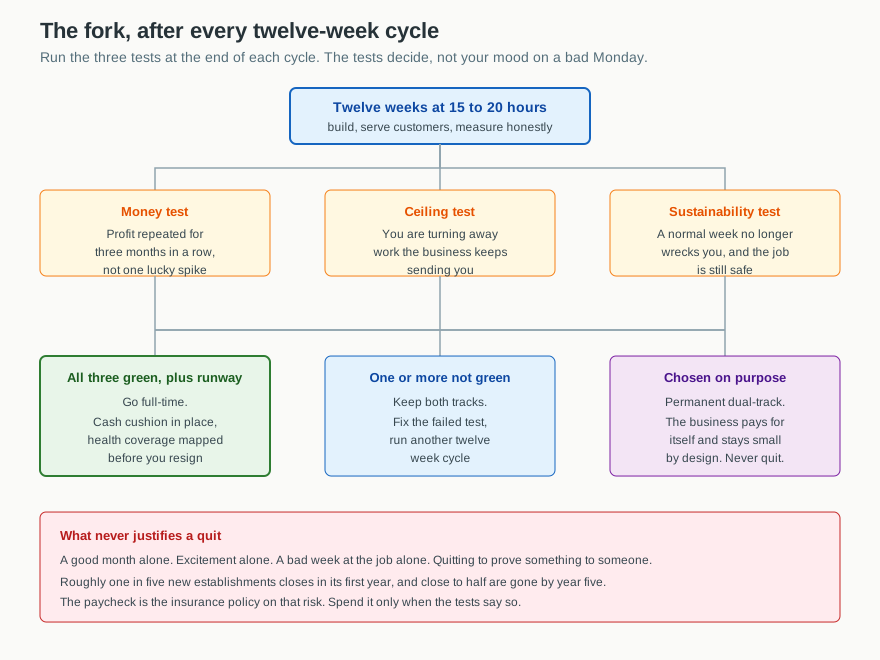
Three tests, all of which must pass, checked at the end of every twelve-week cycle.
The money test. Monthly profit, not revenue, repeats for at least three consecutive months at a level that maps to a real share of your take-home pay. I want to see the business covering half your take-home before a resignation letter is even drafted, because revenue that spikes once is luck, and revenue that repeats three times is structure. Pull the numbers from your separate business account, the one from "Protect the Paycheck," and look at profit after costs, never gross.
The ceiling test. You are turning away work you could have served. Not imagining demand, not reading tea leaves in website visits: actual people with actual money you declined or served late because fifteen hours a week was full. That is the only reliable signal that more hours would convert to more income. A business that has never refused work does not yet know what an extra thirty hours a week would earn. It might just earn thirty hours of idle.
The sustainability test. A normal week at dual-track pace no longer wrecks you, the job's performance numbers are intact, and the household contract still holds. This test fails quietly and people override it with adrenaline. Do not. Quitting on a burned-out nervous system does not produce freedom; it produces a full-time version of the same exhaustion with no salary.
All three green is the beginning of the quit conversation, not the end of it, because two more things must exist first. Runway: months of essential expenses held in cash, so that a bad quarter after quitting is a problem and not a catastrophe. And health coverage: know exactly what insurance costs after the job, mapped as a monthly number, before you resign; this library has an entire guide that runs that math, and it should be read before, not after, the resignation letter. The failure statistics are the reason for the caution. Roughly one in five new establishments closes in its first year, and close to half are gone by the fifth birthday: recent cohorts have cleared five years at survival rates of about fifty-one percent, just over the halfway line, per Bureau of Labor Statistics survival data. The paycheck is your insurance policy on those odds. Insurance you only surrender when the payout is provably waiting.
Now the fork nobody talks about: never quitting. Some businesses should stay the size they are, and that is a design, not a failure. A weekend cleaning route that clears eleven hundred a month on eight build hours. A small design catalog that pays the mortgage's second half. A seasonal service stacked onto a career you actually like. The permanent dual-track is legitimate, and I would estimate, watching how these lives actually go, that it is the right ending for a large share of the people reading this guide. Full-time is one possible graduation. So is a deliberate, profitable, permanent half.
There is even a middle fork worth naming, because it happens constantly and nobody plans for it: the business funds the leap to a different life rather than replacing the job. A second income that covers the gap lets you take a lower-paying job you love, go part-time, or move somewhere the paycheck mattered less. The business does not have to beat the salary to change everything. It only has to cover the difference between the life you have and the one you want.
So run the cycle, run the tests, and let them decide. The first cycle starts now, and it has a shape: twelve weeks, the calendar you built, the first customers, and honest numbers at the end. That shape is this guide's last piece, and then the deeper library takes over.
Downloads for this lesson
Keep going — you're working through Start It on Weekends.
All courses are free ↗