The Calendar Is Your First Asset
Lesson video in production
The full lesson text below is complete — the video version lands with launch.
Ask a struggling side-builder what they own for the business and they will list intentions: an idea, a name, a domain they bought at midnight. Ask me what the business's first asset is and I will point at the calendar. Not the website, not the logo, not the LLC paperwork. The calendar. A business that lives in "whenever I have a free evening" is a wish. A business that owns four defended blocks a week is a going concern, even before its first customer.
Here is the structure I want you to build, and you can bend the details to your life as long as the skeleton holds.
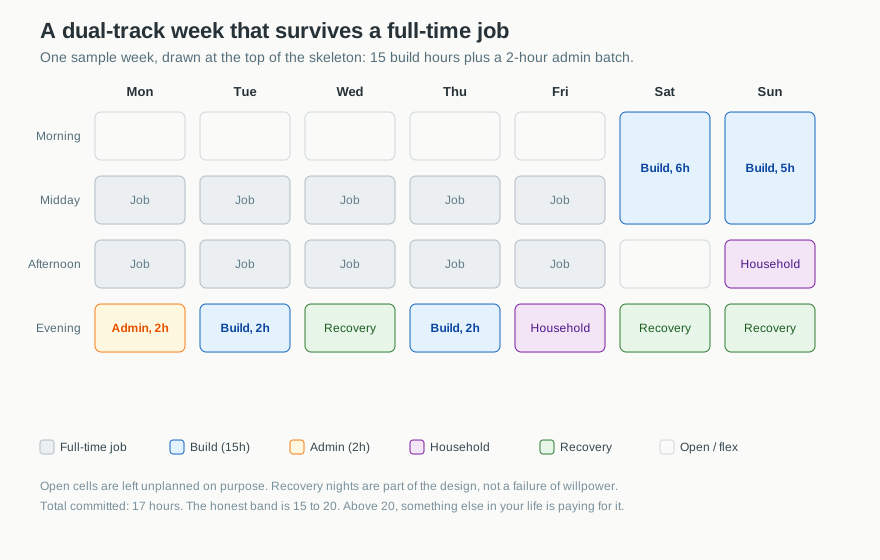
One Saturday deep block of five to six hours. This is the engine. Saturday morning into early afternoon, rested hours, deep work only: building the offer, building the product, planning the route. One Sunday deep block of four to five hours, taken in the morning before the afternoon hands the day back to the household. Between them, the weekend is where the business actually grows. Two weekday deep blocks of two hours. Tuesday and Thursday evenings work for many people because Wednesday can stay light. These carry the week's momentum between weekends. One admin batch of two hours, in a shallow window. Bookkeeping, supply orders, messages, invoices, all in one sitting so they stop leaking into every evening. Add those up and you land at fifteen to seventeen committed hours, inside the honest band from "Find Your Fifteen Hours," with room for a heavier season without breaking the ceiling of twenty.
Three rules make the calendar an asset instead of a decoration.
First, recurring beats ad hoc. The blocks are weekly recurring events, same day, same time, with a name, not "work on business." Your calendar already respects things that repeat. Make it respect this.
Second, the cancellation rule: a block can move within the week, never vanish. Life will eat a Saturday; a kid gets sick, the job erupts. Fine. The block moves to Sunday morning or a weeknight, the same week, before you close the calendar app. The rule is one sentence long and it is the difference between a builder and a dabbler. Keep the move-or-keep promise to yourself for a month and something strange happens: the blocks start feeling as real as the job's meetings.
Third, the calendar is shared. If you live with anyone, they see these blocks, they know what they are, and they were consulted before the first one went in. Which brings me to the part most guides skip and most failures trace back to.
The household contract. You are spending hours that used to belong, in some form, to other people. Renegotiate that openly, once, at the start. Put it in one spoken paragraph, or write it down if that fits your family:
"For the next twelve weeks I'm setting aside [two weeknights and weekend mornings] to build this. In exchange, [Friday nights and Sunday afternoons] are fully ours, no phone, no laptop. I'll show you what I'm building at the end of each month, and at week twelve we'll decide together whether to keep going."
A contract nobody was forced into, with visible payment in both directions. The visible part matters: a partner who sees the business grow monthly can budget the sacrifice. A partner who only sees you disappear into a back room cannot, and no amount of explaining at week ten will fix what was not agreed at week zero. In my judgment the household veto ends more dual-track businesses than market competition ever does, because the calendar stayed silent on what the household got.
One design note on the shape of the week. Guard a real recovery night, midweek if you can, and keep it empty on purpose. An empty night on a calendar looks like waste. It is not. It is the slack that lets the schedule survive the weeks when the job runs hot, and those weeks are coming whether you plan for them or not. A schedule with no slack breaks the first time it is tested, and a broken schedule is usually never rebuilt. Cash works the same way: if the budget under the calendar has no slack and the bills cannot wait for the build, the gig work guide is the honest interim.
When your blocks are recurring, named, shared, and defended, you have built the first real asset. The next question, what can actually be built at this pace and what kind of business fits a life where weekdays are spoken for, gets its answer later in the course.
Downloads for this lesson
Keep going — you're working through Start It on Weekends.
All courses are free ↗