Replace or accelerate
Lesson video in production
The full lesson text below is complete — the video version lands with launch.
Replace or accelerate
Take the question "will AI eat this business?" and make it concrete. A business is not one blob that gets eaten or spared. It is a stack of tasks, and the machine eats tasks, one at a time, in a specific order. So the first move in the assessment is to split every recurring task into two piles.
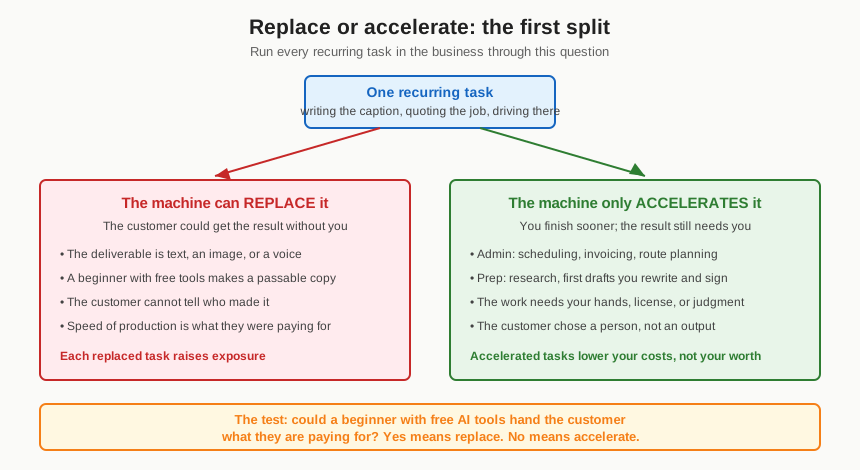
The two piles
Pile one: tasks the machine can replace. The result the customer wanted arrives without you. If you sell blog posts, and the customer can get a passable article from a chatbot in ninety seconds, the writing task has moved to pile one. Same for a basic logo, a voiceover, a product description, a first-draft contract, a translation of a menu. The tell is always the same: a beginner with free tools can now hand over something the customer will accept. Not something excellent. Something acceptable.
Pile two: tasks the machine can only accelerate. The task finishes faster or cheaper, but a human still has to hold it. Scheduling software did not replace the cleaner; it replaced the phone tag around the cleaning. Routing apps did not replace the lawn; they shaved the drive between lawns. Quote calculators, invoice automation, photo organization, transcript search. When software eats these tasks, your margin goes up. The machine is working for you.
Here is the uncomfortable symmetry most people miss. Both piles are growing. The question is never "does AI affect this business," because the answer is always yes. The question is which pile is growing faster inside the business you are considering, and whether the pile-one growth touches the deliverable or only the overhead.
The deliverable is what matters
Overhead getting automated is a gift. Deliverables getting automated is the threat. In the cleaning business, the deliverable is a clean house that a specific person entered a stranger's home to produce. Nothing in the software stack comes near it. Every software improvement in that trade, booking, routing, invoicing, payment, lands on pile two. That is why the cleaning course in this catalog carries an exposure rating of 2, one of the lowest in the fleet, and why its intro says plainly that almost nothing about entering a stranger's home and cleaning it well can be automated.
Now flip it. In an entry-level copywriting business, the deliverable was acceptable text on request. That was pile one the moment chatbots got conversational, and the business model did not survive the move. Same technology, opposite outcomes, and the difference is not the sophistication of the machine. It is which pile the machine landed on.
Run the task inventory
You cannot score an idea you have not broken into tasks. Take your business idea and write down the ten tasks you would repeat most in year one. Be blunt and boring about it. Then mark each one R or A.
Task inventory: mark each task R (machine could replace it) or A (machine only accelerates it)
Two patterns will jump out. First, in healthy low-exposure businesses, the R marks cluster in the admin rows and the A marks, oddly enough, cluster there too, because admin both automates and accelerates. The production rows stay stubbornly A. Second, when you find yourself arguing that a production task is "basically just" assembling information, you have found your exposure. "Basically just" is how pile one talks.
What the split tells you so far
A task inventory does not finish the assessment, but it filters fast. If the money task, the one the customer actually pays for, sits in pile one for a beginner-level version of the business, the exposure score is already climbing toward the danger bands, and no amount of pile-two efficiency will buy it back. If the money task sits in pile two, you are looking at a business where the machine is on your side, and the remaining questions are about demand and blame.
Demand is its own animal. First, though, the deliverable question: what the customer is actually paying for. That is where the piles get named.
Downloads for this lesson
Keep going — you're working through Will AI Eat This Business?.
All courses are free ↗