The five questions
Lesson video in production
The full lesson text below is complete — the video version lands with launch.
The five questions
Everything so far compresses into one page. This is the scorecard we ran across the catalog, and the one you will run on your own idea. Five questions, each answered honestly, then combined into a single exposure score from 0 to 10.
The questions
First question: the deliverable. What is the customer actually paying for: bytes, a physical outcome, or accountability? Pure bytes pushes your score up by 2. A bundle that is mostly outcome or accountability pulls it down by 2. Mixed bundles hold the middle and let the other questions decide.
Second question: the entry floor. Could a beginner armed with free AI tools produce a version of the average provider's offer that average customers would accept? If yes, add 2. This question is about where the floor of the trade sits, not the ceiling, and it is the question that separates businesses that are merely changed from businesses whose first rung has been removed. It matters enough that the guide returns to it later, at full length.
Third question: the demand gate. Who controls whether customers find you? If customers arrive through a platform you do not govern, and that platform does not police machine-generated supply, add 2. If the platform does police it, add 1. If demand flows through referrals, your own list, or a channel where humans are the point, subtract 1. The reasoning behind these numbers gets the same full treatment later in the guide.
Fourth question: the blame. When the work goes wrong, must a licensed, insured, physically present human absorb it? Subtract 2 if yes. Subtract 1 if the accountability is real but partial, like a B2B service where reputation substitutes for a license. Nothing to subtract if the customer simply tolerates a worse output and moves on.
Fifth question: the task split. From your task inventory, what share of first-year hours sits on tasks a machine could do without you? Over half, add 2. Around a quarter to half, add 1. Under a quarter, hold. Remember the direction of the asymmetry: overhead automation never lowers exposure much, because every business gets that subsidy. Only deliverable automation raises it much.
Turning answers into a score
Start at 4. It is the agnostic middle: neither the panic prior nor the denial prior. Apply the five adjustments, then read the bands. The arithmetic is deliberately coarse. Precision here would be theater; the questions carry the information, and the number just files the answer.
| Adjustment | Score moves | |---|---| | Deliverable is pure bytes | +2 | | Deliverable mostly outcome or accountability | -2 | | Beginner with free tools matches the average offer | +2 | | Demand through an unpoliced platform | +2 | | Demand through a policed platform | +1 | | Demand through referrals, direct list, human-first channels | -1 | | Blame must land on a licensed, present, insured human | -2 | | Blame real but partial | -1 | | Most of year one's hours are machine-doable | +2 | | A quarter to half machine-doable | +1 |
Clamp the result to the 0-to-10 range and read it against the scale below.
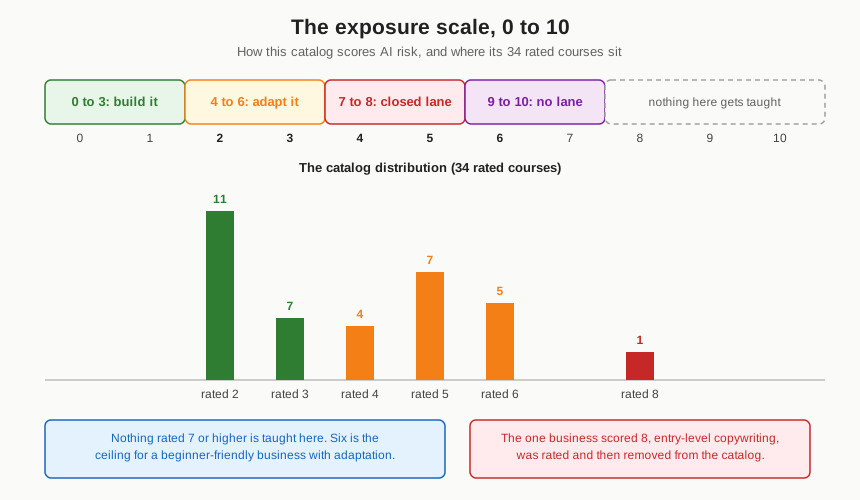
The bands
0 to 3, build it. The machine barely touches the value you deliver. Software arrives in this business as margin. Eighteen courses in this catalog live here: eleven rated 2, every one a physical, local, trust-heavy trade, and seven rated 3, trades where a slice automates but the human core holds. The risk in this band is not AI; it is the ordinary risks of running a small business, and the course for each trade teaches those.
4 to 6, build it with adaptation. The machine does real work inside the value chain, sometimes half of it, and a durable human layer remains: accountability, taste, a relationship, a license, owned demand. Sixteen courses live in this band, and this is precisely why they are still taught: not because the exposure is low, but because the adaptation is teachable. Building here means building the deflection on purpose, and the guide shows that build later, in full.
7 to 8, closed for beginners. The entry lane, the simple work that used to train every newcomer and pay the bills while they climbed, is now the machine's lane. Experts may still thrive for years. A course that teaches a beginner to enter here would be selling a ticket to compete directly with the tool that closed the lane. This band is why this guide exists in a course catalog at all: one business scored here, and we removed it.
9 to 10, no lane. The deliverable is the machine. Businesses here are not eaten so much as obsoleted, and the honest assessment says so.
Sanity checks
Two habits keep scoring honest. Score the beginner's version of the business, not the master's; you are deciding whether to enter, and the machine eats floors before it eats ceilings. And score with a specific customer in mind, one you could actually name or picture; abstract customers produce abstract answers, and abstract answers drift toward whatever you were hoping to hear.
You now have the whole method. What makes it trustworthy is not the rubric, it is the evidence: thirty-four scored businesses, published with their numbers, that you can check the method against. The rest of this guide is that evidence.
Downloads for this lesson
Keep going — you're working through Will AI Eat This Business?.
All courses are free ↗