The honest no
Lesson video in production
The full lesson text below is complete — the video version lands with launch.
The honest no
This is the lesson most business catalogs will never write, because writing it means admitting the catalog had a kill list. Ours did. Here is the entire record.
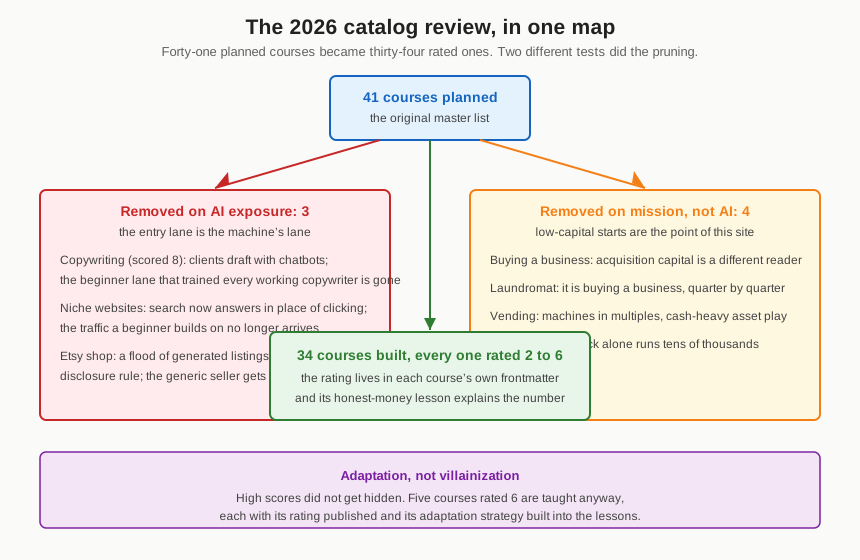
The arithmetic
We planned forty-one business courses. We built thirty-four. Seven proposals were removed after the review, and they left for two entirely different reasons. Three were removed because of AI exposure. Four were removed because of capital. I want to walk through both lists, because a reader deserves to know that the second list exists: a catalog that only ever says "AI" when explaining its choices is a catalog selling a narrative.
The three AI removals
Copywriting, scored 8. You have already sat through the full case in the entry-floor lesson. The deliverable was acceptable text, the floor is gone, and teaching a beginner to enter a trade whose training lane is now a chatbot would be selling a wound as an opportunity. People still make excellent livings with words, strategy, brand voice, the elite lane. We did not remove copywriting because the trade died. We removed it because the door a beginner would use is closed.
Niche websites. The business model was: pick a topic, write helpful pages, rank in Google, earn advertising and affiliate income. Its demand gate was organic search, and you have seen the receipts: roughly two-thirds of searches now end without a click, and AI Overviews cut the clicks that remain at the top. The channel was not merely policed against humans. It was absorbed. A beginner building a niche site today is building on a road that the toll operator closed. Some content businesses survive on email lists, communities, and brand search, but that is a different business with a different name, and it was not the one being proposed.
An Etsy shop. The WIRED numbers from the demand-gate lesson tell most of the story: a flooded marketplace, an unenforced disclosure rule, a decade seller down to almost nothing. The part that decided us was stranger and more honest. One lane is left on Etsy: the distinctive maker whose work is recognizably theirs, and customers do pay for that distinction. But we could not teach distinctiveness. A course that promised "start an Etsy shop" would be teaching a generic seller to compete in the exact lane the machine eats best, while pointing at the distinctive makers as proof it still works. That is not a course. That is a bait and switch with a syllabus.
The four capital removals
Buying a business. Acquiring an existing company is a legitimate path that requires significant capital and serves a different reader than a laid-off worker with runway math to do. It contradicted the mission: this catalog is for starting low-capital businesses.
Laundromat. Beloved of passive-income YouTube, and it is a fine business for some people. But it is buying a business, quarter by quarter, and the buy-in is the whole point.
Vending. Machines cost real money in multiples, restocking is logistics, and the path runs through asset acquisition, not skill acquisition.
Food truck. The truck alone can swallow tens of thousands of dollars before the first taco. Equipment capital of that size contradicts the low-capital mission the same way the other three did.
I list these four in an AI guide on purpose. When we pruned the catalog, the AI question got the headlines, but the capital test actually removed more courses. Both tests were the same kind of honesty: does this business serve a reader leaving a paycheck with limited savings, entering in 2026, with the tools that exist right now.
What a seven or higher means
After the review, the working rule crystallized, and it is the rule I would hand you for your own assessments. A score of 7 or higher does not mean the business is doomed or that its practitioners are finished. It means the entry lane, specifically, the lane a beginner would enter through, belongs to the machine, and no honest course can teach someone into it. Twos and threes get taught straight. Fours through sixes get taught with the adaptation built in. Sevens and above get named, explained, and shown the door.
That is the full "no." The other half of the verdict is the one that matters more to you if your idea scored in the middle: what building well looks like at a four, a five, or a six.
Keep going — you're working through Will AI Eat This Business?.
All courses are free ↗