What a Turnover Actually Is
Lesson video in production
The full lesson text below is complete — the video version lands with launch.
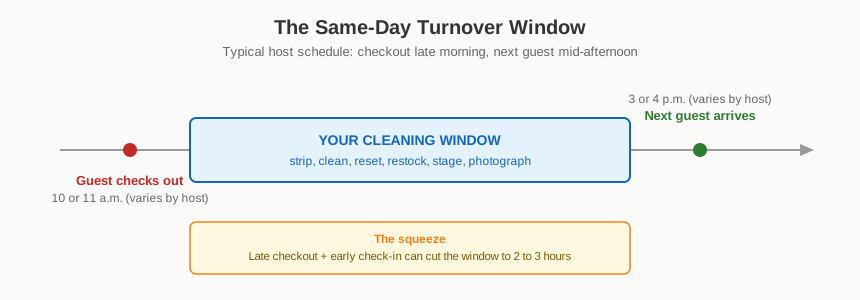
A turnover is a race against a clock you do not control. One guest leaves, the next one arrives, and somewhere in between the unit has to be reset to look like the listing photos. Operators report the window is usually late morning to mid-afternoon, commonly a 10 or 11 a.m. checkout and a 3 or 4 p.m. check-in, though every host sets their own times. Where a host sets none, Airbnb's built-in defaults apply, and they anchor the same window: an 11 a.m. checkout and a 3 p.m. check-in (Airbnb Help). If the next guest books a same-day arrival, your cleaning window might be three hours. Sometimes less.
Guest-ready, not just clean
The standard is the difference between this job and house cleaning. A residential client forgives a missed baseboard. A short-term rental guest who finds a hair in the shower does not forgive, because they paid a cleaning fee and the listing promised hotel-grade. Nearly nine in ten U.S. listings charge a guest cleaning fee, and the U.S. average is about one hundred sixty-one dollars per stay as of 2025 (AirDNA). Guests know that number. A guest paying a fee that size walks in looking for problems.
So a turnover means: every surface cleaned, every linen changed, every towel folded the way the host photographs them, the fridge emptied and wiped, dishes done and put away, trash out, floors vacuumed and mopped, and the unit restocked with toilet paper, soap, coffee, and whatever else the host's welcome kit promises. Then the small theater of staging: pillows arranged, throw blanket folded over the couch, blinds set the same way in every room. Operators consistently photograph each finished room, partly as proof of work and partly as protection when a guest complains about a problem they may have created themselves.
You are not being paid to clean a home. You are being paid to reset a product between users.
Your customer is the host
The guest never pays you and never hires you. The host does both. Hosts are judged by guests through star ratings, and cleanliness is the first thing a bad review mentions. One cleanliness complaint can cost a host their Superhost status and weeks of bookings, which is why hosts fire cleaners faster than almost any service provider. An operator who ran a cleaning company for short-term rentals put it bluntly on Reddit: churn comes from hosts firing cleaners, and bad cleaning drives the reviews that make hosts fire (r/AirBnB hosts thread).
That cuts both ways. Do the job consistently and you become part of the host's rating infrastructure, the person they stop worrying about. Hosts in operator threads describe paying their best cleaners above the going rate and adding bonuses for five-star review streaks, because a reliable cleaner is that hard to replace (r/AirBnBHosts thread). The whole relationship, and the recurring revenue that comes with it, rests on the guest-ready standard being met every single time.
Three clients, one industry
Short-term rental cleaning has three kinds of client, and you will likely serve all three:
| Client type | What they are | What it means for you | |---|---|---| | Individual host | Owns one or two units, often remotely | Steady recurring work, high touch, pays per turnover | | Co-host | Manages listings for owners | Same work, one contract can cover several units | | Property manager | Runs a portfolio of rentals | Volume, tighter prices, professional expectations |
Property managers are the volume play. One operator's first marketplace client turned out to be a management company with roughly thirty properties, and one accepted cleaning turned into eight cleans a week at about one hundred fifty dollars each, then requests to cover more cities. That story is common enough in this industry that the marketplace lesson treats managers as a client category, not a lucky break. The trade-off is price: managers pay less per clean than an individual host, and they expect you to absorb their scheduling chaos.
What the work feels like in one paragraph
You let yourself into an empty unit with a lockbox code. The previous guests left dishes in the sink, a pizza box on the counter, and wet towels balled on the bathroom floor. You strip three beds, start linens if the unit has an in-unit washer, and work top-down: kitchen, bathrooms, dusting, floors last. You remake the beds with hospital corners, restock the welcome kit, photograph each room, punch your completion into an app or a group chat, and drive to the next unit. If you do four in a day, you have had a good day. If a guest checks out two hours late and the next one arrives early, you have had the day this business is actually about.
The hours are odd, the standard is unforgiving, and the work is physical. Some people read that and start assembling a kit. Others close the tab, correctly. Know which one you are before you spend a dollar on either instinct.
Keep going — you're working through Start an Airbnb Cleaning Service.
All courses are free ↗