The Honest Money in Turnovers
Lesson video in production
The full lesson text below is complete — the video version lands with launch.
Start with the industry's own numbers, then work down to what actually lands in your account. National pricing data puts the average turnover at seventy-five to two hundred fifty dollars, with most jobs landing near one hundred fifty dollars, and short-term rental cleans priced twenty to forty percent above comparable residential cleans because of the deadline pressure and the review-driven standard (HomeGuide). Hourly, experienced turnover cleaners land between twenty-five and sixty-five dollars, and the top of that range belongs to fast, detail-perfect operators on large units.
| Property size | Typical per-turnover rate | |---|---| | Studio or 1 bedroom | fifty to one hundred dollars | | 2 bedrooms | one hundred to one hundred fifty dollars | | 3 bedrooms | one hundred thirty-five to two hundred dollars | | 4 bedrooms | one hundred seventy-five to two hundred seventy-five dollars | | 5 or more bedrooms | two hundred fifty to four hundred dollars and up |
Rates from HomeGuide, a national cost guide that aggregates cleaner quotes. Your market may sit above or below these bands. A resort town in July is not a Midwest suburb in February, and metro areas price twenty to fifty percent above rural ones. Operators on host forums describe large-home quotes from four hundred fifty to five hundred fifty dollars in high-cost markets (r/airbnb_hosts), while a budget-template course from a Seattle operation lists one-bedroom turnover rates at one hundred eighty dollars, well above the national band, showing how far local markets vary.
Where the recurring money comes from
The per-clean rate is not the story. The frequency is. A host with one occupied unit turning over every two to three nights generates eight to twelve cleans a month, and they need every one of them. Two hosts like that and you have a fuller calendar than most solo residential cleaners see in a quarter. The booking engine runs itself: guests book, the calendar sync fires, the clean appears on your schedule. You are not re-selling the job every week the way a one-time house-cleaning business does.
One operator's start describes the pattern exactly: a first marketplace client turned out to be a property manager paying about one hundred fifty dollars per cleaning, and single properties grew into requests to cover seven more units in a nearby city, then more. One relationship, compounding volume. That is the upside case, and it is common enough in this industry to plan for, not to count on.
What one turnover nets
Here is a worked example for a solo operator cleaning a three-bedroom at one hundred sixty dollars, mid-range for that size. Supplies for a standard turnover run ten to thirty dollars when you bring your own (HomeGuide), and marketplace-sourced jobs carry a platform fee of five percent of the job (Turno help center).
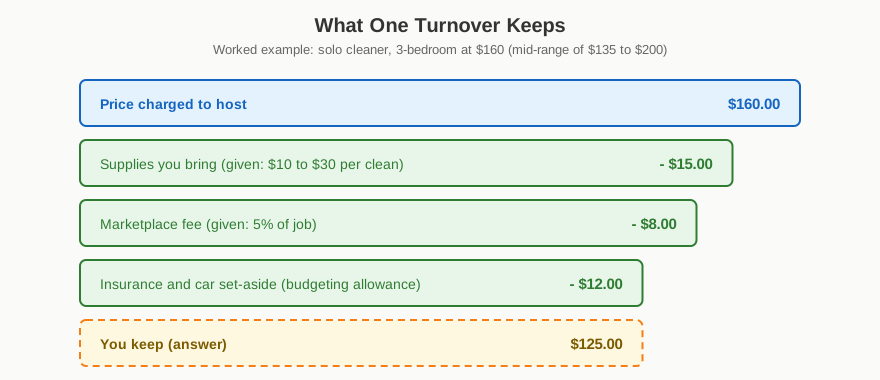
Read the stack: one hundred sixty in, fifteen of supplies, eight of platform fee, twelve set aside for insurance and car costs (a budgeting allowance, explained later in the course), and one hundred twenty-five kept. Work five of these turns in a week and the math starts to look like a wage you chose. Work none and it looks like what it is, a projection. The figure that matters is turns per week, and that number is earned winning hosts, not assumed here.
The middleman spread
The other way to run this business: you win the host, a subcontracted cleaner does the turn, and you keep the spread. A course operator who built this model teaches the bidding arithmetic plainly. If a cleaner in your market charges one hundred dollars for a one-bed turnover, you bid the host one hundred twenty-five and keep twenty-five dollars per clean, forever, for scheduling, quality control, and being the host's single point of contact. Scale that across dozens of properties and the spread compounds. The catch: twenty-five dollars is also your entire margin for absorbing no-shows, re-cleans, and price competition, and your best cleaners can eventually approach the host directly. That failure mode gets the both-barrels treatment later in the course. For now, know that the agency lane is real, it is how the biggest operators in this niche scale, and it is built on the same host relationships you will start earning as a solo cleaner.
The guest-fee ceiling
Your price lives under a shadow: the cleaning fee the host charges the guest, which in the U.S. averaged about one hundred sixty-one dollars per stay in 2025, third-highest in the world (AirDNA). Nearly nine in ten U.S. listings charge one. Hosts set that fee high enough to cover you, but platforms now display total prices up front, and cost guides note that fee fatigue pushes some hosts to lower fees and negotiate your rate down with them. Your protection is being visibly worth it: photos, consistency, and zero-host-effort service. The hosts who pay best in operator threads are the ones buying relief from worry, not the ones buying the cheapest scrub. Fee fatigue is a squeeze you will feel at the negotiating table; automation is not one at all, because this course carries a two out of ten on AI exposure, per how this catalog rates AI exposure, and every dollar above is earned by hands inside a property on a deadline no machine can meet.
Now you know what the work pays. If savings or severance is funding the launch, runway math before you commit is its own guide. The next number worth knowing is what it costs to start.
Downloads for this lesson
Keep going — you're working through Start an Airbnb Cleaning Service.
All courses are free ↗