The Lines You Cannot Cross
Lesson video in production
The full lesson text below is complete — the video version lands with launch.
Every client will, within a month, ask you a question you are not allowed to answer the way they want. "Can you write me a meal plan for my diabetes?" "What should I take for my knee?" "My doctor said my cholesterol is high, what do I do?" How you handle those moments decides whether you are a legitimate health professional or an unlicensed one. This lesson draws the lines precisely, because they are knowable and they are not that complicated once someone maps them.
The nutrition line, state by state
One fact should reorganize how you think about food coaching: many US states license dietitians, and in states with exclusive scope-of-practice nutrition laws, it is illegal for an unlicensed person, including a certified personal trainer, to practice nutrition counseling. Some states make unlicensed practice a crime: North Carolina, the commonly cited example, treats unlicensed dietetics practice under its Chapter 90, Article 25 as a criminal misdemeanor. Other states have weaker licensing that only protects titles, and some have no nutrition licensing law at all. There is no national map that stays current, so your one-time homework is to search your state's dietetics licensure status and write down which category you are in.
What this means in practice:
- Generally inside your lane: teaching general, non-medical nutrition. Macronutrients explained as education. Habit work: protein at each meal, vegetables, water, portion awareness. Sharing public dietary guidelines. Helping a healthy client structure meals to support training.
- Outside your lane, everywhere: prescribing diets or supplements to treat a medical condition. "Eat this to fix your diabetes" is medical nutrition therapy, and it belongs to registered dietitians and physicians.
- Depends on your state: individualized written meal plans, calorie prescriptions, and calling yourself a "nutritionist" in title-protection states. Know before you sell.
The safe universal formula: educate on general principles, coach on habits and behaviors, refer on anything clinical. Notice that the safe lane still covers what nearly every client actually needs. Most clients do not have a clinical condition; they have inconsistent breakfasts.
The decision reflex
Run every nutrition or health question through this loop until it is reflex:
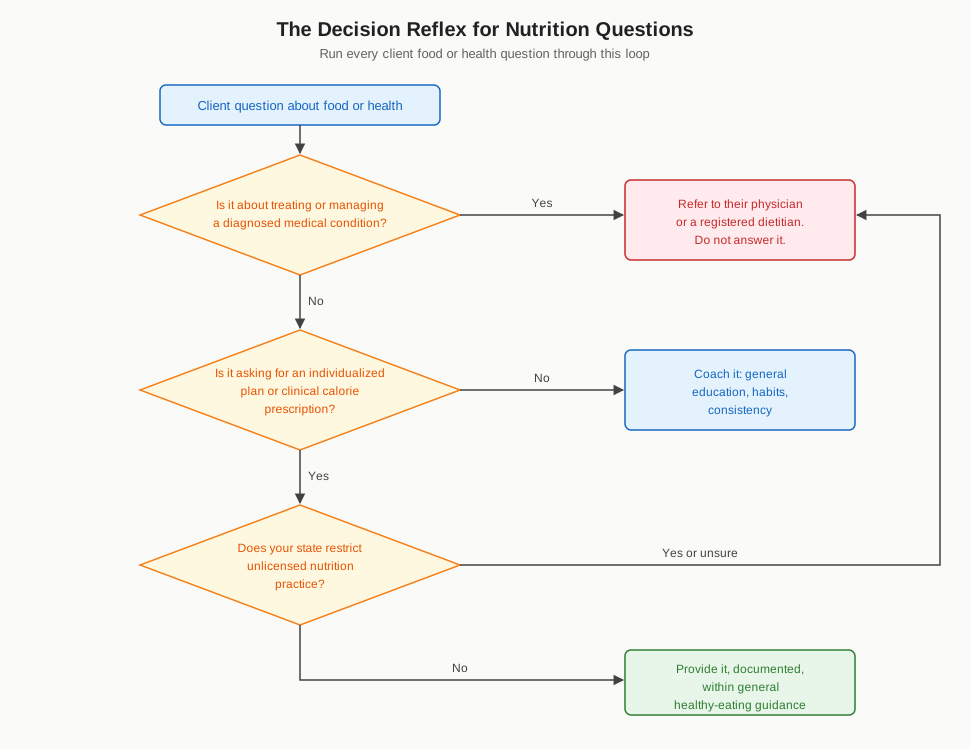
The referral is not a failure. "That question is exactly what your doctor is for, and I want your treatment and your training to work together" makes you look more professional, not less. Clients do not leave coaches who refer. They leave coaches who wing it.
The medical red flags that pause everything
Some discoveries outrank any program. When any of these appear on an intake or in a check-in, stop programming and require physician clearance before the next session:
- Chest pain, pressure, or unusual shortness of breath during activity
- Dizziness or fainting episodes
- A new injury or pain that persists beyond normal soreness
- Surgery, pregnancy, or a new diagnosis since their last clearance
- Medication changes that affect heart rate or energy, common with blood pressure and blood sugar drugs
The PAR-Q+ screening you set up in "The Legal Spine: Certificates, Insurance, and Agreements" catches most of these at intake. Your check-in forms catch the rest. A written policy, applied to everyone identically, is both good care and your legal shield.
Eating disorders: the quiet one
A client losing weight too fast, panicking over rest days, training through illness, or asking you to keep their program secret from family and their doctor: these are patterns, not episodes, and they show up in online coaching more than gym floors, because nobody is watching. You are not a therapist and you must not diagnose. You are allowed to say: "What you're describing is beyond what a fitness coach should handle. I'd like you to talk to your doctor, and I'll keep coaching you alongside that." If the behavior continues, ending the coaching relationship is the ethical move, and saying why is part of the job.
One more boundary: their data
You will hold body measurements, progress photos, health history, and weight logs. Treat that archive like it is dangerous. Written consent before using any photo publicly, a private storage location rather than your camera roll, and no client details in marketing without permission, ever. Beyond ethics, health information attracts privacy obligations in several states and countries. Lock the door now; it is cheap today and impossible after a leak.
Those are the lines. They cost you nothing in coaching power, because everything inside them is the actual job.
Keep going — you're working through Start an Online Fitness Coaching Business.
All courses are free ↗