Programming That Produces Results
Lesson video in production
The full lesson text below is complete — the video version lands with launch.
This is the lesson your clients are paying for. Marketing gets them in; programming and its results keep them. Nothing here requires a degree in exercise science, but every line assumes you will study the craft for as long as you coach, because clients can feel the difference between a coach who programs on principles and one who copies influencers.
The four principles that do the work
Every effective program, from beginner plans to elite blocks, runs on the same four principles. Internalize them and you can evaluate any workout you have ever written.
Progressive overload. The body adapts to what you ask of it, so over weeks you ask for slightly more: another rep, a little more weight, one harder variation, a bit less rest. No progression means no adaptation, and half the stalled clients you will inherit stopped progressing months ago because nothing ever got harder.
Specificity. You get what you train for. A client who wants to keep up with their kids needs squats, carries, and hinges, not more benching. Match the majority of the work to the stated goal, then admit it when a goal needs a different program than the one they enjoy.
Recoverability. Adaptation happens between sessions. Your job is to prescribe enough stimulus that the client adapts, and little enough that they can show up again on Thursday. Online coaching makes under-recovery invisible if you never ask about sleep and soreness, which is why your check-in form asks.
Adherence. The perfect program the client does twice loses to the good program the client does for a year. Adherence is a design constraint, not a bonus. Three sessions they will actually finish beats five they will abandon in week three.
The loop that replaces guesswork
Online programming is not write-and-forget. It runs as a weekly loop, and the loop is what clients are actually buying:
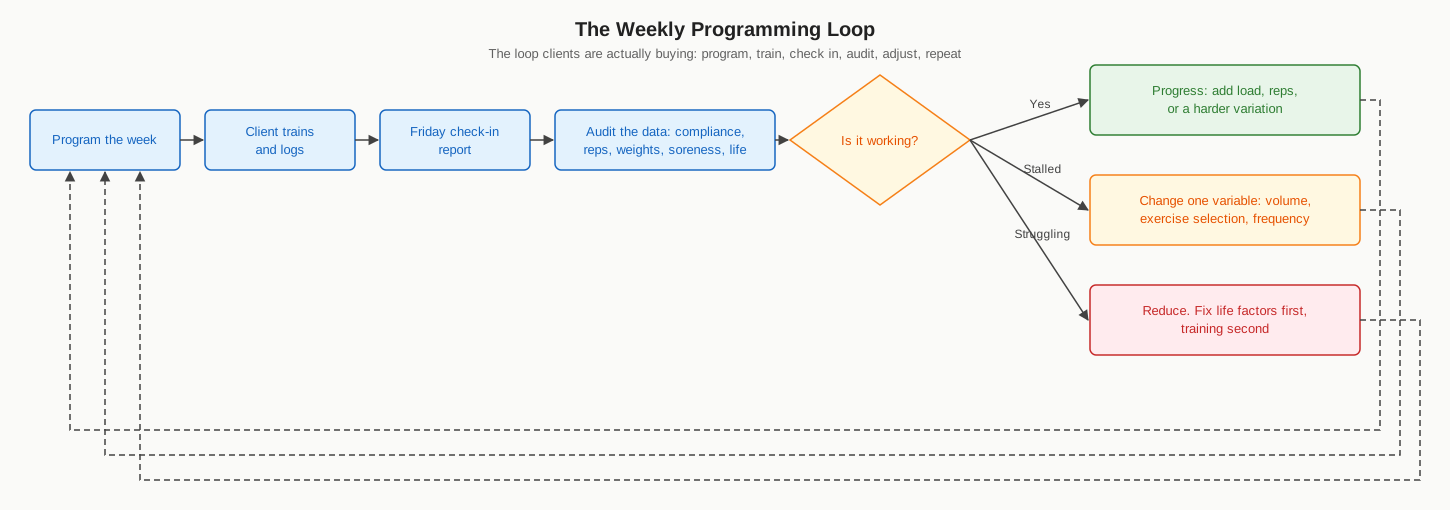
One change per week per problem. Coaches who rewrite everything every Monday destroy the signal; you can no longer tell what worked. The loop only functions if the check-in data arrives, which is the entire argument for the check-in systems later in this course.
Program the life, not the ideal client
You will never see most clients train. That changes what good programming looks like: it must survive contact with their actual Tuesday. Collect three facts at intake and design around them.
Equipment reality. Three lanes cover almost everyone: full gym, home dumbbells and bench, and bodyweight-only. Write your template families per lane, so a business trip or a broken garage gym just means the client slides to the bodyweight version of the same session, and progress continues.
Time reality. Program the sessions they can finish on their worst week, not their best. Two fifty-minute sessions plus one thirty-minute backup session is a schedule that survives most lives. Ask what time of day they will train; 6 a.m. clients and 9 p.m. clients need different warm-up expectations.
Skill reality. New lifters need movement options with low consequence: goblet squats before barbell, push-up progressions before bench. Your first two weeks with any beginner are mostly teaching positions through video and notes, and that time is well spent, because a client who squats well in month one is still training in year two.
The template family method
Write programs the way chefs run kitchens: one base recipe, varied per table. For each population you serve, build a base template, say three sessions built around a squat or hinge, a push, a pull, a carry, and a finisher. Each client runs that skeleton with their exercises, their loads, their rep ranges. New client onboarding drops from three hours to forty-five minutes. Your programming stops being artisanal and starts being a system, and because the skeleton is yours and tested, quality goes up as volume rises.
This is not generic coaching. The differentiation lives in the population template itself and in your adjustments, not in inventing novel exercises, which mostly do not exist. Clients do not churn because the exercises were standard. They churn because nothing progressed and nobody noticed.
Progressions, stalls, and deloads
Keep a small set of rules and apply them mechanically.
- Add reps before weight in the six-to-fifteen range; add load when the top of the range is clean for two sessions.
- When a lift stalls two weeks running, change one variable: swap the variation, shift rep range, or move the exercise to a fresher day.
- Every four to eight hard weeks, schedule a lighter week at roughly half volume. Program it, name it, tell the client why. Deloads you schedule are recovery; deloads the client takes without telling you are usually the start of a quit.
- Log everything. The program that produced a client's best year is an asset: your second client with the same life runs the refined version from day one.
Craft is the product. Systems are how you deliver it at a profit.
Keep going — you're working through Start an Online Fitness Coaching Business.
All courses are free ↗