The Rental Math
Lesson video in production
The full lesson text below is complete — the video version lands with launch.
What customers pay
Start with the price side, because everything else is arithmetic on top of it. Across the US, the national average for a bouncy house rental runs about $312, with a typical range of $240 to $406, according to Thumbtack's cost data, which averages across every unit type from backyard jumpers to dual-lane water slides. For the unit you would actually buy first, manufacturer pricing guides put a standard 13x13 bounce house at $150 to $250 per day, and combo units with slides at $250 to $400. Your market may sit above or below those bands. Seasonal markets with short summers often support higher per-event prices than year-round Sun Belt markets, a pattern one experienced operator reports and the scarcity logic supports, even though exact local figures vary.
The dry lane prices smaller but stacks. In current US market listings, a standard folding chair rents for about $1.50 to $3 each, with padded versions up to $6, and a banquet table for about $8 to $12. Nobody rents one chair. They rent forty chairs, six tables, and a canopy, and the order total lands in the same few-hundred-dollar zone as a bounce house while costing far less to buy and haul.
What the equipment costs
New commercial-grade 13x13 bounce houses from US-based manufacturers list around $1,495 to $1,995 with the blower included, and manufacturer club pricing drops the same units to roughly $1,270 to $1,700. Combos start near $2,450, with most models between $2,900 and $4,300. Used units trade for less, sometimes much less, and the used-buying walkthrough comes later in the course.
That price gap between a $1,600 unit and its $150-to-$250 rental rate is the entire reason this business exists.
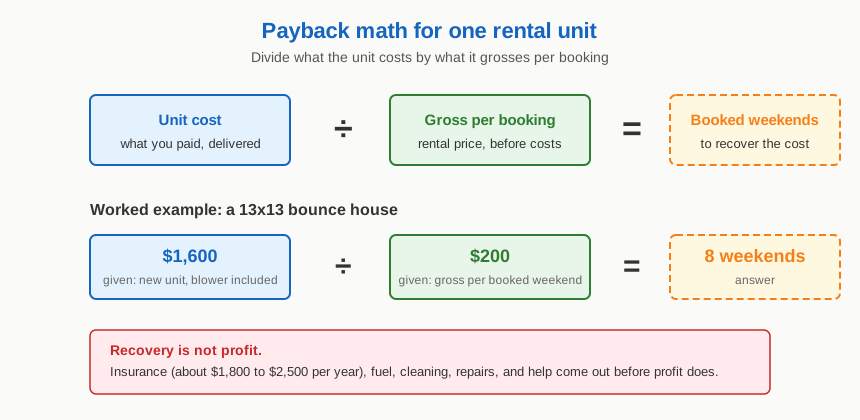
The worked example in that diagram is the formula you should run before every purchase: divide what the unit costs by what it grosses per booking. A $1,600 bounce house at $200 per booking recovers its equipment cost in eight booked weekends. Sixty chairs and six tables bought for $1,200 and rented as a $180 package do it in about seven. Those are equipment-recovery numbers, not profit. Before you have profit you also pay insurance, fuel, cleaning supplies, repairs, and eventually help.
Utilization is the business
Here is the number that separates the operators who make money from the ones with expensive garage decorations: how many weekends each unit goes out.
Run the same $1,600 bounce house three ways across a six-month season:
| Scenario | Booked weekends | Season gross | After a $2,000 insurance + operating year | |---|---|---|---| | Dead weight | 1 per month | $1,200 | Lost $800 | | Part-time | 2 per month | $2,400 | Cleared $400 before labor | | Working it | 3 per month | $3,600 | Cleared $1,600 before labor |
Same unit, same purchase price, same insurance bill. The only variable is bookings, which is why this course comes back to getting found and winning quotes later, after it covers operations. A single unit rented hard is a business. A fleet rented softly is a storage problem with an insurance premium.
Notice also what the table does not say. It does not say you will book three weekends a month. Markets differ, competition differs, and weather cancels Saturdays without apology. Anyone who promises you a first-year figure is selling you something, and the source material this course was researched from contained exactly those promises, including projections like a hundred thousand dollars in year-one revenue on a fifty-thousand-dollar fleet. Treat every projection like that as marketing. The honest framing is smaller and more useful: each unit you buy is a bet that pays back over some number of booked weekends, and your job is to drive that number down with good pricing, good photos, and good reviews. That bet only works if your living costs are covered while it pays back, so do the runway math before you buy assets.
What five thousand dollars actually buys
This course assumes a start between one and five thousand dollars, so here is the honest menu. One new 13x13 and its incidentals fits the low end. Two used commercial units, or one used combo plus a dry-inventory package of tables, chairs, and a canopy, fit the middle. Insurance is the first real check you write in every scenario, roughly two thousand dollars of it, and you should pay it first, not last.
What that budget does not buy: a fleet big enough that you can skip being good. With one to three units, every single booking matters, every review matters, and one moldy bounce house is a third of your revenue capacity. That is not a reason to wait until you can afford ten units. It is the reason the small operator who answers the phone and shows up on time takes bookings from the big company that does neither. That advantage holds against software the same way it holds against big fleets: this course carries a two out of ten on AI exposure, per how this catalog rates AI exposure, because a bounce house cannot be delivered, staked, and inspected by an app, and the booking software that exists just answers the phone faster.
Before you spend anything, though, you need to know whether your local market has room. Reading that market honestly, and turning what it tells you into a purchase list, is the next move.
Downloads for this lesson
Keep going — you're working through Start a Party Rental Business.
All courses are free ↗