The Money, Honestly
Lesson video in production
The full lesson text below is complete — the video version lands with launch.
Every course about podcasting eventually shows you a screenshot of someone else's sponsor invoice. This lesson shows you the plumbing instead: what leaves your bank account, what arrives, and when. Podcasting is cheap to enter and slow to monetize, and pretending otherwise is how people quit at episode six.
What leaves your account
The startup stack is small. A dynamic USB microphone of the kind operators consistently recommend for beginners runs about seventy dollars (Buzzsprout's review of the category's default pick). Add a boom arm, headphones you already own, and a windscreen, and a complete first studio lands under two hundred dollars. The recurring stack is smaller still. Podcast hosting, the service that stores your files and publishes your feed, starts around fifteen dollars a month on the major hosts (Buzzsprout pricing), and every host of that size includes distribution to the listening apps. The honest full stack: about two hundred dollars once, about fifteen to twenty dollars a month, zero dollars in required software.
The one cost that grows with you is editing, if you choose to outsource it. Freelance podcast editing commonly runs fifty to one hundred dollars per hour of finished audio, and per-episode rates cluster around fifty to a few hundred dollars depending on how much you hand over (r/podcasting on outsourcing rates, Resonate Recordings). Editing it yourself costs no cash and roughly two to three hours per episode. That trade is one of the biggest early decisions, and it gets a full treatment later in the course.
What sponsors pay, and when
Podcast advertising is priced per mille, CPM, meaning per thousand downloads per episode within a window after release. Host-read sixty-second mid-roll spots, the format that commands the premium, average eighteen to twenty-five dollars per thousand depending on ad length and placement (Rephonic's rate analysis), and placement moves the number inside that band: an agency benchmark puts mid-rolls near twenty-five, pre-rolls near twenty, and post-rolls at one to five dollars (Ad Results Media). The arithmetic for any show:
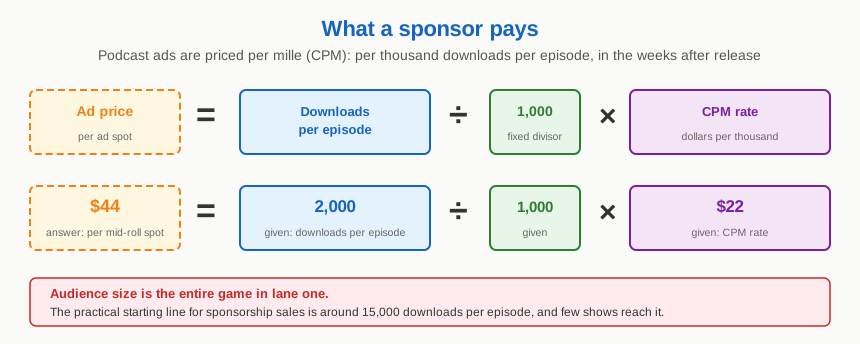
A show with two thousand downloads per episode, at a twenty-two dollar CPM, earns forty-four dollars per mid-roll spot. Run three spots, publish weekly, and you can see the shape of the problem: audience size is the entire game in lane one. Where that game starts depends on who is buying. Direct advertisers, the companies you pitch yourself, will look at shows from about two to five thousand downloads per episode (2026 rate guidance); ad networks, which package shows for bigger buyers, generally hold out for ten to twenty thousand (Castos' ads guide). The fifteen-thousand line operators quote is the network case: standard-rate sponsorship at scale, measured in the weeks after release. Publishers report that few shows reach it. That is not discouragement. That is the reason lane two exists.
What each lane pays, and when
The media business (lane one): affiliate income can start the day you have listeners, but meaningful dollars usually trail audience growth by many months. Sponsorship at standard rates is a years-scale payoff for most shows that ever reach it. You are building a media property.
The relationship engine (lane two): the payoff is not per-download, it is per-relationship. A single guest who becomes a client, or refers one, can out-earn a year of mid-roll ads on a small show, because a consulting engagement or a contract service is worth thousands, not forty-four dollars. Guests who share episodes also compound your audience for free. The catch: conversion is lumpy and mostly untrackable. You will not be able to draw a clean line from episode twelve to the phone call that gets you hired, even when that is exactly what happened.
One more force belongs in the honest money picture: AI. Cheap generation is flooding the directories with shows that publish constantly and say nothing, which makes generic audio worth less every month. That flood is why this course carries a four out of ten on AI exposure, per how this catalog rates AI exposure. The one asset it cannot fake is the one this course keeps steering you toward: a specific person chose to spend an hour in a real conversation with you, and that human-hosted interview is the moat.
Money math is only worth doing if the work suits you.
Downloads for this lesson
Keep going — you're working through Start a Podcast.
All courses are free ↗